Key facts
- University of Florida researchers Andrew C. Schuerger, Robert Ferl, and Anna-Lisa Paul lead the MVP-Plant-02 investigation.
- The Multi-Use Variable-g Platform, or MVP, was developed by Redwire Space Technologies Inc. to enable experiments aboard the International Space Station under different gravity conditions.
- For MVP-Plant-02, researchers divided similar Arabidopsis thaliana plants into three groups: weightlessness aboard the station, Earth-gravity simulation after space travel, and an Earth control group.
- For UF researchers, the MVP-Plant-02 investigation is a scientific milestone and a chance to expand university contributions to space biology by combining plant pathology, horticultural sciences and space research.
University of Florida researchers launched the MVP-Plant-02 investigation to the International Space Station on Oct. 13, 2026, to study plant disease risks for future Moon and Mars missions.
Andrew C. Schuerger, Robert Ferl, and Anna-Lisa Paul lead the investigation for the University of Florida. Robert Ferl and Anna-Lisa Paul contribute decades of space biology experience and have led extensive research into how plants grow and express genes in space. The team brings together plant pathology, plant physiology and molecular biology to study both whether disease takes hold and how plants react genetically. Andrew C. Schuerger offers more than four decades of experience creating integrated disease management plans for plants raised in greenhouses and biological life support systems.
Scientists will study the reaction of Arabidopsis thaliana to Golovinomyces cichoracearum, a powdery mildew fungus, under weightlessness. Andrew C. Schuerger said that plants grown in microgravity from seed have defense mechanisms already altered by weightlessness before spores reach their tissues. He said testing plants after exposure to weightlessness works better than infecting seedlings before launch. The team will infect the plants with the fungus after they reach orbit, a new approach because earlier studies applied the pathogen before launch.
“Wherever plants and humans go, plant pathogens are soon to follow,” said Andrew C. Schuerger. The scientists themselves do not know what to expect from microgravity; it might strengthen plant defenses, weaken them, or have no effect at all.
Scientists will check whether the fungus grows more aggressively under weightlessness and how plant gene activity shifts as the infection advances, seeking a clearer picture of plant responses in orbit. The group intends to watch for stronger fungal growth under weightlessness and to record changes in plant gene activity throughout the disease, looking at both spread of infection and genetic response.
The team will contrast plants raised in weightlessness on the station with plants kept at Earth-like gravity on the station and with a ground control group at Kennedy Space Center. Redwire Space Technologies Inc. created the Multi-Use Variable-g Platform, or MVP, to run experiments aboard the International Space Station under different gravity levels. For MVP-Plant-02, scientists split comparable Arabidopsis thaliana plants into three sets: one in weightlessness aboard the station, one in Earth-gravity simulation after reaching space, and one remaining on Earth.
A joint Redwire and UF team built the Conidia Application Device, a system made to apply fungal spores to plant canopies during spaceflight. Kylee Soltez, who holds a UF master’s degree and serves on the science team, said the group created the first plant pathogen inoculation device for spaceflight. Kylee Soltez helped explain why the inoculation method matters and how the Conidia Application Device fits into the investigation. Her work on the team shows how the project prepares new scientists to study plant health during space missions.
“The Plant-02 team developed the first plant pathogen inoculation device for use in spaceflight,” Soltez said.
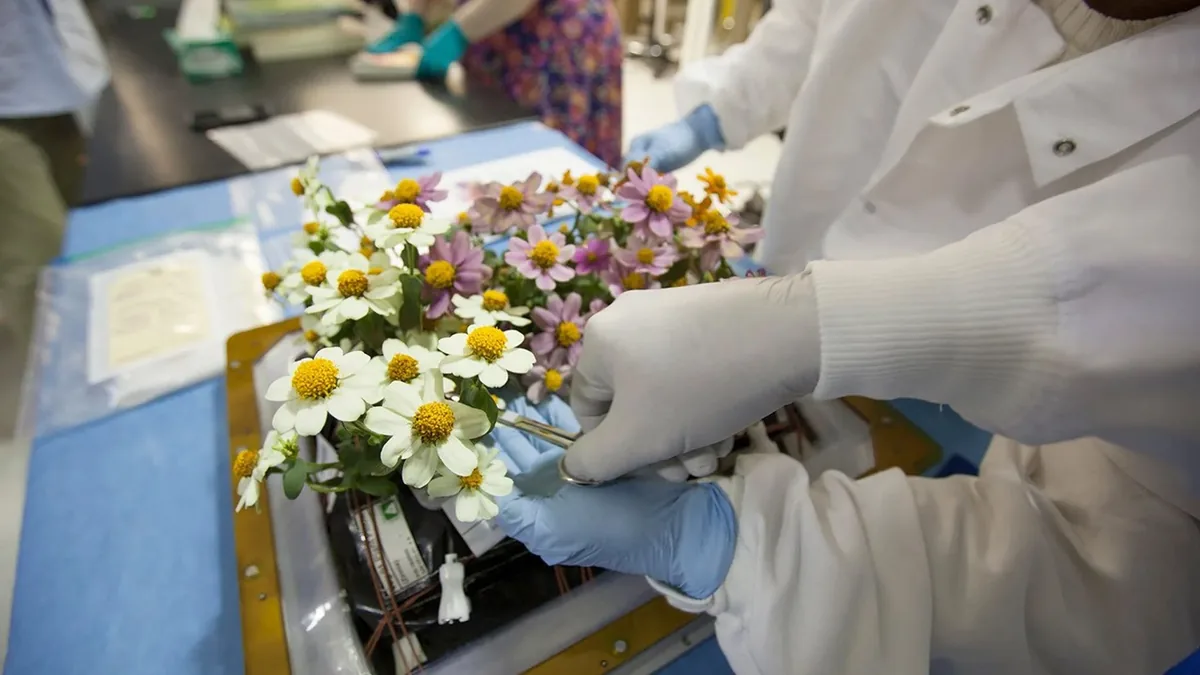
While the mission is underway, the team expects to get pictures from some of the plant growth modules so they can watch plant development. When the flight ends, researchers will preserve the plants in a solution that locks in their on-orbit metabolic state, then test genetic expression after the material returns to Earth to see how the plants responded. Figuring out whether weightlessness changes disease severity and plant gene expression will depend on detailed study of the experimental material after it comes back to Earth.
Bioregenerative life support systems rely on plants and other biological processes to supply food and restore key resources such as oxygen and water. To travel farther and remain in space longer, crews will require sustainable food supplies. Crops can offer fresh food, support astronaut mental well-being, and enhance space habitats. Plants are vital for human exploration away from Earth because they help produce oxygen, food, fiber and fuel.
NASA’s Space Crops portfolio covers Lunar Effects on Agricultural Flora (LEAF), a planned Artemis III experiment on the Lunar surface, and station-based plant research such as Veggie and Advanced Plant EXperiment-12. NASA research aims to develop space horticultural methods and technologies that support plant growth, control crop disease outbreaks and make sure produce is safe to eat. Research on how plants adjust to harsh space conditions could produce farming advances for deep-space exploration and for agriculture in difficult environments on Earth.
Researchers have known for a long time that plants can grow in weightlessness, but they have not yet scaled up the practice. No matter how careful the precautions, fungi might still reach a spacecraft. Fungal plant diseases are common on Earth and fungicides have not wiped out infections entirely, so the experiment will examine how plants respond to fungal pathogens in orbit. Building sustainable space crop production systems is difficult because mature technologies to track plant health and manage water, fertilizer and light inputs do not yet exist.
UF developed the project with backing from NASA’s Space Biology program, working alongside Redwire, which runs the MVP platform for the investigation. The UF electron microscopy and plant molecular biology laboratories supplied crucial technical support for analysis after the flight. The work supports the University of Florida’s wider dedication to space science through the Astraeus Space Institute, which links university knowledge across fields to solve exploration challenges.
The findings may help scientists decide whether plant disease management methods made for Earth-based agriculture must change for use in space. For UF scientists, the MVP-Plant-02 investigation marks a scientific milestone and an opportunity to grow university contributions to space biology by merging plant pathology, horticultural sciences and space research. The study should show that complex plant-pathogen experiments can take place aboard the International Space Station, creating opportunities for more research into growing food away from Earth.

Join the discussion