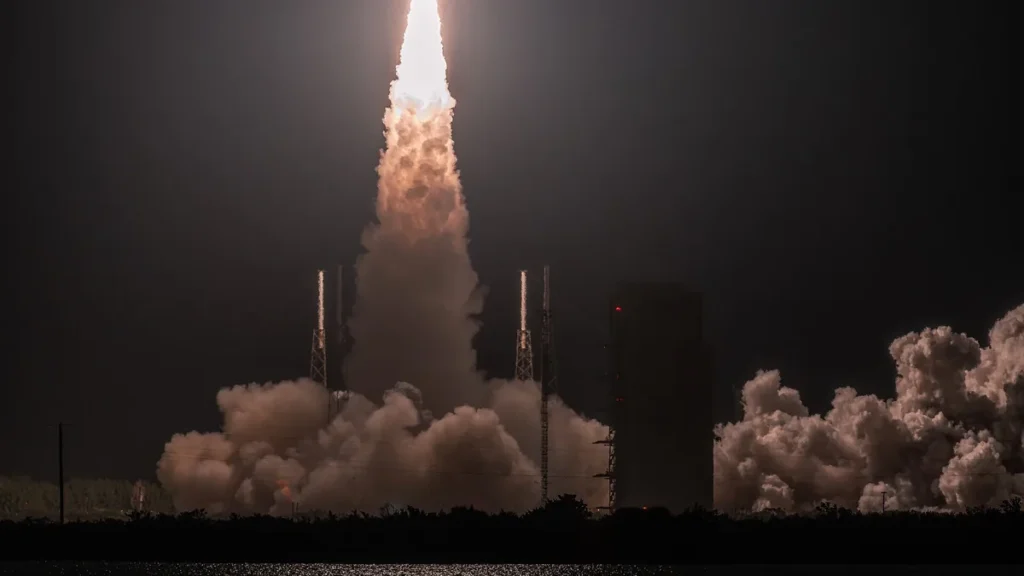
This is a new development in a story we reported earlier: SpaceX launches Starship Flight 15, calls off booster catch.
Key facts
- SpaceX planned to catch the Super Heavy booster in the Mechazilla tower chopstick arms but aborted for an undetermined reason; the booster flew toward the Gulf of Mexico and exploded just before splashdown.
- Reentry began around 2:20 p.m. Central when one of Starship's six Raptor engines fired for a 10-second burn to set a trajectory over the Pacific Ocean.
- The ship passed 100 kilometers altitude just after 3 p.m. Central as heated gas glowed around the windward side protected by 18,000 hexagonal ceramic tiles.
- Reliable and frequent Starship orbital flights are crucial to SpaceX's Starlink broadband constellation buildout and the company's plan to retire the Falcon 9 rocket.
SpaceX recovered Starship’s upper stage, Ship 42, at the Boca Chica, Texas launch tower on Saturday, achieving the first recovery of a ship at the launch site after catching Super Heavy boosters on three earlier test flights. The vehicle flew for 22.5 hours and circled Earth 14 times before landing on Saturday. Oneindia says the craft remained in space for more than 22 hours and that recovery took place on November 15 following a November 14 launch.
The mission began at 4:47 p.m. Central on Friday, November 13, at Starbase, Texas, as the Super Heavy booster split from the upper stage roughly two minutes after liftoff. The upper stage entered low Earth orbit at an altitude of roughly 275 kilometers. This marked the second Starship orbital flight and the first successful ship recovery at Starbase.
The plan called for recovering both stages at the launch site while sending 26 V3 Starlink satellites—the latest generation of Starlink satellites—into orbit. The ship still deployed the 26 V3 Starlink satellites even though the booster abort ruled out catching both stages. Cameras on three satellites photographed the heat shield and other hardware, so engineers could assess vehicle performance and readiness for later flights. Oneindia also confirmed that the flight deployed 26 next-generation Starlink V3 satellites.
SpaceX had planned to catch the Super Heavy booster using the Mechazilla tower’s chopstick arms—mechanical arms on the launch tower designed to catch returning boosters—but called off the attempt for an undetermined reason. SpaceX scrapped the booster catch, and the vehicle flew toward the Gulf of Mexico where it exploded just before splashdown. Kate Tice, SpaceX’s quality management and training director, said a low fuel mass alarm seemed to cut short the booster’s boost back—the burn that flips the booster around to return it to the launch site—and the team was looking into the root cause. Tice said the booster followed safety protocols on its own and kept the pad safe.
Reentry started at about 2:20 p.m. Central on Saturday when a Raptor engine fired for 10 seconds to direct the ship toward the Pacific Ocean. The vehicle crossed the 100-kilometer altitude mark shortly after 3 p.m. Central while hot gas glowed around the windward side shielded by 18,000 hexagonal ceramic tiles. The company studied and modified the tiles with the hope they would not need replacement between flights. That burn slowed the vehicle enough to set its return course.
The path crossed Baja and Northern Mexico and moved north of South Padre Island in Texas before using a swoosh maneuver to approach Starbase from the Gulf. The ship went into a belly flop—a descent with the vehicle parallel to the ground—then fired engines for a landing burn and settled inside the Mechazilla arms.
Tice said the company’s ultimate goal is to land the rocket right away and launch it again like an airplane. During the Saturday livestream, Tice discussed the heat shield modifications and the goal of airplane-like reusability. SpaceX’s Starlink broadband constellation buildout and its plan to retire the Falcon 9 rocket both depend on reliable and frequent Starship orbital flights. High flight rates matter for both the Starlink business and retiring Falcon 9 as the U.S. and global launch workhouse.

NASA gave SpaceX $2.9 billion in contracts to supply Starship lunar lander variants for Artemis crewed missions. The agreements connect Starship to NASA’s plans for returning humans to the moon. A Starship lander test article will fly next year on Artemis III, a two-week low-Earth orbit docking demonstration involving Orion and test versions of Starship and Blue Moon landers from Blue Origin. NASA originally planned Artemis III as the first moon landing of the program but now plans it as a low-Earth orbit demonstration instead.
SpaceX wants to make rocket launches more like flight operations, which could lower the cost of sending satellites, cargo and people into space if SpaceX reuses both stages regularly. Oneindia presents reusability as central to Elon Musk’s long-term Moon and Mars exploration plans. “We caught a Starship and now everything changes,” Dan Huot said during the company’s livestream on Saturday.
In September, Flight 14 marked the first time Starship reached orbit, though SpaceX deorbited early because of an engine issue after planning about six orbits over a 10-hour flight. SpaceX had caught Super Heavy boosters three times before on test flights using chopstick arms on the tower at Starbase. Gizmodo describes the catch system and calls Flight 15 the first attempt to catch both vehicles.
In an October earnings call, Elon Musk said extending consciousness beyond Earth requires full reusability, calling the technology a profound milestone for civilization. SpaceX must still prove that a flown upper stage can fly again, and the company has already re-flown two Super Heavy boosters. Gizmodo offers the quote as part of the rationale for pursuing full and rapid reusability.





Join the discussion