Key facts
- SpaceX launched the Falcon 9 rocket for the Transporter-18 rideshare mission from Vandenberg Space Force Base on October 1, 2026 at approximately 11:30 a.m. local time.
- After stage separation the Falcon 9 first-stage booster landed at Vandenberg's Landing Zone 4 and its re-entry produced sonic booms heard near the base.
- Varda Space Industries launched two of its reentry capsules, designated W-8 and W-9, on Transporter-18; they are scheduled to return to Earth at hypersonic speeds next month and carry commercial and government payloads.
- Meridian Space launched its First Customer Link satellite to test low‑Earth orbit communications technology.
SpaceX launched the Falcon 9 rocket for the Transporter-18 rideshare mission from Vandenberg Space Force Base on October 1, 2026, at approximately 11:30 a.m. local time.
After stage separation the Falcon 9 first‑stage booster touched down at Landing Zone 4 on the base. Its re‑entry created sonic booms heard in the surrounding area. The Transporter‑18 flight delivered 130 payloads to low‑Earth orbit. Starfish Space’s Otter servicing vehicle was aboard to carry out the Small Spacecraft Propulsion and Inspection Capability (SSPICY) mission for NASA.
Varda Space Industries launched its two reentry capsules, designated W‑8 and W‑9, on the same rocket for the first time. The capsules will return to Earth at hypersonic speeds next month and will bear commercial and government payloads.
Two power‑beaming demonstrations flew on the mission. StarCatcher’s Protostar prototype aims to demonstrate power transfer between free‑flying spacecraft, while Cowboy Space’s Reason‑1 intends to prove high‑power laser energy delivery from low‑Earth orbit to a ground receiver.
Meridian Space launched its First Customer Link satellite to test low‑Earth orbit communications technology. CesiumAstro flew Element, its first full satellite built around proprietary phased arrays, software‑defined radios and processors. Fortastra released its Watchdog v0‑A demonstration spacecraft.
The mission included four orbital transfer vehicles that will deploy an additional 41 payloads later. Rideshare integrators Exolaunch, SEOPS, D‑Orbit and Maverick Space Systems supplied customer satellites for Transporter‑18.
Dhruva Space performed integration for its LEAP‑2 satellite, marking the company’s second commercial mission. The satellite hosts a number of in‑orbit demonstration experiments, including hardware from Sodern ArianeGroup and the TAPAS‑1 package from Satleo Labs.
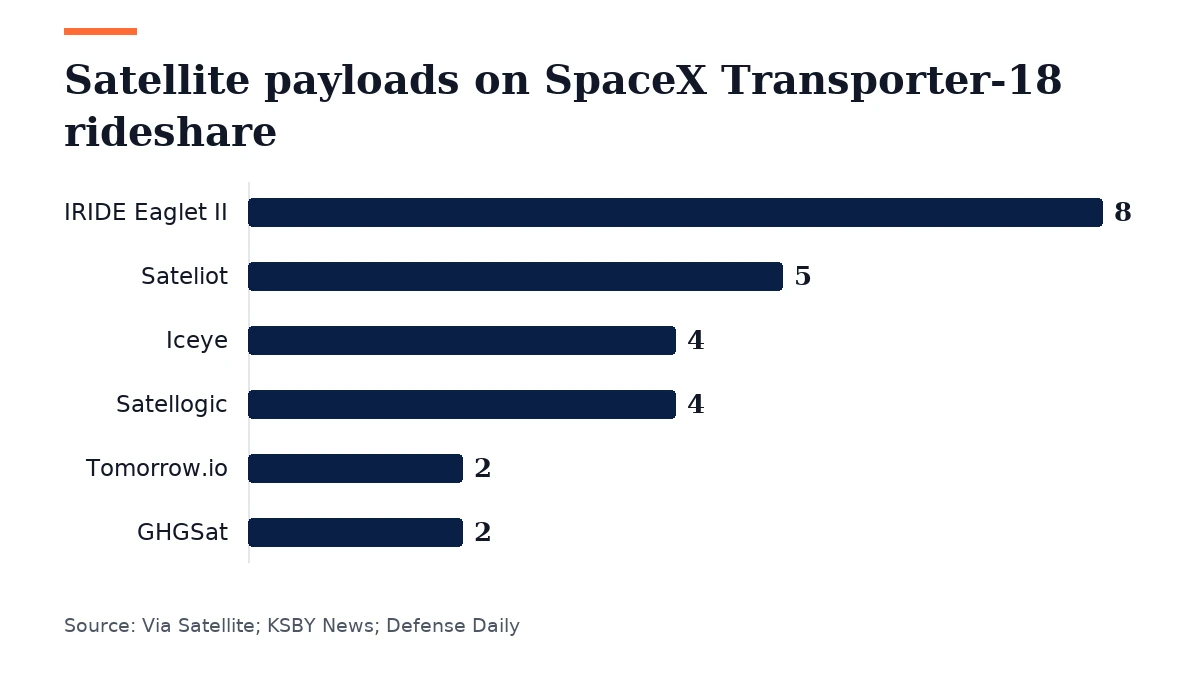
Italy’s IRIDE Eaglet II program contributed eight mini Earth‑observation satellites to the rideshare. Tomorrow.io placed two satellites on Transporter‑18 to expand its weather‑monitoring constellation. Iceye launched four synthetic‑aperture radar satellites as part of the payload manifest. Satellogic launched four optical satellites as part of the Transporter-18 payload manifest.
Unseenlabs sent two radio‑frequency monitoring satellites, BRO‑23 (first generation) and BRO‑32 (Gen‑2 microsatellite), to extend its maritime RF surveillance capability across sea, land and space. GHGSat flew two methane‑monitoring satellites on the mission; SFL Missions manifested the payloads. Spanish IoT connectivity company Sateliot had five satellites aboard Transporter‑18.
On October 1, 2026, SpaceX also flew a Crew‑13 Falcon 9 astronaut mission for NASA from Florida at 11:10 a.m. ET and a Falcon Heavy for the National Reconnaissance Office from Florida at 11:54 p.m. ET. SpaceX confirmed at 3:41 p.m. ET on October 1 that the rideshare deployment sequence for Transporter‑18 had concluded. Vandenberg has supported more than 60 West Coast launches so far in 2026, many of them performed by SpaceX.




Join the discussion