Key facts
- Memory foam is now used in everyday consumer products such as furniture and medical equipment.
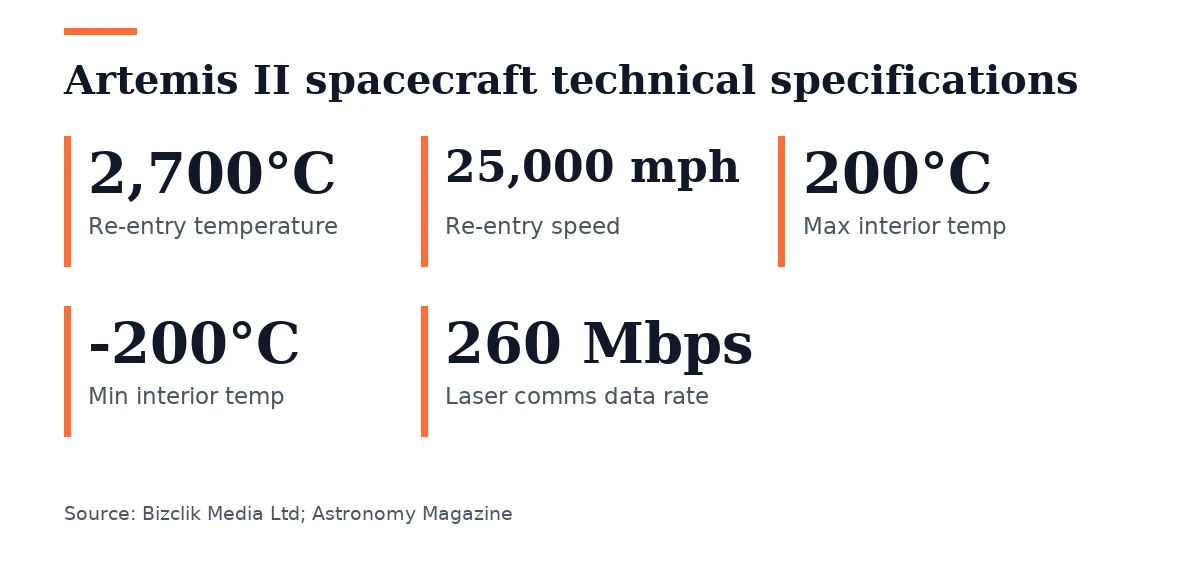
- The Orion heat shield on Artemis II must withstand temperatures of 2,700°C during re-entry at a speed of 25,000 mph.
- Artemis II employed autonomous systems and advanced algorithms to handle the majority of trajectory and life‑support monitoring.
- NASA's dry saliva book technology, used on Artemis II, enables biomarker detection without refrigeration and has potential Earth applications in developing countries.
NASA’s Artemis II mission launched on April 1, 2026, and returned to Earth on April 10, 2026, according to The Pitt News.
The mission’s Orion spacecraft featured a thermal control system designed to withstand the extreme heat of lunar return, with Bizclik Media Ltd specifying that the heat shield must endure temperatures of 2,700°C during re-entry at 25,000 mph. Meanwhile, Bizclik Media Ltd notes the system uses radiators and cold plates to maintain internal temperatures between 200°C and -200°C.
Artemis II also relied on autonomous systems and advanced algorithms for the majority of trajectory and life-support monitoring, as stated in Bizclik Media Ltd. For health monitoring, the mission tested NASA’s dry saliva book technology, which Astronomy Magazine describes as enabling biomarker detection without refrigeration and having potential Earth applications in developing countries.
Reid Wiseman, involved with the mission, emphasized preparedness, stating: “It is a test mission and we are ready for every scenario.” This quote from Bizclik Media Ltd reflects the rigorous testing underlying the technologies deployed.
Beyond the specific mission technologies, NASA has a longstanding pattern of transferring space-derived innovations to consumer products. The Pitt News highlights that inventions such as eyeglasses, jacket insulation and Nike Air have emerged from NASA research, illustrating the economic impact of such technology transfer.
Memory foam serves as another prominent example. Astronomy Magazine notes it was first invented in 1966 by NASA for test pilots’ cushions, while Astronomy Magazine confirms its widespread use today in everyday consumer products like furniture and medical equipment.
Donald E. Ingber, commenting on related health technologies, observed: “Organ chips behave and respond to stimuli very much like human organs.” The Pitt News points to NASA’s history of spinning off space technologies into consumer-goods sectors that illustrate the economic impact of technology transfer.
While the Artemis II mission itself took place in April 2026, the technologies it demonstrated—such as advanced thermal control, autonomous navigation, and non‑refrigerated biomarker detection—exemplify the NASA innovation that has historically found civilian applications, as shown by inventions like eyeglasses, jacket insulation, Nike Air, and memory foam, underscoring the policy value of continued investment in NASA’s technology programs.




Join the discussion