Key facts
- Each DragonCam camera views Titan through a window inside a foam enclosure shielding the cameras and rotorcraft interior from the moon's cryogenic setting, where surrounding temperatures hit minus 290 degrees Fahrenheit.
- Dragonfly also carries two navigation cameras built by Malin Space Science Systems that were installed during summer 2026.
- Two additional side-mounted wide-angle cameras work with the forward cameras so DragonCam can record panoramic views of the Titan landscape.
- A high-resolution microscopic imager will target DrACO's drill site to resolve fine details in sand grains measuring millimeters around the sampling location.
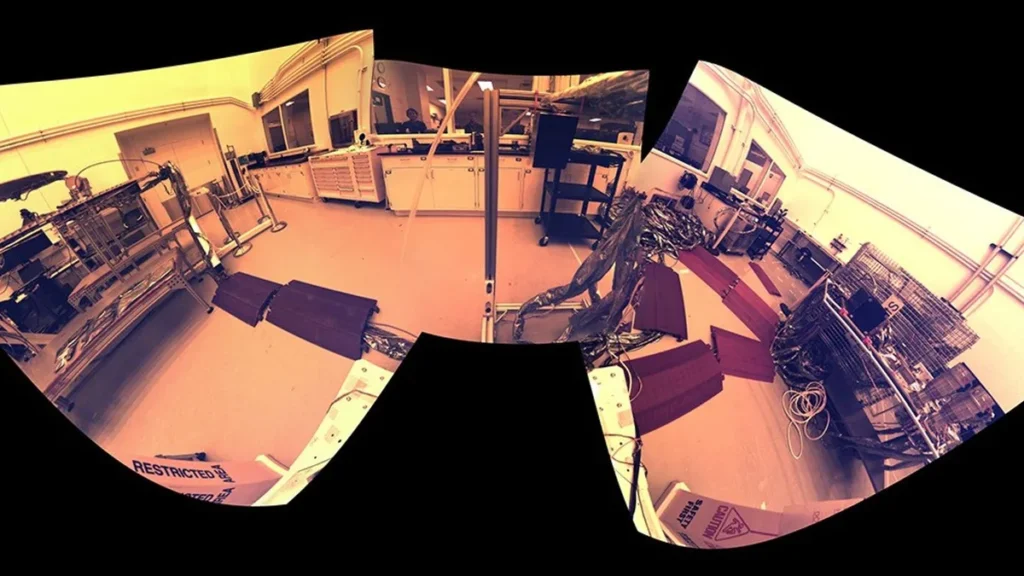
NASA has begun receiving DragonCam, a seven-camera suite for the Dragonfly rotorcraft, at the Johns Hopkins Applied Physics Laboratory in Laurel, Maryland, marking the first science instrument delivered as the vehicle is assembled for a July 2028 launch to Titan, with all seven cameras installed by mid-November 2026.
All seven DragonCam cameras were built by Malin Space Science Systems. They were installed in insulated housings, tested and integrated into the rotorcraft at the laboratory. Dragonfly also carries two navigation cameras from the same builder, installed during summer 2026.
Two forward-mounted cameras—a wide-angle camera with a 90-degree field of view and a medium-angle camera that overlaps it at higher resolution—work together to give a stereoscopic view from the front of the lander. Two side-mounted wide-angle cameras record panoramic views of the Titan landscape. Two downward-facing wide-angle cameras show the surface beneath the craft to help the team judge landing safety for deploying DrACO, the Drill for Acquisition of Complex Organics, and its seismometer.
A high-resolution microscopic imager will target DrACO’s drill site to resolve fine details in sand grains measuring millimeters around the sampling location. A configurable LED array built at the laboratory covers infrared through ultraviolet light and supplies data about surface-material color, so scientists can infer composition.
During Titan’s long night, lasting nearly eight Earth days, LED lighting may allow DragonCam to spot organic molecules fluorescing under ultraviolet light while also letting the cameras view Titan the way human eyes would. Each camera views Titan through a window inside a foam enclosure shielding the cameras and rotorcraft interior from the moon’s cryogenic setting, where surrounding temperatures hit minus 290 degrees Fahrenheit. NASA states the rotorcraft is built to withstand frigid temperatures averaging around minus 290 degrees Fahrenheit, surface dust and potentially liquid methane rain on Titan.
Dragonfly is a 13-foot-long, nuclear-powered rotorcraft that will travel to dozens of sites on Titan in 2034 searching for prebiotic chemical processes. NASA has set the launch for July 2028 and arrival at Titan for late 2034. The mission marks the fourth entry in NASA’s New Frontiers Program.
The rotorcraft will begin exploration near Titan’s equatorial dunes before moving to other scientifically interesting locations. NASA states the mission is not a life-detection effort but is aimed at understanding habitability and prebiotic conditions that existed before life emerged on Earth. With a thick atmosphere and abundant organic chemistry, Titan is regarded as a leading location in the solar system for studying the origins of life.
Its goals include learning about prebiotic chemistry, determining whether Titan had habitable conditions in the past, and searching for signs of life based on water or hydrocarbons. The eight-bladed robotic rotorcraft will visit 20 to 30 different areas and journey across 70 miles on Titan during a planned three-year mission. Plans call for about 3.3 Earth years of operations at Titan, with flights every one to two Titan days and each Titan day lasting about 16 Earth days, including visits to dunes and the young impact crater Selk.

Elizabeth Turtle, Dragonfly principal investigator at the Johns Hopkins Applied Physics Laboratory, said DragonCam will provide detailed surface views and sweeping panoramas while Dragonfly is on the ground or flying, plus insight into processes that shaped Titan. She said seeing the cameras become part of the lander is an exciting milestone.
Michael Ravine, DragonCam development manager and a Dragonfly co-investigator from Malin Space Science Systems, said his team is pleased to have delivered the cameras and that they will serve as eyes to see and explore Titan. Carolyn Ernst, the DragonCam instrument scientist at the Johns Hopkins Applied Physics Laboratory, said DragonCam images will provide critical context for DrACO samples and help relate samples to Titan’s broader geology.
Components of Dragonfly’s other instruments—DraGNS, DraGMet, DraMS and DrACO—are planned for delivery, integration and testing over the coming months. The Dragonfly team at the laboratory in Maryland has delivered the spacecraft’s fuselage for the next phase of integration ahead of schedule.
NASA opened an online Journey to Titan registry allowing the public to add initials to a microchip that will fly aboard Dragonfly, with signees receiving a personalized digital boarding pass. Name submissions close at 11:59 p.m. EST on January 15, 2027. Nicky Fox, NASA’s Science Mission Directorate associate administrator, said NASA is enthusiastic about bringing humanity along for the trip and invites everyone to send their names on the rotorcraft. “We are excited to bring humanity along for the journey of a lifetime.”
Titan ranks as the largest among Saturn’s 292 known moons, has a frigid surface around minus 290 degrees Fahrenheit, and hides a giant ocean beneath its icy shell that astrobiologists say probably contains enough complex compounds for a prebiotic environment. The first mission to Titan was Huygens, which operated for just a few hours on January 14, 2005 after deploying from Cassini, while Cassini flew past Titan more than 100 times before its mission ended in September 2017.
Dragonfly will be one of just a few flying craft on another world, following NASA’s Ingenuity helicopter, which arrived on Mars with the Perseverance rover in 2021 and made 72 flights before blade damage ended operations on January 18, 2024. Ingenuity was designed to make five flights.


Join the discussion