Key facts
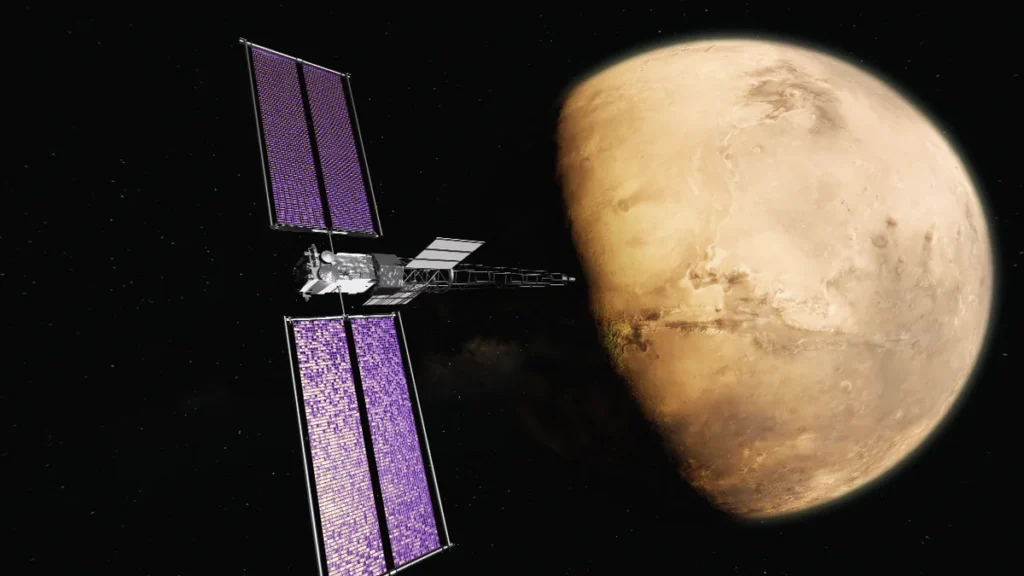
- In March 2026 at the agency's Ignition event, NASA Administrator Jared Isaacman unveiled the SR-1 Freedom concept, with leaders saying they aim to build a fission-powered spacecraft before the next Mars launch window.
- The SR-1 mission will demonstrate how fission power makes extended missions possible, helps build reliable surface power systems for NASA's future Moon Base, and permits travel deeper into the solar system.
- A $39.3 million contract from NASA goes to Johns Hopkins University's Applied Physics Laboratory to build the heat rejection system for the vehicle's nuclear power module.
- The heat rejection system is essential for proving nuclear electric propulsion in space and will support the manufacturing base needed for upcoming high-power nuclear systems in deep space missions.
NASA completed a major design review in Oct. 2026 at its Glenn Research Center in Cleveland and locked in the architecture for SR-1 Freedom, targeting a late 2028 launch to demonstrate nuclear electric propulsion, a system that uses reactor-generated electricity to power thrusters, in deep space for the first time.
At the agency’s Ignition event in Mar. 2026, NASA Administrator Jared Isaacman introduced the SR-1 Freedom concept, describing plans for a fission-powered spacecraft ahead of the next Mars launch window. The spacecraft design has evolved since that introduction, leading to the October review and the locked architecture. Experts from NASA, the Department of Energy, and industry attended the review at the Cleveland center. The gathering advanced the effort from an early concept toward a defined spacecraft design.
Launching in late 2028, SR-1 Freedom will combine nuclear and solar power to carry SkyFall, a capsule holding three next-generation helicopters, to Mars. After arriving, the helicopters will examine Martian geology and climate history, investigate new terrain, and look for signs of ice below the surface. The spacecraft will activate its reactor after leaving Earth orbit and then use solar arrays to power the cruise to Mars. NASA announced the nuclear and solar delivery plan for SkyFall alongside the locked architecture decision.
The locked architecture includes a shorter boom than early drawings depicted. That boom keeps the reactor apart from the spacecraft’s main body, called the Power and Propulsion Element, cutting weight, easing assembly, and simplifying the design. NASA and Department of Energy experts found that better shielding and spacecraft design allow the reactor to sit nearer the spacecraft while still protecting electronics and the SkyFall payload from radiation. The closer reactor position also makes integration easier for the mission team.
The team is also modifying the Power and Propulsion Element by updating its communications system with larger X-band antenna dishes to send data across deep space back to Earth. X-band is a radio frequency range used for deep space communications. Continued development will concentrate on cutting risk, streamlining the design, and keeping to the schedule. Design teams continue studying how many radiator panels the spacecraft needs, what power levels its nuclear power module should produce, and how long the reactor can run.
NASA awarded a $39.3 million contract to Johns Hopkins University’s Applied Physics Laboratory to build the heat rejection system for the vehicle‘s nuclear power module. The contract falls under the Aerospace Research, Development, and Engineering Support II contract and requires the laboratory to design, build, test, evaluate the system, and produce flight hardware. The Applied Physics Laboratory is working with Advanced Cooling Technologies as a key strategic commercial partner to supply heat pipe and composite radiator technologies for removing excess heat from the nuclear power system. The technologies will enable the system to meet demanding mission requirements.

The heat rejection system removes excess heat from the nuclear power system, so the module can run safely and efficiently. NASA says the system is essential for proving nuclear electric propulsion in space. It will also support the manufacturing base needed for upcoming high-power nuclear systems on deep space missions.
After leaving Earth orbit, SR-1 Freedom will activate its reactor, operate it for an initial period while sending performance data to Earth, and then rely on solar arrays to cruise to Mars. The mission plan calls for shutting down the reactor during the solar-powered cruise. Once the spacecraft delivers SkyFall to Martian orbit, it will restart its fission reactor to collect additional data on spacecraft performance in deep space. Planned operations and the mission timeline have been set alongside the spacecraft design.
Steve Sinacore serves as the SR-1 Freedom program director. “SR-1 marks a pivotal step in how we travel through the solar system,” said Steve Sinacore, SR-1 Freedom program director. He called the mission the first freight run on that railroad and said current choices build the track for future nuclear-powered spacecraft.
SR-1 Freedom will demonstrate how fission power makes extended missions possible, helps build reliable surface power systems for NASA’s future Moon Base, and permits travel deeper into the solar system. The mission is moving toward its 2028 launch goal to demonstrate new nuclear-powered transportation capabilities and establish a foundation for future exploration beyond Earth orbit. Teams across NASA, the Department of Energy, and industry are working together on advancing design decisions as the mission approaches its 2028 target. The foundation established by SR-1 Freedom will support future exploration beyond Earth orbit.



Join the discussion