This is a new development in a story we reported earlier: Amazon schedules next Leo satellites on Ariane 6 after Vulcan failure.
Key facts
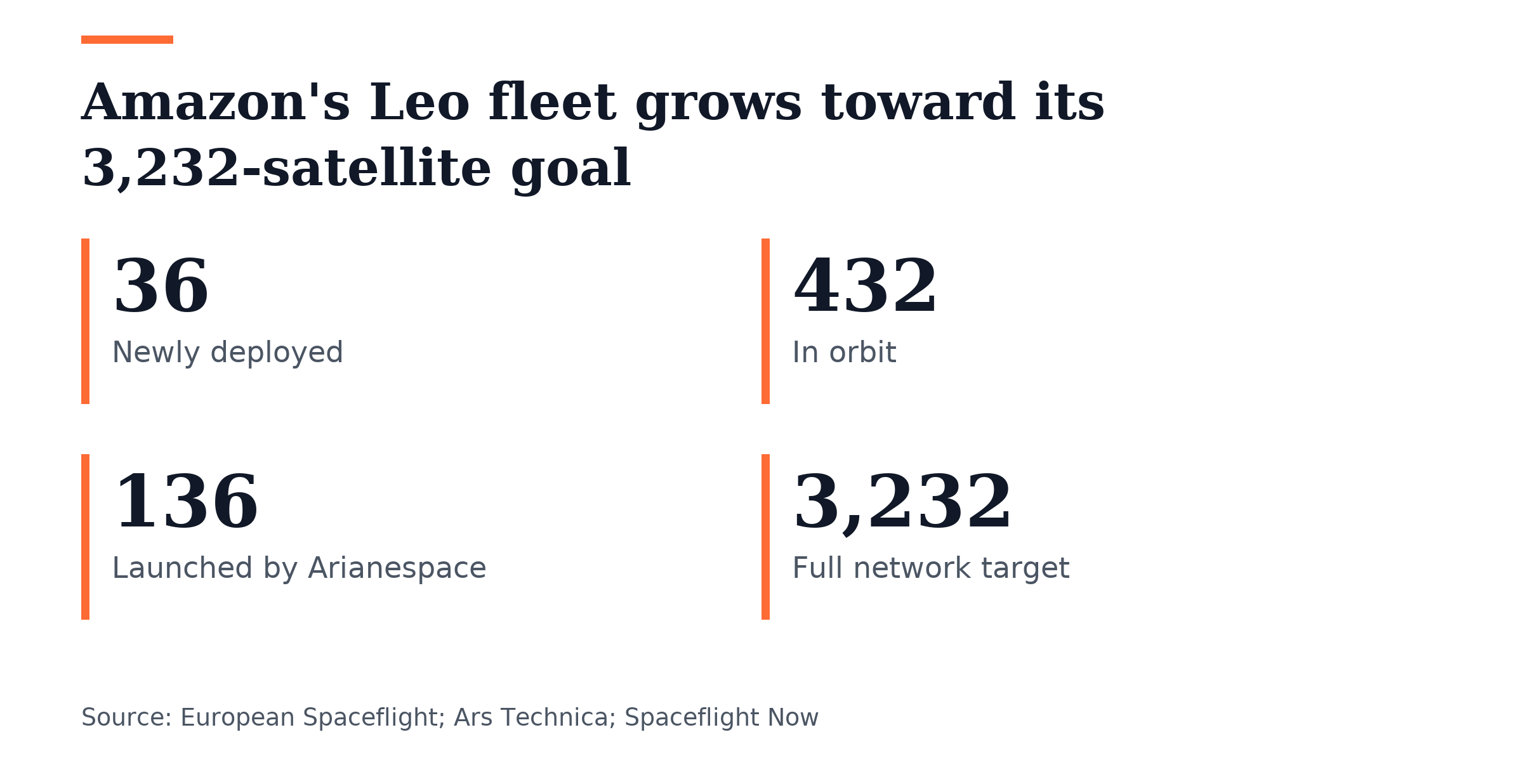
- The mission marked Amazon's fourth Ariane 6 flight of 2026 and lifted the total number of satellites Arianespace has launched for Amazon's broadband internet constellation to 136.
- The deployment raised Amazon's Leo broadband fleet to 432 satellites in orbit as the company works to offset the loss of 40 satellites aboard a failed United Launch Alliance Vulcan flight earlier in November.
- Amazon has bought rides on 108 Western medium- and heavy-lift rockets to deploy 3,232 low-Earth-orbit satellites and had completed 17 of those missions with one failure by late November 2026.
- This launch was Ariane 6's sixth and probably last flight of 2026, and the next Ariane 6 mission is scheduled for 17 December to carry EUMETSAT's MetOp-SG-B1 weather satellite.
Arianespace’s Ariane 6 rocket began its tenth mission from Europe’s Guiana Space Centre at 11:14 UTC on Nov. 24, 2026. The mission sent 36 Amazon Leo satellites toward low Earth orbit, deploying them at about 460 kilometres altitude after just over two hours of flight.
Spaceflight Now identified the vehicle as VA271. It flew in the 64 configuration and used four P160C solid rocket motors. It was the fourth Ariane 6 mission for Amazon this year and the tenth Ariane 6 flight overall, designated LE-04 for the Amazon Leo constellation. Liftoff came at the end of the launch window, one day later than planned, after a technical problem affected ground support equipment for the rocket.
The mission lifted Arianespace’s total for Amazon’s broadband internet constellation to 136 satellites. European Spaceflight confirmed the deployment. With the new spacecraft, Amazon’s Leo broadband fleet reached 432 satellites in orbit.
Amazon is working to offset the loss of 40 Amazon Leo satellites destroyed when a United Launch Alliance Vulcan rocket failed on Nov. 15, 2026. It was the rocket’s first complete mission failure since ULA was founded in 2006, and a problem with the main booster during a return-to-flight flight caused the loss. Vulcan had been grounded for most of 2026 after a February anomaly involving a Northrop Grumman-built motor during the USSF-87 launch, Spaceflight Now said.
Amazon has purchased rides on 108 Western medium- and heavy-lift rockets to deploy 3,232 low-Earth-orbit satellites and had completed 17 of those missions with one failure by late November 2026. The company initially bought capacity from ULA, Arianespace and Blue Origin, and most of those agreements relied on rockets still under development. “There is risk with any launch, and that’s especially true for inaugural missions like LV-01,” Amazon said.
Blue Origin’s New Glenn rocket has been grounded since May 2026 after a pad explosion in Florida. A fourth vehicle designed to carry 48 Amazon Leo satellites was lost in a BE-4 static-fire test, pushing the rocket’s first flight to early 2027. Amazon’s satellites were not aboard the New Glenn when it exploded, and Blue Origin had been working toward a return to flight by year-end before the accident.
Amazon is accelerating several Falcon 9 launches purchased from SpaceX. The next Amazon Leo mission on that rocket moves to December 2026 from the following year, and more Falcon 9 flights will follow quickly. An Amazon official confirmed the acceleration, Ars Technica said. SpaceX also operates the Starlink network Amazon hopes to surpass.
Amazon chose Arianespace in April 2022 for 18 constellation missions. The agreement covered 38 Vulcan launches and 12 New Glenn flights. The company later added three Falcon 9 flights flown in 2025 and converted a New Glenn option for 24 batches in late 2025. In September 2026, Amazon ordered six additional Ariane 64 flights, expanding the launch services agreement to 24 total contracted missions.
Ariane 6 returned to flight after engineers found and fixed a turbopump defect on the main Vulcan 2.1 engine in August 2026. A further engine firing is planned for early December 2026 to check the fix, European Spaceflight said, attributing the plan to a Nov. 19 report by La Tribune. Reports of turbopump problems had delayed the Ariane 6 schedule.
Should the 17 December launch go ahead, Arianespace will end the year with six Ariane 6 missions, up from four in 2025 but still at the low end of the original target of six to eight flights. The next Ariane 6 mission is scheduled for Dec. 17, 2026, to carry EUMETSAT’s MetOp-SG-B1 weather satellite.
Amazon said in October 2026 that it had completed construction of its 1,000th satellite at a plant in Kirkland, Washington. The Federal Communications Commission initially required Amazon Leo to orbit half its constellation by July 30, 2026, but an order from FCC Space Bureau Chief Jay Schwarz in June 2026 granted a partial waiver after Amazon requested a two-year extension in January 2026. The full 3,232-satellite network remains due by July 30, 2029.
Amazon reported 180 satellites launched when it filed in January and estimated roughly 700 deployed by the July deadline. The FCC order requires detailed future launch schedules and investment information.
Join the discussion