
Key facts
- Stellar Alpina revealed two new spacecraft: the Monarch orbiter and the Morpho lunar lander on Nov. 2, 2026.
- Monarch is an orbital transfer vehicle designed for a total velocity change of up to 6,000 m/s.
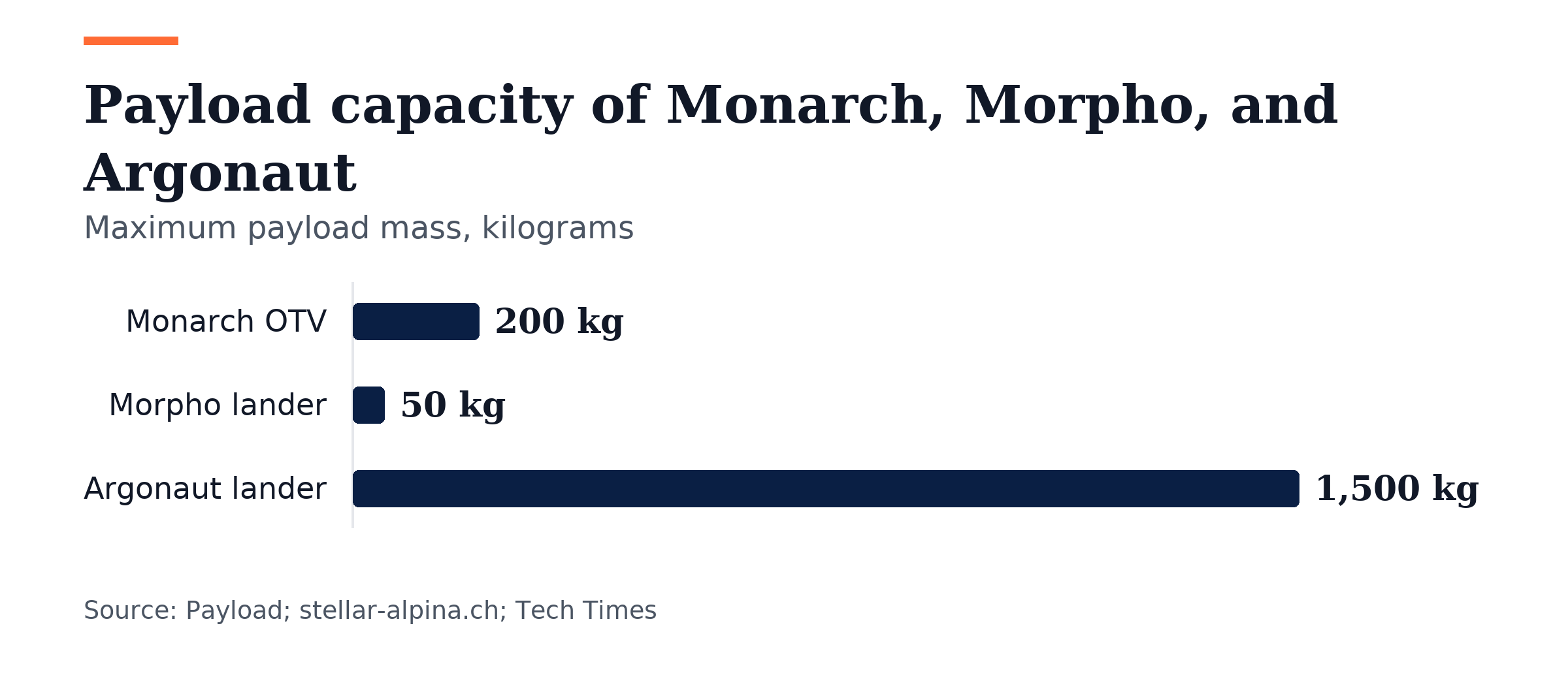
- Monarch has a maximum wet mass of 1,000 kg and can carry a 200 kg payload.
- Stellar Alpina plans to power its vehicles with hydrogen peroxide and propane propellants.
Stellar Alpina, a Swiss company headquartered at Switzerland Innovation Park Zurich in Dübendorf, revealed the Monarch orbiter and the Morpho lunar lander on Nov. 2, 2026, marking its move from propulsion research into complete vehicle development for orbital and lunar transport.
Monarch is an orbital transfer vehicle designed for a total velocity change of up to 6,000 meters per second. It carries a maximum wet mass of 1,000 kilograms and can transport a 200-kilogram payload. The November 2026 reveal was the first time the seven-founder company publicly described performance specifications for either vehicle.
Monarch supports transportation to medium Earth orbit, geostationary orbit and cislunar destinations, plus inspection, monitoring, proximity operations and mission-specific hardware hosting. Its delta-v envelope covers LEO-to-GEO transfers requiring roughly 3,900 to 4,200 meters per second and lunar trajectory insertion from low Earth orbit requiring roughly 3,100 to 3,200 meters per second. Monarch is launcher-agnostic and could reach geostationary orbit after launching on a European microlauncher.
Morpho is designed to deliver up to 50 kilograms of payload from lunar orbit to the lunar surface. It uses an upgraded version of Monarch’s architecture and is built for smaller, more flexible missions across the lunar surface. Stellar Alpina has not fixed a firm date for the lander because Morpho’s development timeline depends on Monarch’s market performance.
Stellar Alpina intends to offer Monarch as a mobility-as-a-service model, under which operators pay based on the specific delta-v consumed during a mission rather than purchasing a dedicated vehicle. The company also wants to operate its own satellite fleet and resell that mobility service to satellite operators, constellation deployers and research institutions.
Stellar Alpina plans to power its vehicles with hydrogen peroxide and propane, storable non-cryogenic propellants that require no cryogenic conditioning, vacuum-jacketed plumbing or active cooling during ground processing or on-orbit storage. Hydrogen peroxide decomposes cleanly into water and oxygen, and ESA environmental standards designate it a green propellant, while propane is a standard industrial gas available at commercial pricing globally.
Monarch utilizes rotating detonation rocket engine technology, a propulsion approach in which fuel and oxidizer inject continuously into a ring-shaped chamber. A detonation wave propagates at supersonic speeds, typically more than 1,000 meters per second, compressing and igniting fresh propellant in a shock-coupled event. Conventional engines burn propellant through subsonic deflagration, whereas RDREs release energy at near-constant volume, creating a pressure-gain combustor with higher stagnation pressure at the chamber exit than at the inlet.
Continuous detonation inside an annular channel was described by Soviet physicist B.V. Voitsekhovsky in the 1950s. High-speed diagnostics and additive manufacturing in the 2010s let engineers study complex combustion chambers and build intricate geometries. JAXA demonstrated the first in-space RDRE firing aboard a suborbital rocket in 2021, and as of November 2026 the technology remained at roughly TRL 4 of 9.
Stellar Alpina remains in the prototyping phase after completing more than 150 engine tests. Its Engine 0 completed eight detonative hotfires within 82 days of incorporation. Venture Kick’s jury verified five stable detonation episodes. The next step is a water-cooled engine intended to keep the hardware from overheating, a thermal-management problem Elliesen identified as one of the biggest hurdles for rotating detonation technology.
Stellar Alpina closed a CHF 3.5 million pre-seed funding round in May 2026, led by Founderful with participation from LP&E and other strategic investors. In September 2026, it received a CHF 150,000 award from Venture Kick, whose jury cited technical differentiation and clarity of target market.
Europe currently lacks a CLPS equivalent, a government-funded commercial contracting mechanism for recurring paid lunar delivery missions to private providers. ESA’s Argonaut lander, developed by Thales Alenia Space Italy, is scheduled to begin its first demonstration mission, ArgoNET, in 2031 aboard an Ariane 64 and is designed to deliver up to 1,500 kilograms of payload to the lunar surface. Victor Elliesen said Europe has no clear commitment to commercial lunar exploration beyond Argonaut and sees Morpho as a smaller complement to it.
Astrobotic was acquired by Voyager Technologies in July and plans to bolt rotating detonation rocket engines onto its Griffin lunar lander. Astrobotic’s Chakram engine completed a 300-second continuous burn on April 24, 2026, and has accumulated more than 470 total seconds of RDRE firing across two engine prototypes. Neither Astrobotic nor Stellar Alpina has flown a rotating detonation rocket engine yet.
No other European commercial program pairs rotating detonation engines with in-space mobility, a position Stellar Alpina says could ease its path in ESA procurement and with European customers. Research cited by Tech Times valued the orbital transfer vehicle market at $1.79–2.31 billion in 2024–2025, with a forecast compound annual growth rate of 13–17.5% and a reach of $3.4–9.9 billion by 2030–2033. Stellar Alpina is aiming at the European slice of that market, which has no RDRE-equipped orbital transfer service today.
Stellar Alpina aims to conduct an in-orbit demonstration of Monarch by 2029, though the realization of that timeline depends on the availability of launch vehicles. Elliesen described Monarch as a platform for high-delta-V missions ranging from in-space transport to responsive defense, and said the vehicle could serve profiles currently requiring a dedicated upper stage or significantly heavier propulsion stack if realized in flight hardware.
“The space industry is shifting its focus from access to orbit toward mobility after launch,” Elliesen said. He also said, “Europe hasn’t established a CLPS program yet,” referring to NASA’s Commercial Lunar Payload Services program, and pointed to growing institutional activity in cislunar space as a sign of emerging lunar demand.


Join the discussion