
Key facts
- Blue Origin is developing GS3, a hydrogen-oxygen third stage for New Glenn intended to give the rocket added performance for geostationary orbit and lunar missions.
- Dave Limp said lower-cost access to space requires examining every part of the vehicle and called the Northstar effort a game-changer.
- Blue Origin's UP.Summit announcement was an invite-only event held at Kennedy Space Center in Florida.
- Dave Limp called Northstar a simpler and more powerful successor to the BE-4 engine.
Blue Origin announced two New Glenn upgrades on Nov. 5, 2026, at the UP.Summit conference, an invite-only event held at Kennedy Space Center in Florida and hosted at the Shuttle Landing Facility: a new booster engine called Northstar and a hydrogen-oxygen third stage called GS3, intended to cut vehicle manufacturing cost and expand payload delivery to geostationary orbit and the Moon. Dave Limp, Blue Origin’s chief executive, said at the summit, “There has never been higher demand for launch, ever.” Limp described a strong market backdrop for launch services at the summit, and the company’s stated goal is to eventually position New Glenn to launch more than 1,000 times a year.
Blue Origin positions Northstar as its second booster engine alongside the BE-4, which powers New Glenn’s first stage and United Launch Alliance’s Vulcan rocket. Dave Limp described Northstar as a simpler and more powerful successor to the BE-4 engine, saying lower-cost access to space requires examining every part of the vehicle and calling the effort a game-changer. The engine emerged from a small team concentrating on weight, cost, manufacturability, and performance. Blue Origin frames Northstar as an additional high-thrust booster option rather than an immediate wholesale replacement for the BE-4 fleet currently flying and supporting ULA.
The BE-4 engine produces 640,000 pounds of thrust, while Northstar will have a starting thrust of 715,000 pounds. According to Dave Limp, Northstar has half the number of parts of a BE-4, about 30 percent less mass, and roughly 65 percent can be 3D-printed. Blue Origin claims more than 65 percent of Northstar is additively manufactured, which the company says represents a 50 percent cut in parts count compared with the BE-4. The extensive use of in-house 3D printing is central to the weight and cost reductions the company claims for the engine.
Northstar burns methane mixed with liquid oxygen, built on a combustion cycle that runs rich in oxygen and a turbopump whose single shaft turns both pumps, an approach the BE-4 also uses. The engine is fueled by liquefied natural gas and liquid oxygen, matching the propellants used on the BE-4. The single-shaft turbopump architecture drives both the fuel and oxygen pumps from a single turbine, mirroring the BE-4’s design. The Northstar programme moved from program approval to development testing in 11 months.
Blue Origin has already begun test firing Northstar as part of a development campaign that the company describes as deep into testing. The engine retains the cycle and architecture foundational to Blue Origin’s propulsion development, and the company says it is developing Northstar as a second booster option alongside the BE-4.
The company believes it can manufacture Northstar at 25 percent of the cost of a BE-4 engine and eventually assemble each engine in less than a day, a result the company attributes to manufacturing advancements that shortened production timelines. Blue Origin stated that Northstar would be joining BE-4 on the New Glenn fleet but did not give a timeline for that step.
Blue Origin also unveiled GS3, a hydrogen-oxygen third stage for New Glenn intended to give the rocket added performance for geostationary orbit and lunar missions. Limp said, “We announced New Glenn’s third stage today (GS3).” The stage is powered by Blue Origin’s BE-7 engine, a liquid-oxygen/liquid-hydrogen unit that also serves the Blue Moon Mark 1 and Mark 2 lunar landers, with a vacuum specific impulse better than 460 seconds.
GS3 reuses New Glenn fluids, mechanical systems, and avionics to cut technical risk, and the company has said the stage is not required for current plans to deliver astronauts to the Moon’s surface. The stage targets direct injection to geostationary orbit and Earth-escape trajectories, and its mission options cover high-energy missions including direct GEO injection and Earth-escape paths.
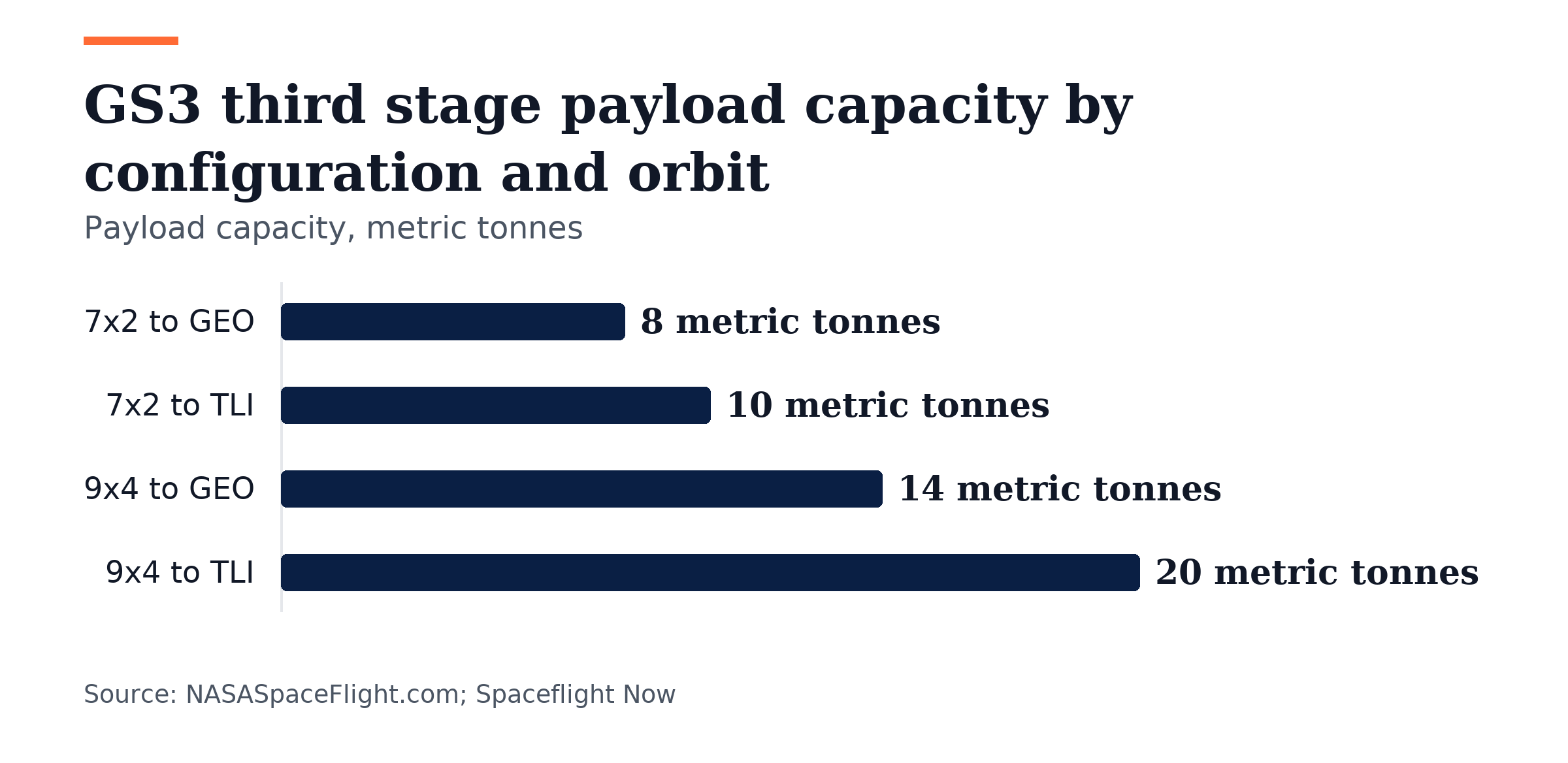
On the 7×2 vehicle configuration, GS3 quotes up to 8 metric tonnes to GEO and 10 metric tonnes to trans-lunar injection; on the 9×4 vehicle, those figures rise to 14 metric tonnes to GEO and 20 metric tonnes to TLI. Blue Origin gave the same performance numbers for the stage. By delivering significant payload mass directly to trans-lunar injection, GS3 enables faster transit times while preserving propellant for on-orbit operations.
The stage uses the same fixed payload adapters and payload fairing as the two-stage New Glenn vehicle, integrated inside an interstage to preserve full fairing volume and the customer payload experience. At Launch Site One in Texas, Blue Origin completed a composite liquid hydrogen tanking test for GS3 using flight fluid systems, pressurizing the tank to 100 percent of expected operating pressure for 2.5 hours and to 150 percent for 10 minutes. The 2.5-hour hold lasted longer than any GS3 mission requires, and Blue Origin expects the tank to be the first composite liquid hydrogen tank flown in space.
GS3 mission options include direct insertion into medium Earth orbit and geostationary orbit, multi-payload deployment, extended coast phases, and several precision burns, targeting national security and other high-energy missions requiring exact orbital placement and strong mission assurance. These features require precise orbital insertion and tight mission assurance. The stage is already under contract for a government cis-lunar mission scheduled to launch in 2028, though Blue Origin did not name the customer.
Spaceflight Now, citing a person familiar with Northstar development, reported that the engine will be compatible with New Glenn 9×4 rockets, while the BE-4 continues to play an important role including on return to flight. Blue Origin plans to keep building the BE-4 for United Launch Alliance, whose Vulcan rocket flies with two of the engines.
New Glenn has already flown as a two-stage vehicle from Launch Complex 36 at Cape Canaveral, on missions NG-1, NG-2, and NG-3. NG-1 carried the Blue Ring Pathfinder, NG-2 served as the NASA ESCAPADE mission, and NG-3 deployed AST SpaceMobile satellites. NG-4 was destroyed in a pad explosion during a static fire attempt in May.
The company still must convert the GS3 tanking test results and Northstar development testing into actual flight hardware before the upgraded third stage and booster engine fly on New Glenn, following ground tests and a contract for a 2028 government cis-lunar mission. Thanks to pad repair work following the May explosion, Blue Origin is preparing to return to flight with NG-4.1, using the booster named Never Tell Me The Odds, early in 2027.
The company is also promoting an ambitious forward schedule for 2027 and beyond with increasing launch cadence, a second launch pad designated LC-36B, and a new rocket variant, adding a high-energy option to the existing 7×2 and 9×4 architectures. Blue Origin aims to eventually position New Glenn to launch more than 1,000 times a year.
Blue Origin plans to keep building the BE-4 for United Launch Alliance, whose Vulcan rocket flies with two of the engines. The BE-4 engine runs on methane, with combustion staged so it is rich in oxygen, and it produces 640,000 pounds of thrust at sea level. ULA selected the BE-4 in 2014 for the Vulcan Centaur rocket and finalized the choice in September 2018; the engine first flew on Vulcan on Jan. 8, 2024, and on New Glenn on Jan. 16, 2025.
New Glenn is a 7.0-meter diameter two-stage orbital launch vehicle with an optional third stage, its first stage powered by seven BE-4 engines and reusable while the second stage is expendable. On its first launch on Jan. 16, 2025, all seven BE-4 engines performed well in ascent, though the first-stage booster failed during atmospheric reentry on the landing attempt. The BE-4 is designed for reusability up to 100 flights and uses a single oxygen-rich preburner with one turbine driving both fuel and oxygen pumps.
The BE-4 competed with and defeated the AR1 engine for the Atlas V RD-180 replacement program, and a February 2016 U.S. Air Force contract provided up to US$202 million in partial development funding to ULA for BE-4 use on Vulcan.



Join the discussion