Key facts
- United Launch Alliance is targeting a November 13, 2026 return to flight for the Vulcan rocket, pending approval from the U.S. Space Force's Eastern Range.
- LV-01 will fly Vulcan's heavy-lift VC6L configuration with six boosters from Northrop Grumman and a 5.4-meter payload fairing.
- Military officials reassigned national security flights to SpaceX after Vulcan's grounding following a Space Force mission anomaly.
- Vulcan Leo 1 is Vulcan's fifth flight since the rocket debuted in 2024.
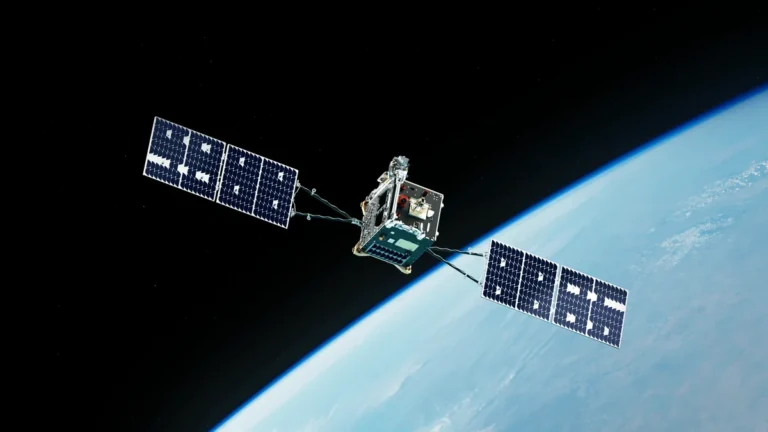
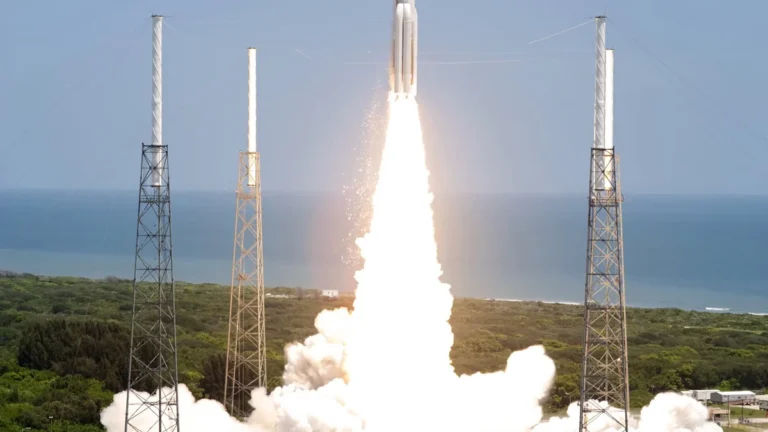
United Launch Alliance is targeting November 13, 2026, for the return to flight of its Vulcan rocket from Cape Canaveral Space Force Station in Florida, carrying 40 Amazon Leo broadband satellites.
The Vulcan Leo 1 mission, also designated LV-01, marks the first Vulcan flight for Amazon’s Leo constellation and will be the rocket’s fifth flight since its 2024 debut. LV-01 stands for Leo Vulcan 1, ULA’s designation for the first Vulcan mission carrying Amazon Leo internet satellites, and it will be Vulcan’s first flight with six strap-on boosters.
The 5.4-meter payload fairing and six Northrop Grumman boosters will fly on LV-01 as part of Vulcan’s heavy-lift VC6L configuration (a heavy-lift variant), and satnews.com calls this the biggest payload volume for Amazon’s network so far. ULA has tied the November 13 target to approval from the U.S. Space Force’s Eastern Range and has not confirmed a launch time or trajectory.
Vulcan was grounded after a solid rocket booster nozzle anomaly struck one of four boosters less than 30 seconds into the USSF-87 mission on February 12, 2026. A similar nozzle disintegration had occurred on the rocket’s second flight, when one of its two 63XL Graphite Epoxy Motors failed.
Reporting from Reuters ties the February 2026 anomaly to an earlier nozzle problem on a Vulcan certification flight in October 2024. In both cases, the methane-fueled first stage and hydrogen-fueled upper stage compensated for reduced and asymmetric thrust to reach the intended orbits. The grounding has kept Vulcan on the ground for roughly nine months, and ULA has not published a financial figure for the pause.
ULA, Northrop Grumman, and the U.S. Space Force convened an industry-government investigation team to examine the February incident. ULA said it has “identified several potential contributors which have been mitigated through design and process improvements to the nozzle,” with testing continuing in parallel with the mission. The company has not named a single root cause and has not published nozzle test data.
Northrop Grumman performed a test firing of a 63XL motor earlier this year as part of the effort to resolve the problem. The six GEM 63XL solid rocket boosters on the upcoming flight have reinforced thermal nozzle insulation, and the vehicle uses an optimized Centaur V upper stage.
Amazon currently has fewer than 400 operational broadband satellites in orbit for its Amazon Leo constellation. Under its FCC authorization, the company must deploy half of its 3,232-satellite constellation by mid-decade and complete all satellites by July 2029. Amazon originally contracted 77 heavy-lift missions across Arianespace, Blue Origin, and ULA to deploy the constellation, but technical setbacks have constrained launch cadence.
The company has booked 38 Vulcan launches to deploy the bulk of its network. Amazon’s previous constellation deployment missions used Atlas 5, Ariane 6, and Falcon 9 vehicles before turning to Vulcan for heavy-lift launches, and the company had hoped to use Vulcan earlier because it can carry more Leo satellites than any rocket except Blue Origin’s New Glenn.
However, Blue Origin’s New Glenn vehicle exploded during a static fire test in May, stalling its orbital timeline and further constraining Amazon’s launch options. The satellites meant for New Glenn were not attached during the May pad explosion. Meanwhile, an Ariane 6 flight carrying 36 more Amazon Leo satellites is set for no earlier than November 23, as Arianespace’s launch manifest has struggled to achieve the high flight frequency needed for Amazon’s deployment schedule.
The grounding has also affected Vulcan’s national security role. The U.S. Space Force certified Vulcan for national security launches in 2025 and flew two missions on the rocket before the February 2026 grounding. Space Force officials lost confidence in Vulcan after the nozzle failures, even though the Pentagon entrusted Vulcan for roughly half of its major launches through the early 2030s.
Military officials reassigned national security flights to SpaceX after the grounding, and Space Force officials will closely scrutinize the return-to-flight mission. The Space Force has not said what work remains before Vulcan can carry national security payloads again, and ULA has not said when Vulcan will fly its next government mission.
Vulcan assembly for LV-01 began on May 14 when the first stage booster was hoisted into ULA’s Vertical Integration Facility. The stack rolled to Launch Complex 41 in August for fueling tests and later received its six solid rocket boosters, and ULA stacked the first LEO-optimized Centaur upper stage onto the Vulcan booster four days after the May 14 booster hoisting.
The payload fairing holding the 40 Amazon Leo satellites left Amazon’s satellite processing facility near the former shuttle landing strip on October 21 for attachment to the rocket. The 40 satellites will be deployed from an adapter on the Centaur upper stage over about half an hour.
According to industry analysts, 2027 could mark the decisive operational turning point for Amazon if flight rates rise across each of the three contracted rocket families, while satnews.com says Vulcan and European launchers need a regular monthly launch pace to avoid spectrum priority penalties. A second vehicle is already assembled for the Vulcan Leo 2 mission in ULA’s original Vertical Integration Facility, awaiting launch after LV-01 returns Vulcan to service.
Regulators have cleared Amazon Leo’s $11.57B Globalstar deal, but Amazon has not disclosed how many satellites it considers necessary for each service milestone of its constellation. In the broader LEO broadband race, Telesat’s plan to send 225 satellites to orbit relies on 14 SpaceX Falcon 9 launches, illustrating the scarcity of alternatives as constellation builders compete for limited launch capacity. ULA has not published a list of customers who may have switched away from Vulcan during the grounding.


Join the discussion