Key facts
- Astronomers identified a millisecond pulsar paired with a white dwarf companion that appears to have just completed mass transfer, with leftover debris still visible around the system.
- The pulsar's companion, COM-NGC 362D, is the youngest millisecond pulsar companion ever found.
- COM-NGC 362D is a proto-white dwarf at the start of its transition to a white dwarf.
- Researchers identified COM-NGC 362D by matching pulsar radio data with ten years of Hubble ultraviolet and near-infrared observations.
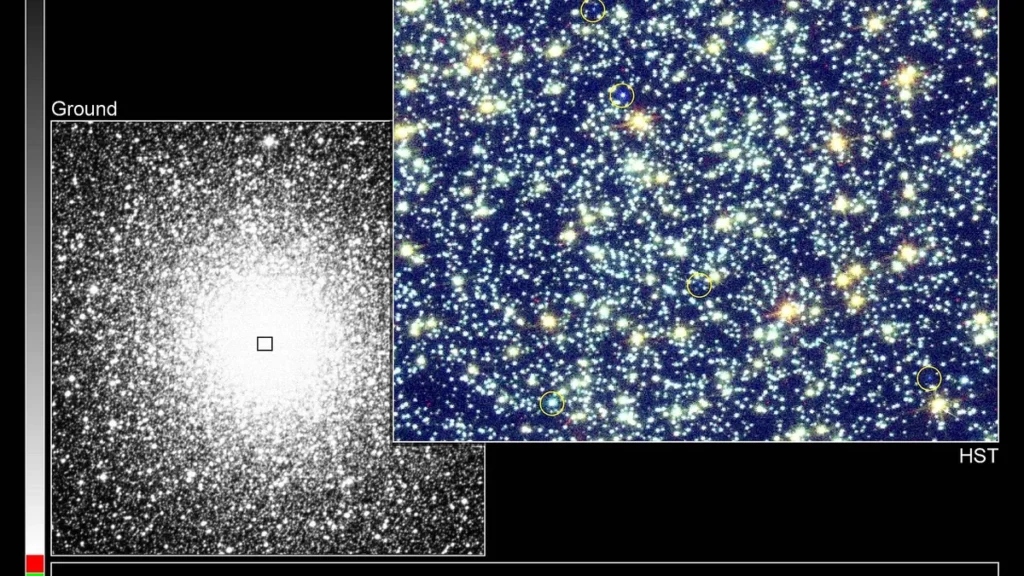
A team of researchers from Italy and Germany found a millisecond pulsar with a white dwarf companion in globular cluster NGC 362, about 29,300 light years away, in work published Nov. 9, 2026; the system appears to have just finished mass transfer, leaving debris still visible around it.
NGC 362D completes one rotation every 5.83 milliseconds, which amounts to more than 10,000 turns per minute. Initial detection occurred in December 2022. Such clusters are fertile ground for millisecond pulsars since their dense concentrations of stars make it more likely that neutron stars will have companions.
The companion, known as COM-NGC 362D, ranks as the youngest millisecond pulsar companion ever discovered. It sits as a proto-white dwarf, meaning it has just begun the shift to becoming a white dwarf. Classified as a very low-mass helium white dwarf with roughly 0.18 solar masses, it remains in the pre-cooling phase.
Researchers matched pulsar radio data to a decade of Hubble ultraviolet and near-infrared observations to identify COM-NGC 362D. Models of stellar evolution predicted more ultraviolet light than what researchers observed for COM-NGC 362D, indicating that something blocked or weakened the UV signal. The photometry of NGC 362D displays significant wavelength-dependent variations matching residual circumstellar material, something never before seen in this category of objects.
Circumstellar material is matter orbiting a star. The leftover material around COM-NGC 362D was probably ejected during mass transfer, which highlights how young the white dwarf is. The authors state that they do not know if the material could have lasted this long, even though they still favor that explanation.
Another possibility raised by the authors is that the debris was ejected during an earlier hydrogen-shell flash. A hydrogen-shell flash is a burst of nuclear fusion in a star’s outer hydrogen layer. The favored view holds that COM-NGC 362D is a young white dwarf enveloped by residual material that causes self-extinction.
Self-extinction occurs when material around a star dims its own light. Greta Ettorre, the lead author, said the system matters because researchers can observe it at an early point in its evolution, and ultraviolet attenuation may point to material around the white dwarf. She is a doctoral candidate in the physics and astronomy department at Alma Mater Studiorum University of Bologna.
“What makes this system particularly interesting is the possibility of observing it at a very early stage of its evolution,” Ettorre said.
Emanuele Dalessandro, who works at INAF and co-authored the study, said NGC 362D presents a rare chance to examine the period right after millisecond pulsar recycling. He noted that material around the white dwarf might produce radio signatures resembling those seen in systems with non-degenerate companions, aiding the study of other young systems. Non-degenerate companions are stars that are not white dwarfs or neutron stars.
The work appeared in Astronomy and Astrophysics under Ettorre’s lead, with the author enrolled as a doctoral student at Alma Mater Studiorum University of Bologna. Researchers from Italy and Germany make up the team. INAF employs co-author Emanuele Dalessandro.
A millisecond pulsar begins as a slowly spinning neutron star that picks up rotation from mass and angular momentum transferred by an evolving companion. As the pulsar draws matter from its companion, it pushes the companion to become a white dwarf far sooner than nature would allow, a process known as recycling. In the recycling picture, mass transfer typically starts when the donor star is on the main sequence, a subgiant or the red-giant branch.
The Sun is a stable main sequence star. A subgiant is a star evolving away from the main sequence. A red-giant branch star is a cooler, larger star in a later stage of life. While pulling material, the pulsar drives the companion toward white-dwarf status much faster than it would reach on its own.
That is why spotting a young core such as COM-NGC 362D could simplify the search for comparable systems. NGC 362D provides an exceptional opportunity to examine what happens after recycling ends.
Ettorre said millisecond pulsars turn with remarkable consistency and work as natural clocks for testing gravity and general relativity. Precise measurements of pulse arrival times enable the study of gravity in extreme settings. Knowing a pulsar’s environment and its past development is key to using these cosmic laboratories effectively.
Cosmic laboratories are natural systems used to test physics.
The Five-hundred-meter Aperture Spherical radio Telescope from China, known as FAST, found pulsar PSR J1810−0623 on June 11, 2026. The object completes one spin every 4.55 milliseconds, totaling roughly 220 rotations per second.
The companion weighs about 0.64 solar masses and is probably a carbon-oxygen white dwarf. A carbon-oxygen white dwarf is a white dwarf made of carbon and oxygen. The two bodies orbit their common center of gravity once every 15.4 days.
PSR J1810−0623 probably came together in a moderate-mass X-ray binary as the companion moved material to the neutron star. A moderate-mass X-ray binary is a system where a neutron star pulls gas from a companion star. Gradually, the companion sent material to the neutron star, stripping away its outer layers and leaving behind a white dwarf remnant.
Most millisecond pulsars begin slowly and pick up speed through extended interactions with a companion, a process called recycling, astronomers say. This path to formation seldom happens in the Milky Way, making such systems particularly valuable, according to astronomers. The companion kept transferring material to the neutron star, spinning it up rapidly and eventually leaving behind the white dwarf remnant.
Its path is almost a perfect circle, with an eccentricity of roughly 0.000015. Eccentricity measures how oval an orbit is, with zero a perfect circle. The orbit of PSR J1810−0623 is rounder than the orbit of PSR J1614−2230, giving researchers a fresh test case for binary evolution theories.
Steady mass transfer over long periods generally circularizes orbits by gradually ironing out orbital irregularities. Observations spanning six and a half years show that PSR J1810−0623 went through thorough recycling. The surface magnetic field of the pulsar has fallen to roughly 100 million Gauss.
The team used the pulsar’s radio signal polarization to gauge magnetic field details along the line of sight, helping map the Galaxy’s magnetic field layout. Polarization describes the orientation of radio waves. The Galaxy’s magnetic field layout is the large-scale magnetic structure of the Milky Way.
Upcoming timing observations with FAST and other radio telescopes seek to pin down the neutron star’s true mass and test gravitational theories using precise orbital measurements. The pulsar should work as a useful natural laboratory for research into pulsar recycling, binary evolution, and the Galaxy’s magnetic field structure.





Join the discussion