Key facts
- General relativity expects a range of masses among primordial black holes rather than one uniform size, so a varied mass distribution produces gradual evaporation over time with the lightest black holes blowing up first.
- Stephen Hawking's theory holds that the black holes would shed mass by releasing radiation and disappear before light atomic nuclei first formed.
- Past studies investigated a poltergeist mechanism where almost simultaneous evaporation would trigger strong sound waves in hot radiation, creating gravitational waves described as moving distortions of spacetime.
- Even the smallest spread made the transition to radiation smooth enough to cut the gravitational-wave signal by orders of magnitude, while a broader range of heavier black holes would reduce it still more.
In 2026, Yann Gouttenoire, Nicholas Leister and Pedro Schwaller published their findings in Physical Review Letters, saying evaporating primordial black holes below roughly one billion grams could have heated the early universe while leaving a much fainter gravitational-wave signal than some models predicted. The work weakens a constraint previously used to rule out some versions of this proposed chapter of cosmic history, and the research came from physicists at Johannes Gutenberg University Mainz and the Institut d’Astrophysique de Paris.
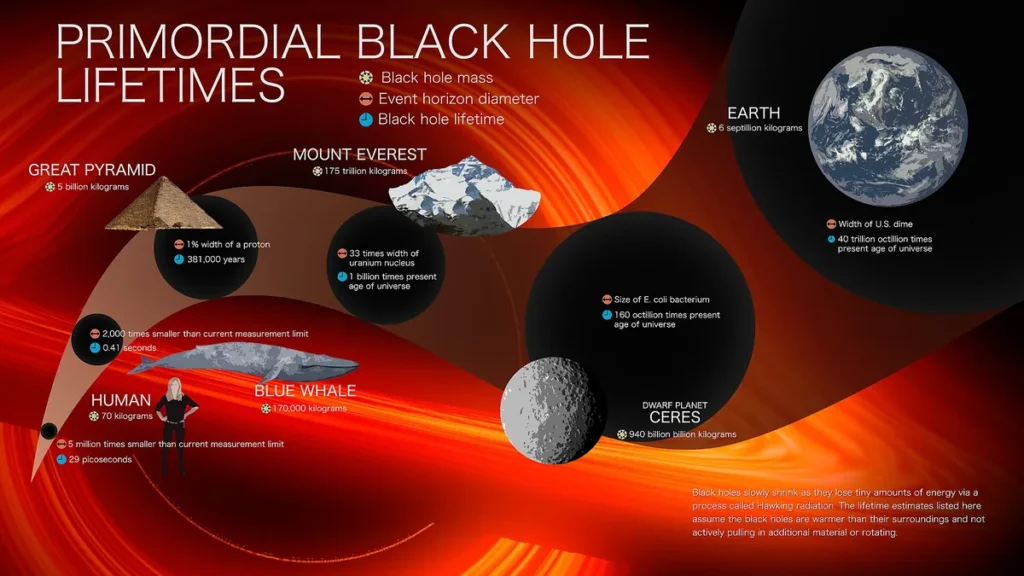
The black holes in question weigh less than about 1,000 metric tons, or roughly one billion grams, tiny by black-hole standards, and may have formed in dense patches of the newborn cosmos. Stephen Hawking’s theory holds that they shed mass by releasing radiation and disappear before light atomic nuclei first formed, with larger holes enduring longer and smaller ones evaporating faster. Universe Today said Stephen Hawking established in the 1970s an upper limit of 1,000 metric tons on how big such primordial black holes could be, comparing the weight to a large container ship, and said a black hole at that limit would last only one second. Universe Today also said larger black holes could destroy newly formed atoms through explosion-generated gravitational waves, particularly if they all exploded at once.
Past studies looked at a poltergeist mechanism under which nearly simultaneous evaporation would set off strong sound waves in hot radiation, producing gravitational waves described as moving distortions of spacetime. An older theory held that all these black holes were the same size and released identical amounts of gravitational waves when they ended their lives in evaporation explosions. Earlier models that assumed uniform black-hole size concluded these objects could not have triggered reheating after inflation, since a simultaneous burst would create a poltergeist signal far stronger than anything found in the gravitational-wave background. Giving up the old idea that all the black holes were the same size does not break the account of how atoms formed.
Instead, the new team modeled the narrowest mass distribution that collapse physics allows, keeping the lighter black holes that cannot be avoided while cutting off the heavier end as sharply as possible. Objects born in patches only slightly above the collapse threshold weigh less than those born farther above it, meaning black holes from the same era need not have the same mass. General relativity predicts a spread of masses among primordial black holes instead of a single uniform size, so a varied mass distribution leads to gradual evaporation over time, with the smallest black holes blowing up first. A spread as small as this made the shift to radiation smooth enough to slash the gravitational-wave signal by orders of magnitude, while a wider range of heavier black holes would cut it further, and earlier poltergeist research found that varying black-hole masses and evaporation times weakens the wave signal.
Gravitational waves carry energy, and too much of it would conflict with limits based on the formation of light elements in the early universe; reducing the predicted signal opens some combinations of black-hole masses and amounts that had been excluded. Assorted black holes below the limit held down gravitational waves enough for atoms to form and for the universe to keep expanding, mainly because they exploded at different times rather than all at once.
Pedro Schwaller of Johannes Gutenberg University Mainz and the PRISMA++ Cluster of Excellence said robust evidence points to an early phase of exponential expansion called inflation between 10⁻³⁵ and 10⁻³³ seconds after the cosmos began, after which supercooling and an initial reheating occurred. Schwaller said cosmologists know surprisingly little about the epoch between initial reheating and the formation of the first atomic nuclei, so unexpected physical mechanisms may have operated in the universe’s first seconds. Universe Today said understanding the early universe is central to cosmology and could help explain how humans came into being and how life might emerge and develop elsewhere.
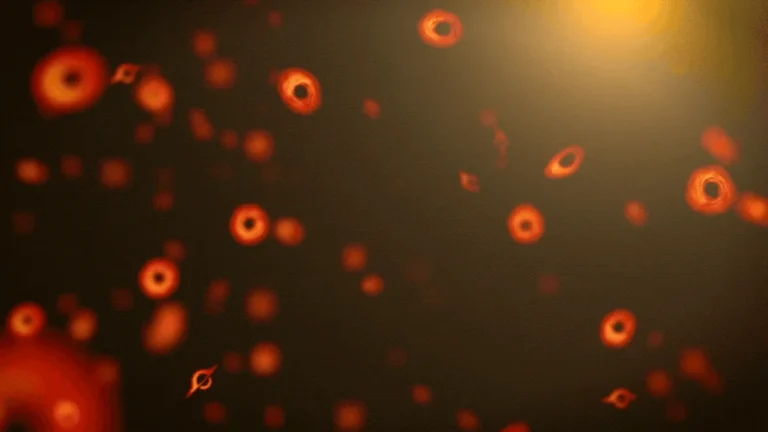
Tiny black holes may have emerged soon after inflation ended, and as spacetime expanded the surrounding hot radiation thinned and cooled much faster than the black holes, allowing the singularities to dominate the cosmos. After inflation, the expanding universe fell back into a supercooled state consisting mostly of expanding spacetime and black hole singularities. Radiation cooled faster than the black holes, changing the energy balance until the singularities dominated and created this extra supercooled epoch linked to the black holes’ eventual demise.
Once the black holes evaporated and exploded, their released energy reheated the cosmos a second time, creating the hot Big Bang conditions observed today. The team’s calculations indicate that primordial black holes smaller than one atom may have held nearly all the early universe’s energy and saturated the cosmos with hot plasma across many different formation scenarios.
The result is theoretical and rests on computer models instead of direct observation of the early universe. The research comes from scientists at the PRISMA++ Cluster of Excellence and the Mainz Institute for Theoretical Physics in Germany, working with the Institut d’Astrophysique de Paris. The team’s modeling allowed researchers to simulate the universe’s earliest microseconds and identify the exact conditions needed for a black-hole gas to become dominant, while calculations across a broad range of formation scenarios confirmed that the second reheating mechanism does not depend on narrow assumptions. The research suggests that all observable matter in today’s universe could ultimately be leftovers from atomic-scale black holes.
“Yann Gouttenoire, Nicholas Leister and Pedro Schwaller report their findings in Physical Review Letters.” The Physical Review Letters paper is titled Reduced Gravitational Wave Signal Reopens the Ultralight Primordial Black Hole Window with DOI 10.1103/bgv1-lpq7.
Even if future observatories perform optimistically, the evaporation signal fell below the projected sensitivity of the instruments the team examined, making a direct search more difficult.
A companion analysis available as a preprint points to gravitational waves from the density fluctuations that formed the black holes as a potentially detectable exception, although later evaporation would dilute those waves too. The strength of those formation waves depends on how the black holes formed and how numerous they were, setting them apart as a separate target from the evaporation signal.
Researchers have not determined how primordial black holes shaped the early universe, and Universe Today said it remains to be seen what scientists will learn in the coming years and decades about their role. “He said the smallest ‘may have been smaller than an atom.’” — Nicolas Leister, a PhD student at PRISMA++ and co-author, described the objects as ultra-light black holes able to dominate the very early universe, and said the black holes held nearly all of the universe’s energy while their explosions could have filled the cosmos with hot plasma.

Join the discussion