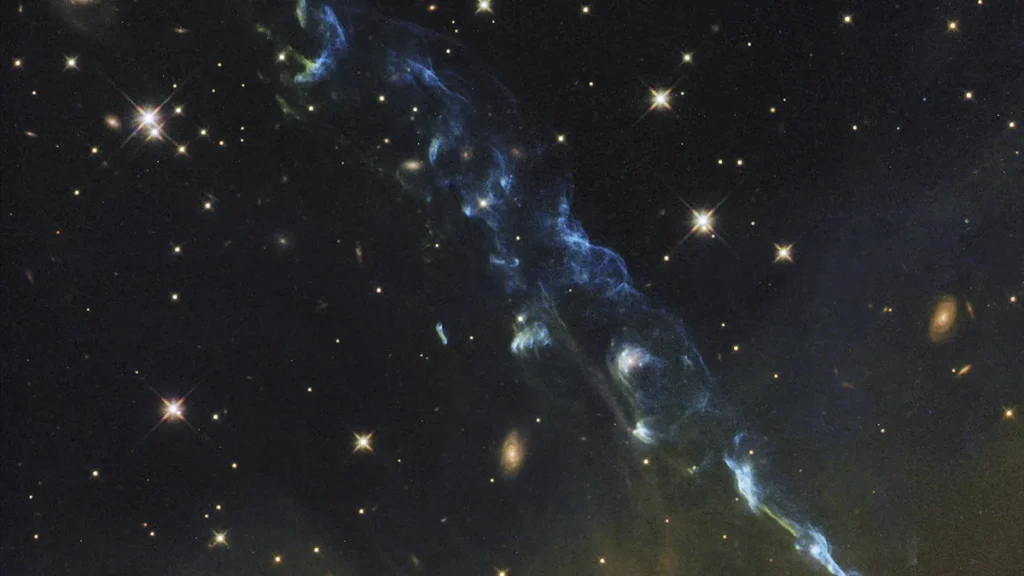
NASA’s Astronomy Picture of the Day featured Barnard 68, a dark molecular cloud, on November 29, 2026, with an explanation written by a professional astronomer..
APOD presents a daily image or photograph of the universe, and each entry includes a brief explanation prepared by a professional astronomer. The entry described Barnard 68 as a notable dark absorption nebula toward Ophiuchus, the Snake Carrier. An absorption nebula is a cloud that absorbs light from stars behind it. Its distance is about 500 light-years, and it measures half a light-year across.
The explanation links the lack of visible stars in the center to the cloud’s relative proximity. Barnard 68 contains dense dust and molecular gas that block nearly all visible light from stars behind it. Astronomers now call it a dark molecular cloud rather than a hole in the sky. A dark molecular cloud is a cold, dense cloud of gas and dust that obscures background stars.
Infrared light, radiation at wavelengths longer than visible light, allows observers to see directly through Barnard 68. Molecular cloud interiors rank among the coldest and most isolated locations in the universe because of their dark surroundings. A molecular cloud is a dense region of gas and dust where molecules can form. The APOD text connects this cold, isolated trait to the interiors of molecular clouds such as Barnard 68.
Such clouds are considered likely sites where new stars can form. A star system is a star with planets or other bodies bound to it by gravity. Barnard 68 is likely to collapse to form a new star system. The source presents this collapse finding as part of what Barnard 68 reveals about nearby star formation.
The exact formation process of molecular clouds such as Barnard 68 remains unknown. The source states this uncertainty alongside the point that such clouds are likely places for new stars. Collapse means the cloud’s material falls inward under its own gravity.



Join the discussion