Key facts
- The depth of shock waves in a planet's atmosphere determines its fate: shallow shocks retain the planet's gaseous envelope, while deep shocks strip it, leaving behind dense, rocky cores.
- The team predicts that the process of atmospheric stripping during migration could be observable, and they are investigating which telescopes might detect these luminous events.
- Rapid orbital stretching can cause a planet to plunge too close to its star before shock waves stabilize its orbit, leading to complete atmospheric stripping and explaining the 'Neptune desert.'.
- Hot Jupiters on closer orbits may have been dragged inward later by tidal forces raised on their host stars, according to the team's model.
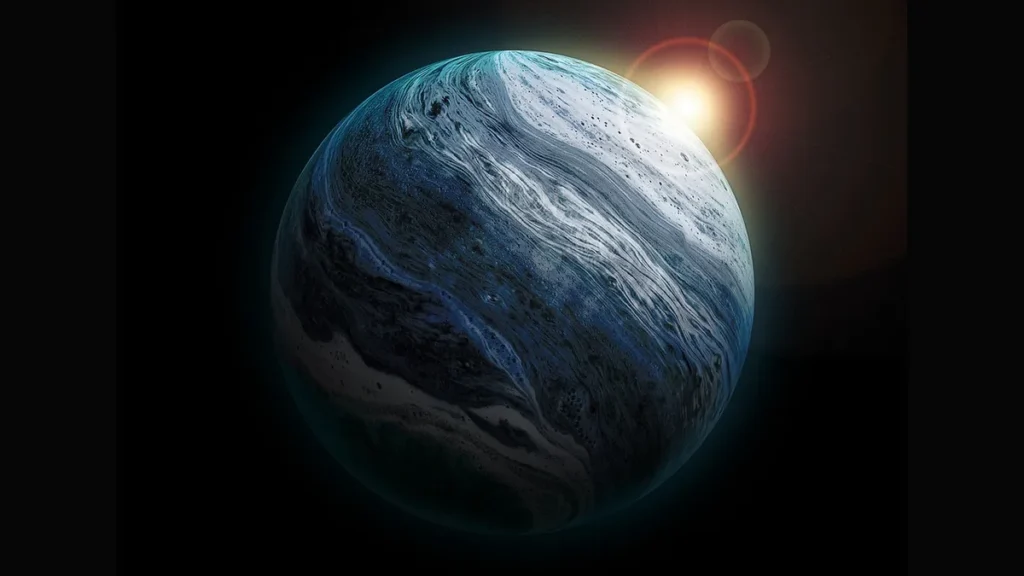
Researchers at The Pennsylvania State University, led by J. J. Zanazzi, used simulations to show that supersonic shock waves in the outer atmospheres of giant gaseous exoplanets can drive their migration from distant elliptical orbits into tight, close-in orbits around their host stars. The Astrophysical Journal published the study in 2026.
Researchers at The Pennsylvania State University, led by J. J. Zanazzi, used simulations to show that shock waves moving faster than sound in the outer atmospheres of giant gas planets can push those worlds from long, oval-shaped paths into tight orbits close to their stars, Phys.org reported. The study, published in The Astrophysical Journal in 2026, explains how these shock waves, triggered by surface gravity waves during close stellar encounters, convert orbital energy into heat, altering the planets’ trajectories. This mechanism could account for observed populations of hot Jupiters and Neptune-sized exoplanets.
The process begins with surface gravity waves inside a giant planet. During a close stellar encounter, gravitational forces from the passing star trigger horizontal oscillations across the planet’s surface. Those oscillations turn supersonic in the thin outer atmosphere and become shock waves, creating abrupt pressure and density jumps. Morgan MacLeod at Harvard University ran separate simulations showing that surface gravity waves in giant exoplanets become supersonic in their thin outer atmospheres.
The work focused on the layer where pressure and density jump suddenly. MacLeod’s simulations also showed that these shock waves dissipate orbital energy as heat, which changes the planet’s orbit. The results describe how a close stellar encounter can redirect its path around its star.
The depth of the shock wave decides the planet’s fate. If the shock stays shallow, the planet keeps its gaseous envelope, the outer layer of gas surrounding its core. If the shock goes deep, it strips the envelope away, leaving behind a dense, rocky core. This process explains the existence of unusually dense exoplanets found near their host stars because migration strips away their gaseous layers.
If orbital stretching happens too fast, the planet can fall toward its star before the shock waves stabilize its path. Complete atmospheric stripping follows, with no gaseous envelope left behind. The team connected this chain of events to the Neptune desert. The result is a world that loses its gas entirely as it migrates inward.
This mechanism suggests that planets migrating too quickly may lose their gaseous layers entirely, resulting in the observed scarcity of Neptune-sized planets within the desert.

The Neptune desert is the shortage of Neptune-sized planets on orbits shorter than about three days. Neptune-sized planets have masses between those of Neptune and Saturn. Observations show these worlds cluster in a feature called the Neptune ridge. This gap suggests a threshold distance where rapid orbital stripping or other mechanisms prevent these planets from migrating too close to their stars.
Hot Jupiters on closer orbits may experience a later migration stage. Tidal forces raised on the host star can pull the planet inward after the initial shock-driven movement. This secondary process could account for where some hot Jupiters land within their observed orbital clusters.
The researchers said atmospheric stripping during migration could produce luminous events. Telescopes might be able to detect these flashes. The team is investigating which observatories could spot them, with the goal of testing the model through future observations of exoplanetary migration.
The study appeared in 2026 in The Astrophysical Journal. Its title is Dynamical Tides during High-eccentricity Migration Produce the Hot-Jupiter Pileup, Neptune Ridge, and Neptune Desert. The title highlights the role of dynamical tides in driving the migration of planets from high-eccentricity orbits to their current positions. The title points to the three observed planetary groupings the model addresses: the hot Jupiter pileup, the Neptune ridge, and the Neptune desert.

Join the discussion