Key facts
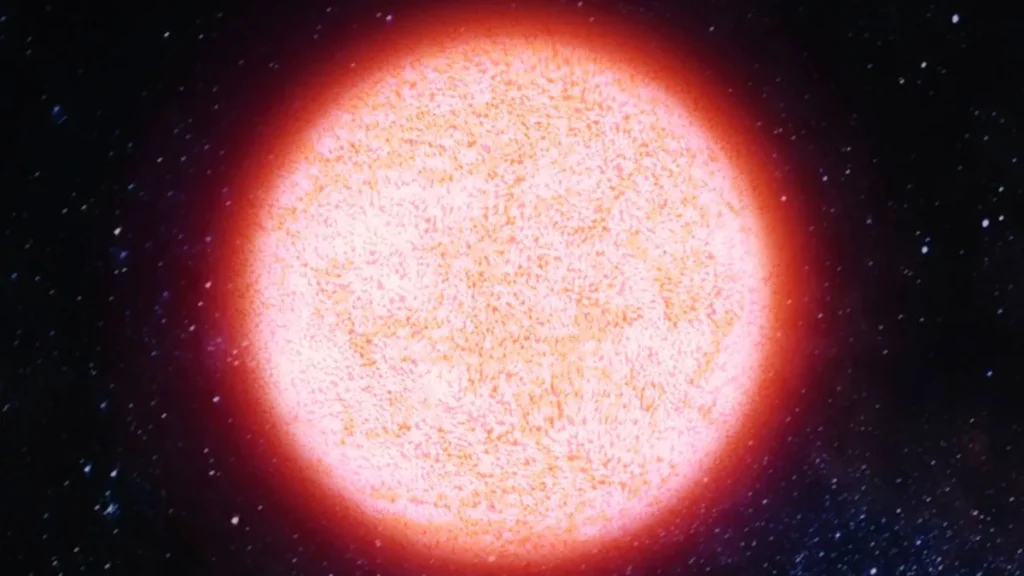
- Siwarha is believed to orbit at only about twice Betelgeuse's radius, passing directly through the red supergiant's extended atmosphere.
- The VLT's SPHERE instrument directly imaged Betelgeuse B, nicknamed Siwarha, in December 2024 at greatest elongation, revealing a bright source at 52.32 ± 0.18 milliarcseconds from Betelgeuse.
- Dr. Lynn D. Matthews of MIT Haystack Observatory led the VLA and ALMA study with scientists from the Center for Astrophysics | Harvard & Smithsonian, the University of Manchester, and the European Southern Observatory.
- Months before the Great Dimming, a Matthews-led study detected unusually cool radio temperatures that researchers proposed resulted from a convection-driven shock wave disturbing outer gas.
New research led by Dr. Lynn D. Matthews of MIT Haystack Observatory used the NSF VLA and ALMA to find evidence of Siwarha moving through Betelgeuse’s atmosphere and distorting the star, based on observations gathered between 2021 and 2026.
Using seven radio frequencies spanning 22 GHz to 485 GHz, the researchers built a layer-by-layer picture of Betelgeuse’s atmosphere. The view ran from just above the visible surface out to several times the star’s radius. Different radio frequencies probe different depths, so combining both facilities let the scientists reconstruct the vertical structure of the outer atmosphere rather than take a single snapshot.
Siwarha is likely too faint to detect directly in the collected radio observations, so the team studied the shape of Betelgeuse’s atmosphere instead. The radio-emitting atmosphere looks more elongated when Siwarha reaches its greatest separation and rounder when the companion passes in front of or behind the star.
The study included colleagues from the Center for Astrophysics | Harvard & Smithsonian, the University of Manchester, and the European Southern Observatory. Matthews described the finding in a statement, and the results appeared in The Astronomical Journal. “It was the combination of the incredible data from the NSF VLA and ALMA that gave us a convincing result here,” she said.
The companion orbits at about twice Betelgeuse’s radius, passing through the star’s extended atmosphere. The SPHERE instrument on the Very Large Telescope (VLT) later imaged Betelgeuse B, nicknamed Siwarha, in December 2024. It found a bright source 52.32 ± 0.18 milliarcseconds from Betelgeuse at greatest elongation. Miguel Montargès of the Observatoire de Paris–PSL led the VLT imaging team.
Montargès called the result “the conclusion of a century-long quest.” SPHERE used its ZIMPOL sub-instrument in pupil tracking mode and Angular plus Spectral Differential Imaging to separate real sources from rotating speckle noise without a coronagraph. PACO ASDI gave a detection significance of 6.1 sigma. Principal component analysis independently confirmed the detection at 5.1 sigma.
Betelgeuse B appears to be a 2.6 to 3.1 solar-mass B-type young main-sequence star, more massive than the roughly one-solar-mass value earlier models predicted. Since it outshines earlier predictions, the companion passed SPHERE’s detection threshold even while sitting close to the brilliant red supergiant.
Researchers first proposed Siwarha in 2024 to explain a roughly 2,100-day brightness cycle around Betelgeuse. Imaging and spectroscopy have since added support. The star also shows a short roughly 400-day cycle from internal pulsations, plus a long 2,100-day secondary period that lacked an explanation.
A Center for Astrophysics | Harvard & Smithsonian team used Hubble and ground-based telescopes to find Siwarha’s wake by following changes in Betelgeuse’s light for nearly eight years. The dense gas trail shows up just after the companion crosses in front of the star every six years, or about 2,100 days, backing up theoretical models. Siwarha does not dim Betelgeuse directly. Instead, it changes ultraviolet light from ionized iron, creating a spike when passing in front and absorption as the gas trail moves behind; the pattern repeats every 2,109 days.
Betelgeuse lies roughly 650 light-years away in Orion, holds more than 400 million Suns, and ranks among the few stars whose surface and atmosphere astronomers can observe directly. Universe Today places it between 400 and 550 light-years away, with about 14 times the mass of the Sun, an age of no more than 10 million years, and an expected supernova within the next 100,000 years.
Dust cloud findings have reduced talk that Betelgeuse was nearing a supernova, and the star seems unlikely to explode any time soon. The star sits in a lopsided envelope of material ejected after it stopped hydrogen fusion in its core, creating ongoing mass-loss ejections normal for red supergiant evolution.
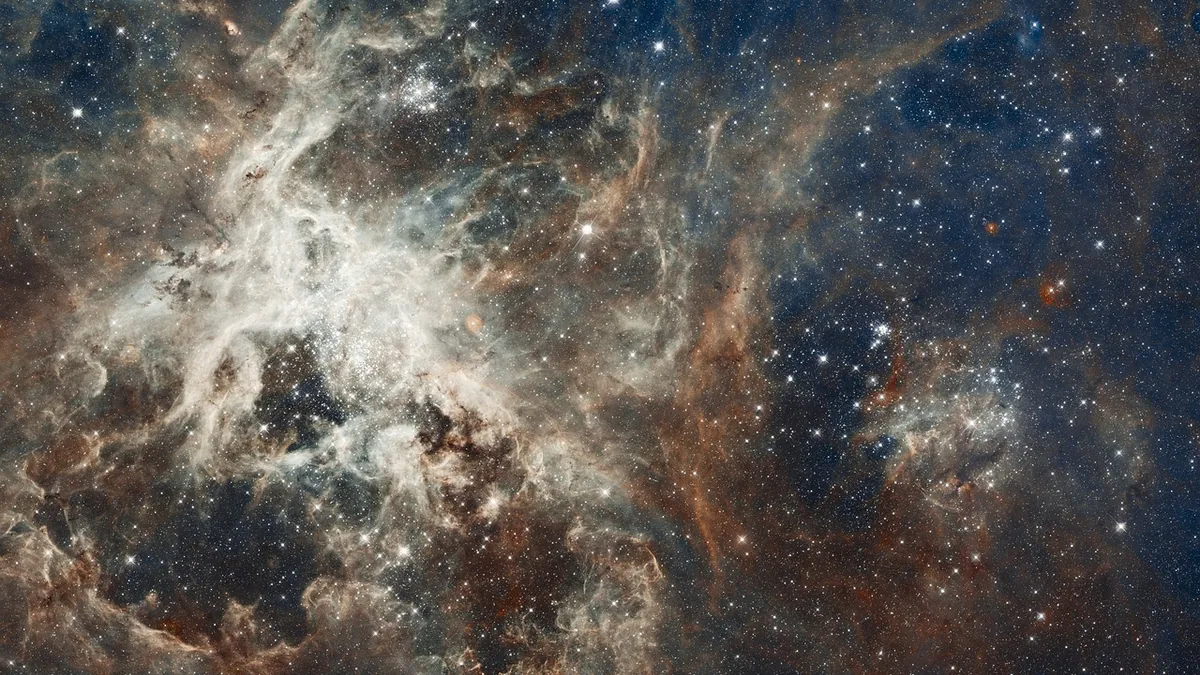
During the Great Dimming of late 2019 and early 2020, Betelgeuse’s brightness fell to its lowest recorded level in more than 100 years. Its extended atmosphere has since recovered. Months before the fading, the star ejected about a billion tons of solar material that partly blocked our view. A Matthews-led study detected unusually cool radio temperatures that researchers proposed came from a convection-driven shock wave disturbing outer gas.
At about 2.7 times Betelgeuse’s radius, gas now shows a brightness temperature near 3,500 Kelvin, close to the star’s surface, a sign the atmosphere has warmed since the Great Dimming. ALMA’s highest frequencies found a cool layer between the visible surface and chromosphere. It drops to roughly 2,200 Kelvin, over 1,000 degrees below the photosphere, confirming the MOLsphere temperature minimum in a molecular gas layer.
Siwarha means “her bracelet” from Arabic siwar, while Betelgeuse derives from an Arabic expression meaning “the hand of al-Jawza.” The International Astronomical Union’s Working Group on Star Names assigned the name on September 22, 2025, proposed by Steve Howell of NASA Ames Research Center.
Whether Siwarha is gravitationally bound to Betelgeuse remains undetermined, astronomers said. Montargès said a confirmatory observation on the opposite side of the star is still needed, with little space left for doubt. The companion should reach greatest elongation on the opposite side in late 2027, which would settle the question.
Betelgeuse is currently eclipsing Siwarha from Earth’s viewpoint, so astronomers are planning observations for the companion’s next emergence in 2027. Siwarha will not reappear until August 2027. More observations covering more of Siwarha’s orbit, particularly at radio frequencies not yet studied extensively, could confirm the orbital link. The Next Generation Very Large Array under development should help.
ESO’s Extremely Large Telescope is under construction at Cerro Armazones about 20 kilometers from Paranal. It will eventually provide sharper views for precise mass, orbit, and brightness measurements. The current dataset spans 2021 to 2026, but a wider orbital range would strengthen the case.
Siwarha orbits at roughly 2 to 2.5 times the star’s radius, inside the extended outer atmosphere where tidal forces are strong. Binary models say tidal forces will pull Siwarha inward over the next tens of thousands of years. Betelgeuse could engulf Siwarha before the supernova, changing whether the explosion strips hydrogen or produces a different subtype than standard Type II.
Andrea Dupree said Montargès keeps calling it a candidate, but some researchers are more confident that the companion is real. Goldberg, Joyce and collaborators suggest that what observers see is Betelgeuse’s light bouncing off dense dust clumps stirred by Siwarha, not the companion itself.
If that idea is right, the companion may weigh less than the originally assumed 2–3 solar masses and stay hidden in ultraviolet light. Heavily polarized light could test the dusty scenario. Earlier Hubble far-ultraviolet and Chandra X-ray searches found nothing, and a 2025 Gemini North speckle imaging attempt gave only a tentative 1.5-sigma result before VLT/SPHERE succeeded.




Join the discussion