Key facts
- The angle between a star's spin axis and its planets' orbital axis is stellar obliquity, offering clues about spin-orbit evolution, said Lauren Biddle, a Princeton University astrophysicist, by email.
- Brendan Bowler and Biddle compared stellar axial tilt against orbital tilt for 114 single sunlike stars, in work The Astronomical Journal has accepted.
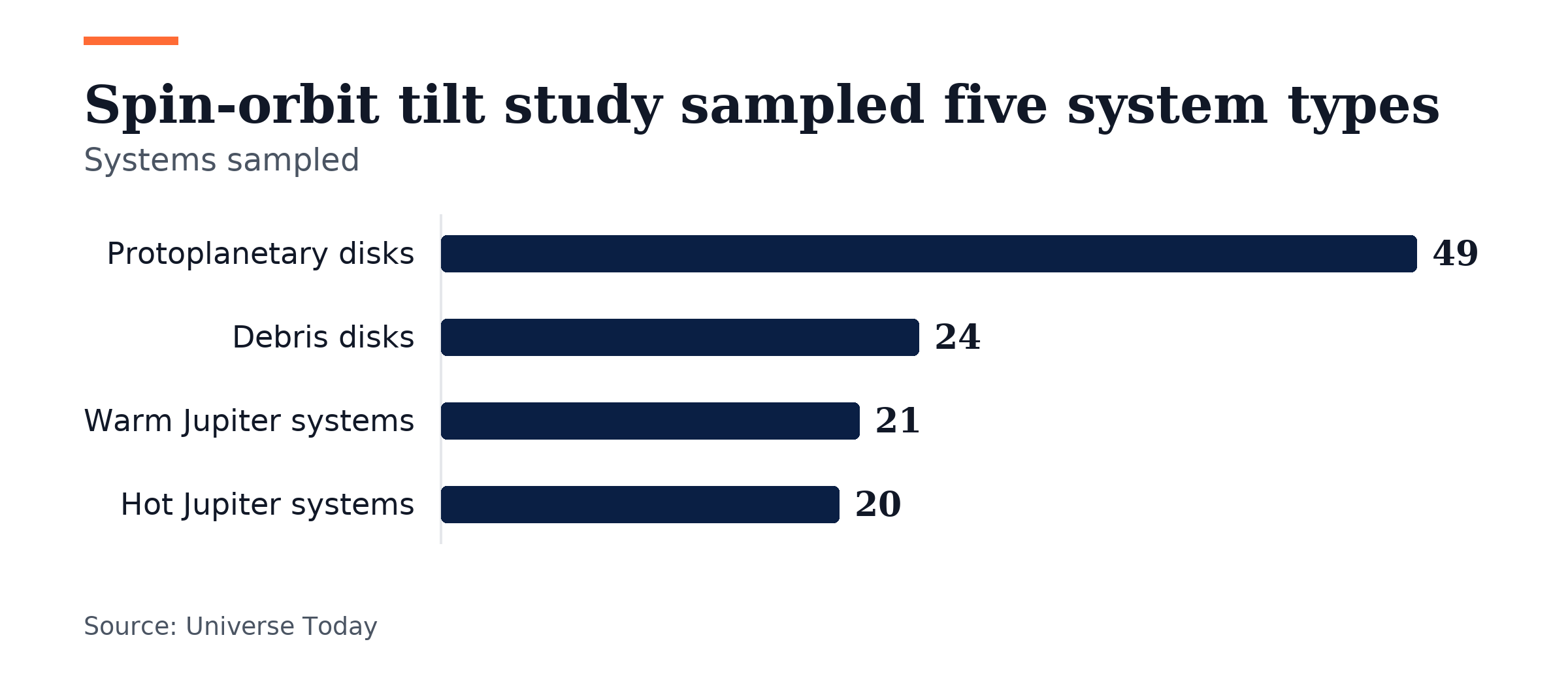
- They sampled 21 warm Jupiter systems in which gas giants circle their stars on orbital periods between 10 and 100 days.
- They sampled 20 hot Jupiter systems.
Brendan Bowler and Lauren Biddle compared stellar spin and planetary orbital tilts across 114 single sunlike stars, in research Universe Today reported on Nov. 24, 2026, and accepted for publication in The Astronomical Journal.
Stellar obliquity is the tilt of a star’s axis measured against the disk of material around it, or the angle between the star’s spin axis and its planets’ orbital axis. Solar-type stars show many different tilts across space and time, leaving the influence of a starting tilt on planet formation as an open question. Biddle, an astrophysicist at Princeton University, explained by email that this relationship preserves clues about how those orientations evolve over a system’s life.
Bowler and Biddle compared stellar axial tilt against orbital tilt for 114 single sunlike stars, in work The Astronomical Journal has accepted; that comparison of stellar inclinations with orbital inclinations across 114 single sunlike stars is the central comparison in the paper. The sample included 49 protoplanetary disk systems in which planets were just beginning to form around nascent stars, 24 debris disk systems surrounded by disks containing gas, dust, and rocky planetesimals, 21 warm Jupiter systems with gas giants on orbital periods between 10 and 100 days, and 20 hot Jupiter systems. The 21 warm Jupiter systems add gas giants on intermediate-period orbits spanning 10 to 100 days to the sample’s range of separations.
Hot Jupiters are gas giants on very short orbits; they were the first exoplanets found around sunlike stars, typically orbit in less than ten days, and at least one orbits its star in only 16 hours. Biddle noted that the processes driving stellar obliquity changes may depend on both a planet’s distance from its star and the system’s age, which is why the sample spans different separations and ages. The work tests for obliquity evolution across space by comparing spin-orbit angles at different orbital distances and across time by comparing systems of various ages, Biddle said.
The results show stellar obliquities are similar across orbital separation and across system age, Universe Today reported on Nov. 24, 2026. Biddle said that means large orbital changes are rare once planets form, and any changes that occur remain beyond what current data can detect.
She said systems classified as misaligned each show tilts of at least 10 degrees. Misaligned systems average roughly 30 degrees to 50 degrees, she said. She characterized large stellar-obliquity changes as rare across the systems studied.
Biddle said some theories predict big shifts in planetary orbital inclinations over time, driven by gravitational tugs from other planets or stars or by tidal forces on hot Jupiters from the host star. She said the observations do not match that prediction, since young and old systems show similar fractions of misaligned orbits.
She defines stellar misalignment as the star’s spin axis pointing away from its planet’s orbital axis. She said alignment means the star’s equator lies in the same plane as the planet’s orbit, comparable to a spinning top sitting at the middle of a hula hoop. Misalignment means the star’s spin axis points away from the orbital plane instead of lining up with it, she said. Observational limits let researchers measure only the minimum angle between the star’s tilt and the orbit’s tilt, so the actual misalignment may exceed the measured value.
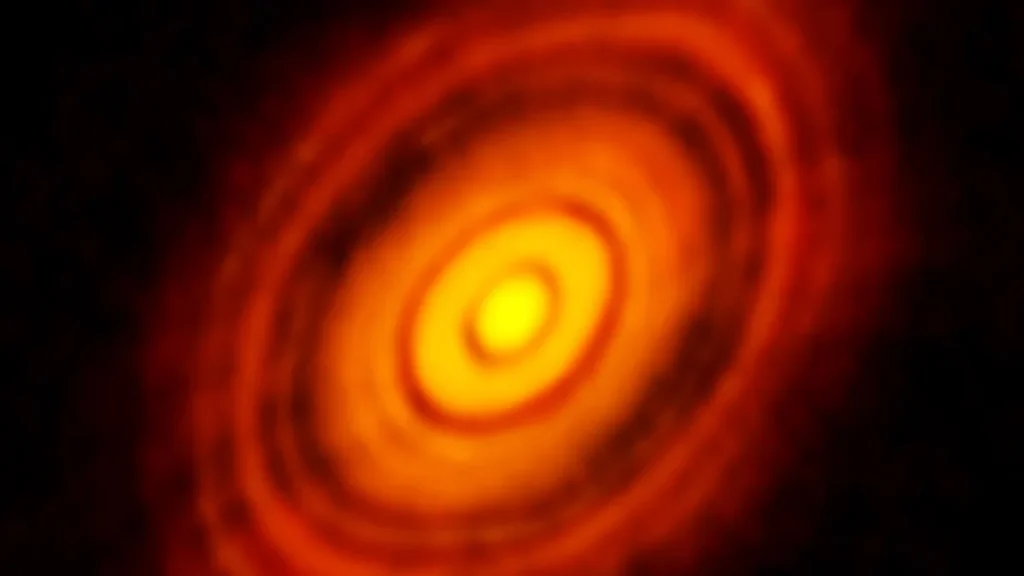
She said the sample covered single, cooler stars hosting transiting giants and left out close companions, hot stars, small planets, and widely orbiting non-transiting giants, meaning large tilts could be common in excluded categories. The article’s illustration depicts HD 113766, a binary system about 424 light-years away and roughly 10 to 16 million years old, in which a rocky planet may be forming around one star; binaries are among the populations excluded from the study sample.
Before exoplanet discoveries, ideas about alignment came only from the Solar System, where planets mostly share the Sun’s plane and the largest planets orbit farthest out, making misaligned close-in giants a surprise, according to Biddle. The planets in our solar system are pretty much coplanar, Biddle said.
The Sun’s spin axis is offset by roughly 6 degrees from the mean orbital plane of the planets and dwarf planets, according to Biddle. It is unknown to Biddle whether the Sun was born with its axial tilt. If the Sun began aligned, Biddle said, possible explanations for its later tilt include a past fly-by of another star, pulls from an undiscovered distant planet, stellar-wind torques, and internal gravity waves.
Biddle stated that no evidence shows stellar obliquity by itself affects planetary habitability. She said obliquity instead reveals planet-formation history and a planet’s final position around its host star, both of which matter greatly for habitability.
She told Universe Today, “There isn’t evidence that stellar obliquity itself affects planetary habitability”. The study examined single, cooler stars hosting transiting giants, a population where large obliquity changes appear rare. It excluded small planets and widely orbiting non-transiting giants, categories in which large tilts could still be common.



Join the discussion