Key facts
- The study uses IBEX-Hi data gathered from 2009 to 2022 to follow lobe motion through a complete 11-year solar cycle and beyond.
- Dr. Maher Dayeh, the lead author and a SwRI Space Science Division senior manager, said the tail's energetic neutral atom output rises, fades and relocates as the solar cycle progresses, after a lag of a few years.
- The data reveal four heliotail lobes in a four-leaf clover pattern, with two zones of higher energetic neutral atom emissions and two zones of lower emissions.
- Dayeh said the Sun reshapes the heliosphere's tail in a predictable way, and the traced paths give models new information for interpreting future heliotail observations.
A SwRI-led study published 30-Oct-2026, mapped distinct motion paths of the solar system’s heliotail lobes using 14 years of data from NASA’s IBEX spacecraft in Earth orbit.
IBEX-Hi is a sensitive imager that detects energetic neutral atoms created when solar-wind ions take electrons from cold interstellar neutral atoms, allowing remote imaging of otherwise invisible heliotail plasma. The study used IBEX-Hi data gathered from 2009 to 2022 to follow lobe motion through a complete 11-year solar cycle and beyond. The solar cycle tracks the Sun’s magnetic activity as it rises and falls in a pattern lasting about 11 years, with solar minimum at the start and end and solar maximum near the middle. At solar maximum the Sun’s magnetic field becomes complex and disordered.
The data reveal four heliotail lobes in a four-leaf clover pattern, with two zones of higher energetic neutral atom emissions and two zones of lower emissions. Tracking the lobes reveals how solar activity shapes the heliotail, the wake-like trailing region of the heliosphere. Scientists describe the heliotail as a trailing wake-like region of the heliosphere, a vast bubble made when solar wind meets interstellar plasma around the solar system. The paper summarizes 14 years of data showing each lobe’s location, shape and motion path during the solar cycle.
Dr. Maher Dayeh, the study’s lead author and a senior manager in SwRI’s Space Science Division, said the tail’s energetic neutral atom output rises, fades and relocates as the solar cycle progresses, after a lag of a few years. “The data show us that the tail’s ENA emissions surge, fade, and shift position as the solar cycle progresses, with a few years delay,” Dayeh said. He said the Sun reshapes the heliosphere’s tail predictably, and the traced paths give models new information for interpreting future heliotail observations.
Several competing models currently disagree about the shape of the tail, and the study’s authors say their mapping of solar cycle-driven lobe motion is meant to improve models and support future observations. Dayeh said the study maps solar-cycle-driven lobe motion to build a framework for reading future observations across solar cycle phases.
McComas said in 2018 that linking solar changes to energetic neutral atom observations clarifies long-term space radiation hazards because the expanding and contracting bubble affects how many cosmic rays enter the heliosphere, endangering astronauts. He described this as understanding space climate rather than space weather, with consequences for long-duration human spaceflight. McComas also said future IBEX data over the next few years will allow researchers to map how the heliosphere’s outer edges grow and change.
Dayeh said IBEX data establish the baseline for future studies by the IMAP mission, which is NASA‘s Interstellar Mapping and Acceleration Probe. According to Dayeh, IMAP launched in September 2025 and functions roughly 1 million miles (1.6 million kilometers) nearer to the Sun than Earth. IMAP uses energetic neutral atoms to map the heliosphere’s boundaries in detail and study the solar wind’s interaction with interstellar space. The spacecraft carries ten instruments, including the Compact Dual Ion Composition Experiment built by SwRI for studying solar-wind particles and energetic particles from solar storms that drive space weather.
NASA selected the IBEX mission in November 2003 after Southwest Research Institute, based in San Antonio, Texas, proposed it as a Small Explorer-class microsatellite and technology demonstration. SwRI received official confirmation from NASA/HQ in May 2006 to proceed into the mission implementation phase. IBEX launched on October 19, 2008, aboard a Pegasus-XL rocket released from a Lockheed L-1011 aircraft that departed Kwajalein Atoll in the South Pacific.
IBEX was launched into a highly elliptical orbit with a perigee of 7,000 km and an apogee of 50 Earth radii (RE; 319,000 km), 11-degree inclination and a 7.5-day period. In June 2011 the spacecraft moved to a more efficient 3:1 resonant orbit with perigee above 7.3 RE and an initial period of 9.03 days. IBEX science operations take place only when spacecraft altitude exceeds 10 RE, since the spacecraft must operate beyond the area where the Sun’s interaction with Earth’s magnetic field generates energetic neutral atoms.
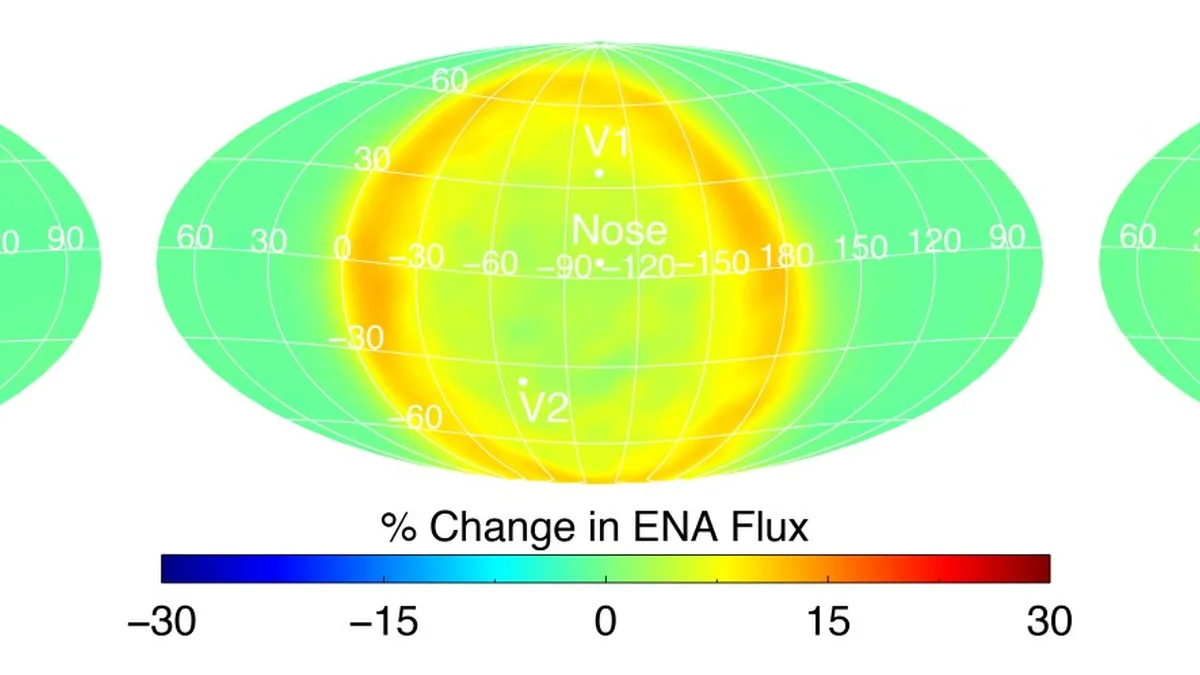
The heliosphere contains all the planets and much of the surrounding space, separating the Sun’s domain from interstellar space, with edges that arc around the Sun like a comet’s tail. The termination shock lies roughly 9.3 billion miles from Earth in every direction, marking where the solar wind slows abruptly before moving outward in a hotter state. Beyond that boundary lies the heliosheath, where some energetic neutral atoms form and travel ballistically back to Earth for IBEX to detect.
NASA spacecraft detected in late 2014 that solar wind pressure rose by about 50 percent and stayed elevated for several years. Two years later IBEX detected the first sign of the aftermath as particles from that pressure increase reached the heliosphere’s edge, became neutral, and returned to Earth. David McComas, IBEX principal investigator at Princeton University, said the 2014 solar wind pressure increase moved from the Sun to the outer heliosphere, changing and enlarging its boundaries toward the front.
In late 2016 IBEX’s energetic neutral atom imager recorded an unusually strong signal from about 30 degrees south in the interstellar upwind direction, where the heliosheath is nearest Earth. McComas and his team investigated the cause of that signal, linking it to the 2014 solar wind pressure increase using numerical simulations. A paper published March 20, 2018, in the Astrophysical Journal Letters reported findings connecting the late 2016 IBEX signal to the 2014 solar wind pressure increase.
Computer simulations described by NASA on June 6, 2018 indicated that three years after the 2014 pressure increase the termination shock should expand by seven astronomical units, or Earth-Sun distances, and the heliopause, the heliosphere’s outer edge, by two astronomical units. Simulations show a pressure wave from the termination shock rebounds at the heliosphere’s edge, forcing particle collisions in the denser heliosheath where IBEX’s energetic neutral atoms were born. As the 2014 solar wind reaches more distant points of the heliopause, the particles take longer to bounce back, creating an echo that forms a ring because of the heliosphere’s rounded shape.
Zirnstein and colleagues modeled the heliosphere eight years after the 2014 pressure increase in a paper published May 30, 2018, in The Astrophysical Journal. Using the same data and simulations as the earlier paper, the researchers ran the clock forward to study the heliosphere’s evolution after the pressure increase. Eric Zirnstein, lead author of one paper, said the heliosphere’s precise shape remains very much up for debate among modellers.
Scientists should see a ring expanding across the sky toward the heliotail directions, and if the heliosphere were an ideal comet shape the ring would expand symmetrically, but it probably will not, Zirnstein said in 2018. “We could estimate the distances to the different boundaries of the heliosphere just by looking at this ring changing over time in the sky,” Zirnstein said. Tracking how the ring changes over time could reveal distances to different boundaries and expose any asymmetries in the bubble’s shape.
Zirnstein said in 2018 that he hopes more IBEX data over the next few years will let scientists build a 3D picture of the heliosphere’s shape. Tracking how the ring changes over time could reveal distances to different boundaries and expose any asymmetries in the bubble’s shape. IMAP, launched in September 2025, will use energetic neutral atoms to map the heliosphere’s boundaries and study the solar wind’s interaction with interstellar space, building on the baseline established by the 14-year IBEX data set.

Join the discussion