Key facts
- The authors find that most sampled planets line up with debris disks to within 10 degrees, covering orbital spans from 0.1 to 100 astronomical units, with 30 of 32 planets in agreement.
- The Astrobiology Web summary of the preprint says the planetary orbits are also aligned with their host stars' equators, echoing the solar system.
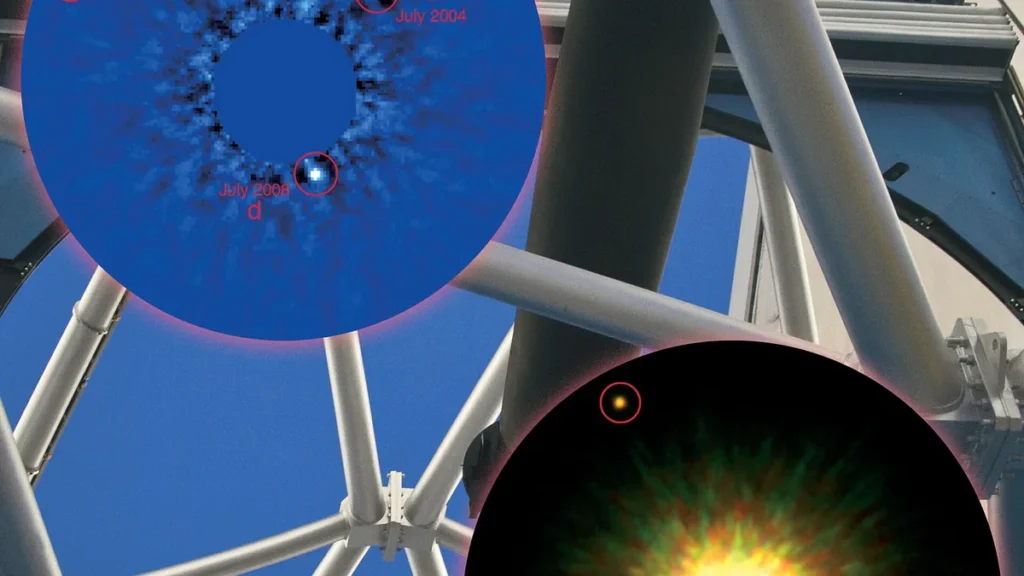
- Researchers supply the first population-level gauge of how 32 planets in 16 systems are tilted against nearby debris disks.
- The posted manuscript is a preprint sent to Science Advances, and the arXiv copy keeps the original text without changes from reviewer feedback.
Researchers led by Jingwen Zhang found that most sampled exoplanets line up with their systems’ debris disks to within 10 degrees across 16 systems, according to an Astrobiology Web summary of a preprint posted Nov. 12, 2026.
The researchers called the work a population-level gauge of planetary tilt against nearby debris disks, and they described it as the first constraint of its kind for a full population of planets and systems. Astrobiology Web published its summary of the preprint Nov. 17, 2026.
The Astrobiology Web summary ties this alignment to the local arrangement of planets, the Kuiper Belt, and the Sun’s equator in our own system.
The work treats planetary layouts as records of how systems form and evolve, measuring the exoplanet result against the solar system’s lineup of planets, the Kuiper Belt, and the solar equator. The planets, the Kuiper Belt, and the Sun’s equator line up closely in our own system, an arrangement tied to formation from a disk. The local case helps interpret planet formation from a rotating disk made of gas and dust.
The authors posted the manuscript to arXiv on Nov. 12, 2026, and submitted it to Science Advances. The arXiv version retains the original text without revisions from reviewer feedback. The arXiv comments say the paper went back to Science Advances as the original submission, without peer-review changes.
The sample includes systems that are tens of millions of years old, along with systems a few gigayears old. Because the group includes both young and old systems, the authors read the alignment as a signature of birth conditions rather than a temporary arrangement. They also describe the orderly solar system layout as typical of the starting conditions for exoplanet systems. The authors base that conclusion on how the exoplanet-disk alignments match the local lineup of planetary orbits, the Kuiper Belt, and the solar equator.
Not every system fits the neat pattern. Some exoplanet systems have worlds on skewed paths compared to their stars or nearby planets, leaving it unclear whether the mismatch started at birth or came later. The paper raises this as an open question about whether tilted orbits are primordial or produced by later dynamics.
The authors are Jingwen Zhang, Maxwell A. Millar-Blanchaer, Brendan P. Bowler, Tim D. Pearce, Marvin Morgan, William Thompson, and Dori Blakely. Zhang is the submitting author. Zhang uploaded Version 1 on Nov. 12, 2026, at 19:00:11 UTC, which was a Thursday.





Join the discussion