Key facts
- NIT Srinagar announced it will open India's first NIT-based campus observatory, according to officials on Monday September 21, 2026.
- The observatory, designated NIT-Srinagar Observatory for Astronomy and Astrophysics (NSOAA), is scheduled for inauguration on Tuesday September 22, 2026.
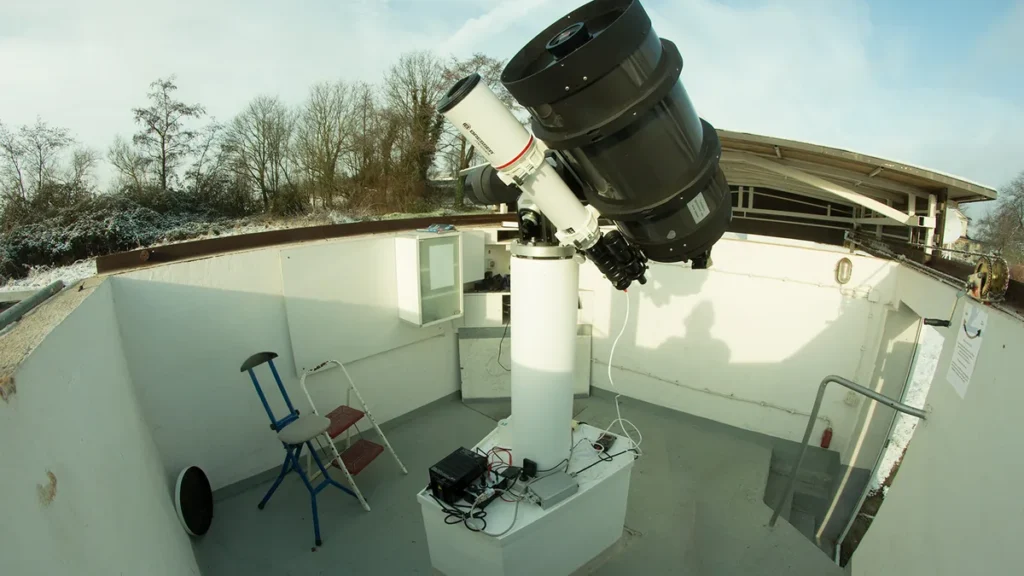
- Its centrepiece is a 14‑inch Celestron C14 EdgeHD Schmidt‑Cassegrain telescope that produces flat‑field images free of optical aberrations, making them suitable for astrophotography and planetary observation.
- Development of the observatory involves scientific guidance and collaboration from the Indian Institute of Astrophysics (IIA) in Bengaluru.
NIT Srinagar announced on Monday September 21, 2026 that it will open India’s first NIT-based campus observatory. Inauguration is scheduled for Tuesday September 22, 2026. Its centrepiece is a 14‑inch Celestron C14 EdgeHD Schmidt‑Cassegrain telescope (a design using mirrors and lenses for compact, high‑quality images) that produces flat‑field images free of optical aberrations, suitable for astrophotography (the practice of capturing images of celestial objects) and planetary observation.
The telescope system incorporates planetary and cooled deep‑sky cameras (cameras for imaging planets and faint deep‑sky objects, with cooling to reduce noise), LRGB filters (filters that isolate red, green, blue and luminance light for color imaging), a 2.5× Barlow lens (an optical element that increases the telescope’s effective focal length for higher magnification) and high‑speed imaging capabilities (capturing images at fast frame rates to study rapid phenomena). These capabilities allow observations of objects ranging from the Moon and planets to nebulae, star clusters and distant galaxies.
Development of the observatory involves scientific guidance and collaboration from the Indian Institute of Astrophysics (IIA) in Bengaluru. Dr Niruj Mohan Ramanujam, Scientist F and head of the Science Communication, Public Outreach and Education section (a division focused on educating the public and communicating science) at IIA, serves as an adviser and collaborator on the project.
Prince Ahmad Ganai, Professor and Head of the Department of Physics at NIT Srinagar, leads the observatory initiative. Ganai said the goal is to give students a venue to go beyond textbook learning and engage directly in astronomical observations, data collection and scientific analysis. He said he hopes the observatory will spark curiosity, promote research and foster a stronger astronomy and astrophysics culture across Jammu and Kashmir.
Officials describe the observatory as more than just a telescope site, intending it to serve as a hub for hands‑on science education, imaging practice, research projects, student training and public outreach. Ganai added that the facility may serve as a regional hub linking educational institutions and amateur astronomers throughout Jammu and Kashmir to contemporary astronomy practices.
Planned activities include regular sky‑watching sessions (observing the sky with telescopes or the naked eye), student workshops, teacher training programs and public viewing events intended to make astronomy more accessible to youth and inspire studies in physics, space science and astrophysics. The institute plans to introduce a practical astronomy and astrophysics course soon (a course focusing on hands‑on learning of astronomical observation and analysis), with dedicated slots for schools, colleges and universities across the Kashmir Valley within its outreach activities.
NIT Srinagar joins a limited group of Indian technical colleges that maintain sizable on‑campus astronomy observatories (facilities located within college campuses used for observing celestial objects). Officials cited the Indian Institute of Technology Kanpur as an example, noting it operates a 14‑inch Schmidt‑Cassegrain observatory (a design using mirrors and lenses for compact, high‑quality images) equipped with CCD imaging (a sensor that converts light into electronic signals for digital images) and remote‑operation capabilities (the ability to control the telescope from a distance).





Join the discussion