Key facts
- Francis Halzen of the University of Wisconsin–Madison received the 2026 Nobel Prize in Physics for IceCube and high-energy astrophysical neutrinos.
- IceCube detects neutrinos when collisions in the ice produce faint Cherenkov light recorded by thousands of sensors.
- Scientists are not sure where all astrophysical neutrinos come from.
- A study published in October 2026 in The Open Journal of Astrophysics proposes using radio telescopes to find astrophysical neutrino sources.
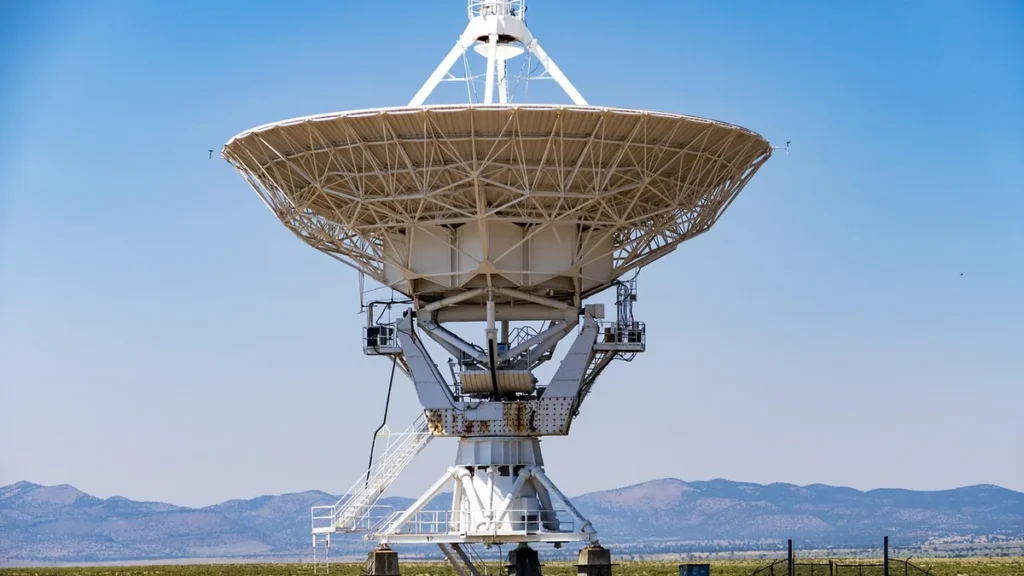
In October 2026, The Open Journal of Astrophysics published a paper by Yjan Gordon et al. that proposes using radio telescopes to find the cosmic sources of high-energy neutrinos. The study carries DOI 10.33232/001c.172273. Its authors, including an IceCube physicist, compared neutrino detection times from IceCube with radio flare times from the Very Large Array’s VLASS survey and found coincidences above random expectation. They describe the signal as intriguing but not yet conclusive, and they expect more observations in the coming years to test whether the link is real.
Neutrinos are subatomic particles that carry no electric charge, have almost no mass, and travel close to the speed of light. Solar reactions, radioactive decay, and collisions involving cosmic rays produce them. To put this in perspective, about 65 billion solar neutrinos pass through a person’s little fingernail every second, and trillions pass through human bodies without leaving a trace.
Magnetic fields do not deflect neutrinos, so their arrival direction indicates where they came from. By contrast, magnetic fields bend charged cosmic rays, so they cannot reveal their origins so directly. Cosmic rays are particles, commonly protons, travelling through space, with some reaching Earth at energies beyond human particle accelerators. Neutrinos travel in nearly straight lines and may reveal cosmic-ray origins.
Scientists are not sure where all astrophysical neutrinos come from. The same trait that makes neutrinos useful for seeing obscured high-energy processes also leaves their origins uncertain. Because neutrino-producing processes such as subatomic-particle decay should also create high-energy gamma rays, scientists expect neutrino sources to produce gamma-ray outbursts.
Yet beyond a single well-known case, there is little evidence of a general relationship between gamma-ray outbursts and neutrino detections. In 2017, IceCube detected a neutrino from quasar TXS 0506+056 at the same time a telescope saw a gamma-ray outburst from that object. A black hole millions of times the mass of the Sun powers the quasar. However, TXS 0506+056 is only one object and may not represent where most high-energy neutrinos originate.
Dust and gas near supermassive black holes can block gamma rays from reaching Earth, but radio waves are not so easily shielded. If gamma-ray wavelengths hide a neutrino source but radio wavelengths do not, radio telescopes could become an essential tool in neutrino astronomy. More than 90% of radio outbursts potentially linked to neutrinos are not seen by gamma-ray telescopes.
IceCube operates at the South Pole, instrumenting roughly a cubic kilometre of Antarctic ice to detect neutrinos. A neutrino hitting an atom in the ice can spawn a muon moving faster than light in ice, creating a cone of Cherenkov light—the detectable flash produced when a charged particle moves through ice faster than light travels in ice. The detector’s 5,160 light sensors, mounted on 86 cables between 1,450 and 2,450 metres below the surface, record the arrival time and brightness of these faint flashes.
Software combines signals from many sensors to rebuild the particle’s trajectory and energy, inferring the neutrino’s direction. Some events create long tracks of light especially useful for estimating direction, while others produce compact flashes. IceCube registers more than 100 million cosmic-ray related particles and hundreds of atmospheric neutrinos each day, so researchers must separate the rare cosmic signals from this background.
Cosmic rays striking the atmosphere create particles that can enter the detector and imitate neutrino signals, but the overlying Antarctic ice absorbs much of this unwanted background while neutrinos pass through the Earth to reach the instrument. Deep ice is dark and transparent enough for faint flashes to reach nearby sensors, and its volume gives neutrinos many target atoms.
Building a conventional detector of IceCube’s size would be extraordinarily expensive, so scientists use the ice itself as both target and light medium. Crews lower sensor strings into deep boreholes, and the water surrounding them refreezes to lock the hardware permanently in place, making extraction impractical and requiring every instrument to function reliably from the start. Scientists monitor IceCube and analyze its data from research centres around the world.
AMANDA, IceCube’s predecessor, finished construction in January 2000 and demonstrated that the deep-ice detection method functioned, though the detector was too small to gather enough rare cosmic neutrinos. IceCube construction finished in 2010, and the team waited three years for the first anticipated detection. In 2013, IceCube reported its first evidence of high-energy cosmic neutrinos.
During September 2017, IceCube tracked a high-energy cosmic neutrino back to a distant galaxy located nearly four billion light-years from Earth. IceCube has since detected astrophysical neutrinos hundreds of thousands of times more energetic than previously detected neutrinos. Its observations have established that high-energy neutrinos arrive from beyond the solar system, including sources within and outside the Milky Way.
IceCube researchers have detected high-energy neutrinos associated with the Milky Way, thought to arise when cosmic radiation collides with atoms in interstellar gas.
Since 2017, the Very Large Array in New Mexico has monitored radio brightness variations through a project named VLASS. Most objects with fluctuating radio emissions seen by VLASS are quasars of the type IceCube has associated with neutrino production. Radio flares accompany about 13% of the astrophysical neutrinos detected by IceCube, leaving most origins unaccounted for by this method alone.
The probability that the observed neutrino-radio correlation arose by chance is roughly 1 in 30, which the authors liken to five consecutive coin tosses. Scientists want odds closer to one in a million before accepting the correlation as real, a standard equivalent to twenty consecutive coin tosses.
The authors expect more observations in the next few years to confirm whether the link is real. Identifying which types of objects produce neutrinos can tell astronomers about the physics occurring inside those objects. Radio-telescope data can match IceCube detections to candidate sky objects, and identifying those object types reveals the physics inside them.
High-energy neutrinos can form when particles accelerated to extraordinary energies collide with matter or radiation, helping scientists investigate natural cosmic accelerators. Active galaxies may host supermassive black holes surrounded by hot material that launches powerful jets of particles and energy, acting as cosmic accelerators. A neutrino from an active galaxy, especially with other signals, can help scientists test how the jet produces high-energy particles.
IceCube has found 79 neutrinos apparently arriving from active galaxy NGC 1068, also called M77, though the evidence is not yet definitive. Much of the energy from a collapsing massive star escapes as neutrinos, and a nearby supernova could spike IceCube activity before ordinary light gives a clear view.
A single neutrino detection does not automatically confirm a source; researchers must compare direction and timing with other telescopes and assess the statistical evidence. When IceCube registers a neutrino, astronomers can aim other telescopes at the same part of the sky to search for a galaxy, burst, or other indicator, weaving together clues for a fuller picture. Researchers hope high-energy neutrinos can reveal what happens near exploding stars, energetic galaxies, and other extreme cosmic environments. Neutrino data complement conventional telescopes, giving astronomy another way to study the universe without replacing existing methods.
IceCube is being upgraded, and scientists are planning larger future detectors to identify more neutrinos and improve measurements. A planned successor called IceCube-Gen2 would instrument about eight cubic kilometres of Antarctic ice, eight times the existing volume, to catch more rare high-energy neutrinos.
Teams are developing other neutrino observatories in Lake Baikal, the Mediterranean, the South China Sea, and off western Canada, complementing the South Pole ice detector. IceCube’s target is the energetic neutrino population tied to cosmic particle accelerators producing some of the highest-energy particles known.
The 2026 Nobel Prize in Physics recognized Francis Halzen of the University of Wisconsin–Madison for building IceCube and discovering high-energy neutrinos from space. The Royal Swedish Academy of Sciences awarded the prize “for decisive contributions to the IceCube Neutrino Observatory and the discovery of high-energy neutrinos of astrophysical origin.” Halzen is the first individual to receive the Nobel Prize in Physics alone in 34 years.
Halzen, a Belgian-born physicist at the University of Wisconsin–Madison, realized nearly four decades ago that South Pole ice could instrument neutrino detection. In the 1980s, he heard Soviet researchers were considering radio receivers in Antarctic ice for neutrino signals, so he began considering light detection instead. Physicists had proposed decades earlier that large bodies of transparent water could detect neutrinos.
Halzen discussed the idea with physicist John G Learned, involved in DUMAND, a project to look for neutrinos in deep ocean water off Hawaii. In 1988, Halzen and Learned presented the concept of a South Pole ice neutrino observatory at a conference in Poland. The South Pole offered a research station and logistics, plus deep ice that is dark, free of signal-creating creatures, low in radioactivity, stationary, and geologically stable, keeping sensor positions fixed.
Researchers can reach the South Pole only in the short Antarctic summer, roughly November to February, so glacier detector construction occurred in short annual bursts. Teams employed heated-water jets to bore deep holes, inserted detector strings into the water-filled boreholes, and allowed the water to refreeze, locking the instruments in place. Halzen compared the detectors to lightbulbs in reverse: they detect light and convert it into an electrical signal.
Researchers first tested sensors in Greenland before beginning South Pole work on AMANDA. Shallow ice contained air bubbles that scattered light, but beneath roughly 1,400 metres the ice became clear enough for flashes to travel around 300 metres before ice absorbs them. IceCube selects high-energy-neutrino interactions and analyzes them statistically by energy and arrival direction to test whether the pattern exceeds atmospheric explanations.
With more data, researchers concluded IceCube was really seeing neutrinos originating in distant regions of the universe. Neutrino astronomy began in the 1960s when Raymond Davis Jr detected solar neutrinos, and Masatoshi Koshiba’s team later developed ways to determine incoming neutrino direction. Davis and Koshiba shared part of the 2002 Nobel Prize in Physics for pioneering neutrino astrophysics.
Halzen’s proposal emerged in the 1980s, IceCube reached full scale in 2011, cosmic-neutrino evidence followed in 2013.

Join the discussion