Key facts
- Evidence for recoiling supermassive black holes has been hard to secure because researchers found some candidates, yet every case offered an alternate explanation for what was observed.
- LISA will serve as the first space-based observatory for detecting gravitational waves, using three spacecraft orbiting the Sun in an equilateral triangle with laser beams linking all three to detect the waves.
- Big galaxies contain supermassive black holes in their cores, and gravitational wave detectors show growing evidence that they merge when galaxies merge.
- A recoiling supermassive black hole merger remnant does not keep a steady speed, moving quickest near the galactic center and slowing down at the opposite end of the swing.
Researchers led by Bence Bécsy, an assistant professor in the School of Physics and Astronomy at the University of Birmingham, published statistical evidence for gravitational-wave recoiling supermassive black holes in Monthly Notices of the Royal Astronomical Society, Universe Today reported Oct. 22, 2026.
Big galaxies contain supermassive black holes in their cores, and gravitational-wave detectors show growing evidence that these black holes merge when their host galaxies merge. Astronomers think that sometimes the merger does not complete, and these non-merging remnants are called recoiling supermassive black holes. The authors describe large galaxies as known hosts of supermassive black holes at their centers, with gravitational-wave detectors gathering growing evidence that these black holes merge when their host galaxies merge, while in some cases the merger does not complete.
Theoretical predictions say uneven gravitational waves can kick the merger remnant black hole away from the galactic center at between 360,000 km/h and 3.6 million km/h. The kick produces pendulum-like motion rather than the remnant leaving the galaxy entirely. A supermassive black hole merger takes a long time and releases powerful gravitational waves in its final moments. The remnant does not leave the galaxy entirely but swings back and forth across the galactic center.
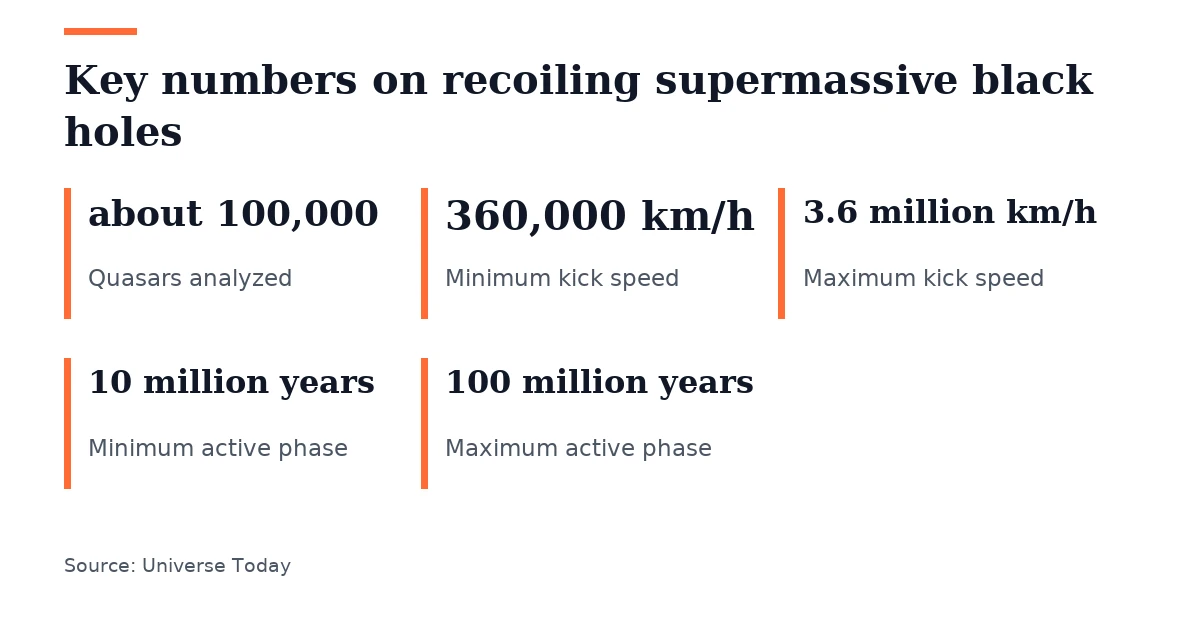
A recoiling supermassive black hole merger remnant does not keep a steady speed, moving quickest near the galactic center and slowing down at the opposite end of the swing. This variation in speed matters because it connects motion to the observable dust and velocity signal. The authors expect a recoiling supermassive black hole to keep the inner region of its accretion disc and stay active as a quasar, an extremely bright active galactic nucleus powered by an accreting supermassive black hole, with detectable merger signatures for between 10 million and 100 million years after the merger.
Quasars are the brightest active galactic nuclei, consisting of supermassive black holes that are actively accreting material. These bright objects are active galactic nuclei driven by supermassive black holes consuming matter, and their brightness helps astronomers find them. Their high luminosity makes them easier to find and observe. These bright objects stand out from other sources, which aids their detection and study even though many of their properties remain poorly understood.
The researchers searched about 100,000 quasars from the 16th data release of the Sloan Digital Sky Survey quasar catalogue, looking for a population-level signature connecting how much dust obscures the light to how far broad emission lines shift in velocity compared with the host galaxy.
Astronomers use spectrographs to detect a Doppler shift between light from the Broad Line Region, which moves with the recoiling supermassive black hole, and the Narrow Line Region, which remains at the galactic center, to determine the black hole’s speed. As a recoiling supermassive black hole oscillates, its speed varies with where it sits relative to the galactic center. The authors assume it moves with its Broad Line Region while the Narrow Line Region exhibits a redshift consistent with the host galaxy and dust torus. This assumption lets researchers compare light from the two gas regions to infer the black hole’s motion relative to the galaxy.
Dust around a quasar makes its light redder in an effect named extinction, and a redder quasar than comparable sources suffers more dust extinction, which researchers can measure with spectroscopy and photometry. Dust is thickest near the galactic center, where the remnant supermassive black hole moves fastest. Because dust concentrates near the center, the same region where the recoiling remnant moves quickest, the researchers reason that greater speed should correspond to greater dust reddening. This relationship forms the core of their statistical analysis.
The results show dust obscuration tracks black hole speed, with the fastest-moving group of quasars having an obscured fraction three times that of the slowest group. The authors say recoiling black holes would produce this relationship. They still find the pattern interesting in a big statistical sample despite noting that other phenomena could produce the same correlation.
Evidence for recoiling supermassive black holes has been hard to secure because researchers found some candidates, yet every case offered an alternate explanation for what researchers observed. The new work differs by not focusing on individual candidates and instead searching statistically for traces of an entire population of recoiling black holes. Previous efforts struggled because every candidate had an alternate explanation, so the approach abandons individual candidates and tests population-level predictions statistically instead.
Lead author Bence Bécsy said in a press release that proving a single quasar’s black hole was ejected is very difficult because other effects can create the same appearance. He said studying an entire population statistically let the team identify a relationship matching theoretical predictions. The team searched statistically for traces of an entire population rather than looking for individual candidates.
Professor Zsolt Frei, study co-author and head of the HUN-REN–ELTE Extragalactic Astrophysics Research Group, said that if the signal comes from ejected black holes, a pair of supermassive black holes merged not long ago in many quasars, making these events common. Frei said this sets the number LISA may detect. The statement links the signal to recent merger activity in a significant share of quasars.
According to the paper, gravitational-wave emission drives many supermassive black hole binaries through a final inspiral before they merge, and LISA should detect these events in the millihertz gravitational-wave band. In describing the expected behavior of merger remnants, the paper notes that many supermassive black hole binaries should complete their merger after inspiralling because of gravitational-wave emission, and that these events should be detectable by LISA in the millihertz gravitational-wave band.
More definitive proof for recoiling supermassive black holes might arrive with LISA, the Laser Interferometer Space Antenna, after its planned launch in 2035. LISA will serve as the first space-based observatory for detecting gravitational waves, using three spacecraft orbiting the Sun in an equilateral triangle with laser beams linking all three to detect the waves. LISA should detect recoiled supermassive black holes if the research is correct.
The authors write that the correlation might show a population of recoiling supermassive black holes, but alternative explanations remain possible, including winds, viewing angle, or other effects. They nonetheless describe the result as intriguing.

Join the discussion