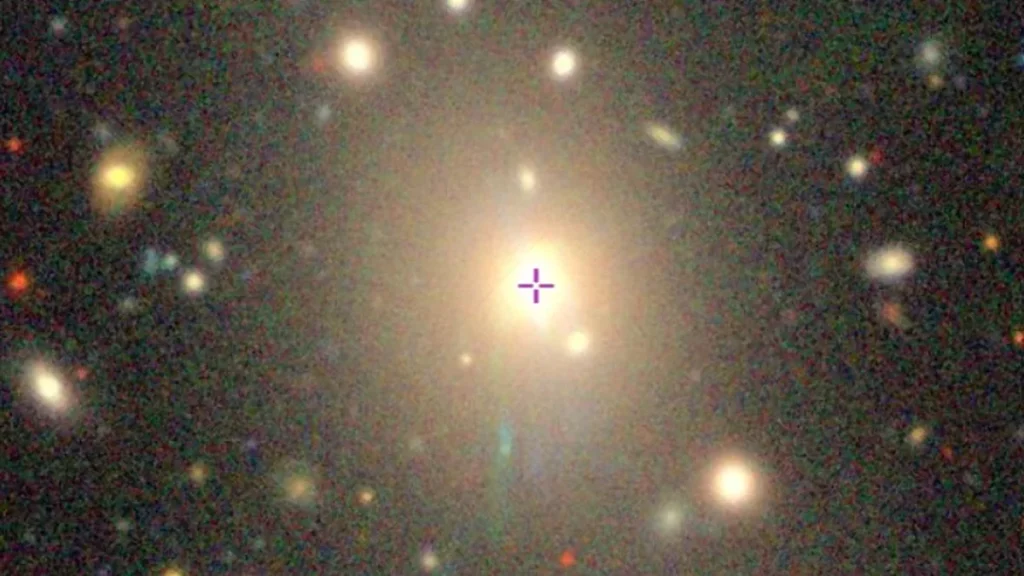
Andrea Botteon‘s team confirmed Oct. 24, 2026 that a massive galaxy cluster sits behind VLSS J0318.9+5755, a musical-note-shaped radio source hidden behind the Milky Way’s dusty disk. Sci.News identifies the source as the glowing remains of an ancient black hole outburst inside the colliding cluster. Sci.News places the cluster about 1.5 billion light-years away, while Mashable gives the distance as about 1.6 billion light-years.
The Treble Clef stretches about 2.5 million light-years and consists of thin filaments with a steep radio spectrum, meaning its emission fades rapidly as frequency increases. Radio observations revealed a bright network of narrow twisting strands, and comparing measurements at different radio frequencies showed how the source’s emission changes. The cluster weighs about 600 trillion times as much as our sun, a mass measured for the first time using Chandra and eROSITA X-ray data. The team estimates the plasma is around 190 to 200 million years old.
The astronomers classify VLSS J0318.9+5755 as a radio phoenix, an old, faded cloud of plasma that shines again after its radio glow dimmed. The researchers attribute the revival to gas motions stirred up in the colliding cluster environment, and they reconstruct the sequence from present-day observations.
The researchers said the Treble Clef likely formed in a two-stage process involving an earlier black hole outburst and a later cluster collision. The sequence began when an earlier outburst by a supermassive black hole in the cluster’s center expelled material carrying charged particles and magnetic fields at close to the speed of light. After losing energy, the particles left a dimmed cloud that could later respond when the cluster collision arrived. Next, the collision between the two clusters compressed or reenergized the cloud, which brightened again in radio waves.
Shock waves like sonic booms from supersonic jets may have played a role in the reenergizing process; the researchers compare cluster merger shocks to sonic booms, and these shocks may have helped revive the faded plasma cloud. The researchers say churning gas from the smashup sculpted the faded cloud into its treble clef appearance.
Early radio surveys picked up the object in the 1960s, and its location near the Galactic plane once led astronomers to suspect it was a pulsar. A 2004 study tentatively linked VLSS J0318.9+5755 to a galaxy cluster, but it had not been investigated further until now, and the object later faded from the scientific literature. The object popped up once more in a 2022 list of possible X-shaped radio sources before new LOFAR data revealed its twisting structure clearly.
Radio telescopes see through the gas and dust that block ordinary telescopes, which is especially valuable because foreground stars, gas and dust in the Milky Way obscure the system in ordinary visible light, making radio and X-ray methods especially valuable for seeing through the obscuration. LOFAR’s long-wave network captures sharp images, resolving blurry smudges into detailed filament structures.

The team modeled the hot gas as a smooth oval, subtracted it from the X-ray image, and found excess emission on opposite sides supporting a collision direction. Galaxy clusters contain hundreds of galaxies alongside quantities of hot gas, and when clusters collide the encounter stirs and compresses the gas and can change energetic particle behavior, reshaping the hot gas and particle populations. The researchers estimate the clusters’ direct encounter occurred a few hundred million years ago.
The object ranks among the most extreme faint, spread-out radio glows ever found in hot gas between a cluster’s galaxies. The delicate threads could help crack a bigger puzzle about how cosmic rays travel through clusters, but scientists still debate what keeps them shining. Mashable says the merger may have produced a broad, dim central radio haze called a radio halo, though the Giant Metrewave Radio Telescope remains the only instrument to detect it so far. The nickname reflects a visual pattern seen by human observers, not any actual link to music.
The researchers describe a sequence in which an early black hole jet burst is later revived by a cluster collision, showing how outbursts can shape the hot gas during mergers. Radio surveys pierce the dusty disk to reveal structures optical telescopes cannot see, offering a view of particle clouds hidden behind the Milky Way.
The team’s paper is in press at the journal Astronomy & Astrophysics. The preprint carries arXiv identifier 2607.06659.




Join the discussion