Key facts
- The data come from observing programs 5058 and 6882, led by researchers L. Furtak and S. Fujimoto.
- Current cosmological models suggest early galaxies grew via mergers, becoming elliptical/lenticular galaxies observed near the Milky Way.
- Scientists use gravitational lensing with Webb; Webb's huge 6.5-meter primary mirror enables the detection of faint lensed sources.
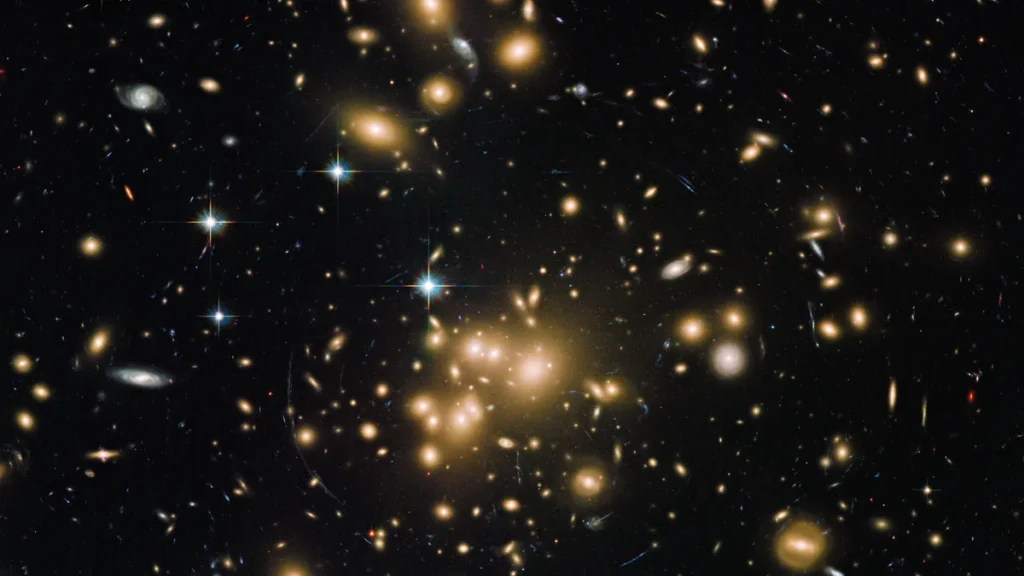
The NASA/ESA/CSA James Webb Space Telescope released its Picture of the Month on Oct. 19, 2026, showing the galaxy cluster MACS J0454.1-0300 with brilliant golden galaxies in great detail.
MACS J0454.1-0300 lies five billion light-years away. The golden galaxies belong to a cluster that existed when the Universe was roughly eight billion years old.
Analysis of the JWST image shows that the cluster magnifies some background objects by more than 300×, and the magnification factor comes from the gravitational lens model, not from any conventional zoom in Webb’s optics. The cluster creates a rare alignment that produces four or more separate images of one galaxy, seen twice – a configuration not previously observed with a single galaxy cluster. The image shows orange arcs that are actually background galaxies far more distant than the cluster.
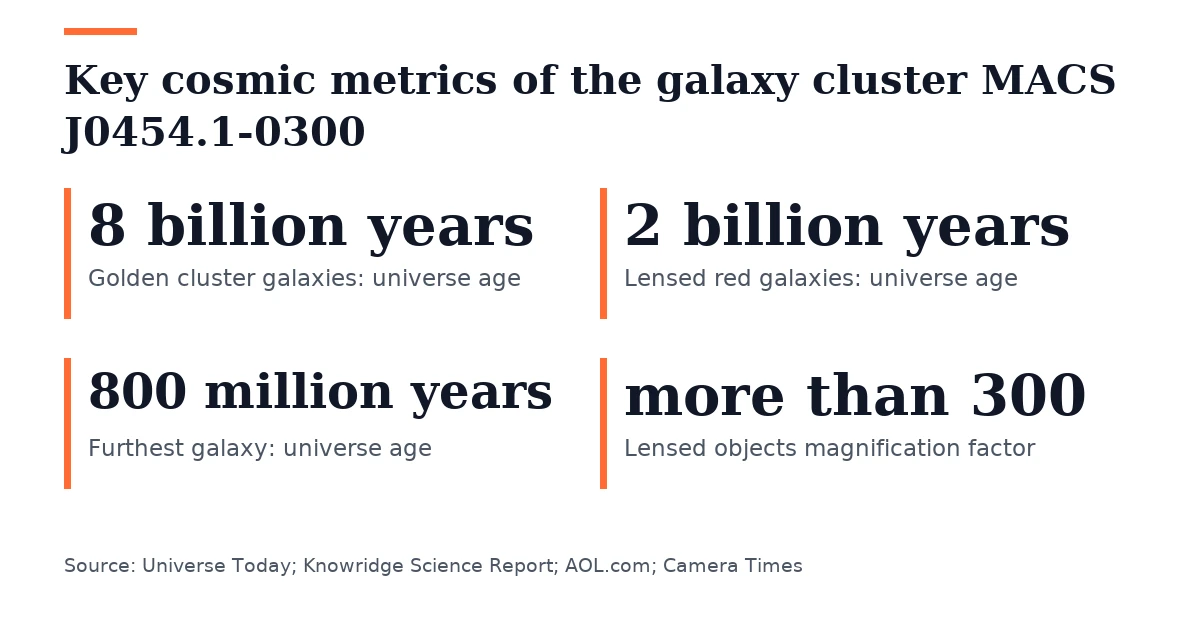
Included are a group that existed when the Universe was roughly two billion years old and a single galaxy observed when the Universe was only 800 million years old, both of which exhibit signs of merger‐driven star formation. ESA’s Webb team has described the view as a ‘cosmic house of mirrors,’ noting how the galaxies appear warped and multiplied by the cluster’s gravity. Such configurations arise when the lensing alignment creates multiple light paths, producing duplicate images of the same background source.
Compared with Hubble observations from 2014, the Webb image reveals hundreds of additional galaxies that were missed because the telescope’s near‐infrared sensitivity captures redshifted light invisible to Hubble. Hubble imaged the same cluster area twelve years ago, and the new Webb data demonstrate an advancement in capability.
The image is a NIRCam composite made from ten filters spanning 0.9 to 4.44 micrometres, assigning colours to different wavelengths so that the final picture represents a measurement of infrared emission rather than what the eye would see. Published colours organize information from the filters and should not be mistaken for an unaided‐eye view of the field. The data come from observing programmes 5058 and 6882, led by researchers L. Furtak and S. Fujimoto.
Furtak’s team searches for magnified individual stars in the early Universe, while Fujimoto’s program studies the onset of star formation in galaxy clusters. These programs enable the study of lensed galaxies down to scales of just a few light-years. Together, the programs allow researchers to examine magnified individual stars and the early stages of galaxy formation across cosmic time.
The cluster’s great mass warps spacetime, acting as a natural magnifying glass that bends and amplifies light from far‐away galaxies. This effect, combined with Webb’s 6.5‑meter primary mirror, lets astronomers detect objects that would otherwise be too faint or distant to see. Webb detects the photons after the deflection, with the light having traveled along curved spacetime paths before reaching the telescope.
Scientists regularly use gravitational lensing to see objects that would otherwise be invisible to telescopes. When combined with next‐generation instruments like Webb, lensing has opened new windows into the cosmos, enabling the detection of record‐breaking distant galaxies.
The galaxy observed just 800 million years after the Big Bang shows signs of a merger that set off a powerful burst of star formation. A grouping of galaxies seen roughly two billion years after the Big Bang is undergoing a merger and intense star formation. These observations fit with cosmological models that propose early galaxies grew via mergers, eventually becoming the elliptical and lenticular systems observed near the Milky Way. The cluster’s light travel time shows we see it at an early cosmic epoch, providing insight into its stellar population and mass distribution.
Join the discussion