Key facts
- Powerful relativistic jets launched by supermassive black holes are made of extremely hot plasma and are observed in systems such as 3C 120 and in radio galaxies whose jets extend beyond the visible galaxy.
- The research was published in The Astrophysical Journal Letters.
- Noda said that using state-of-the-art X-ray and radio telescopes on the same black hole let the team see both the hot plasma around it and the jet coming out of it.
- Large galaxies are surrounded by a circumgalactic medium of cold, dense gas extending roughly 10 to 20 times farther than the visible galaxy.
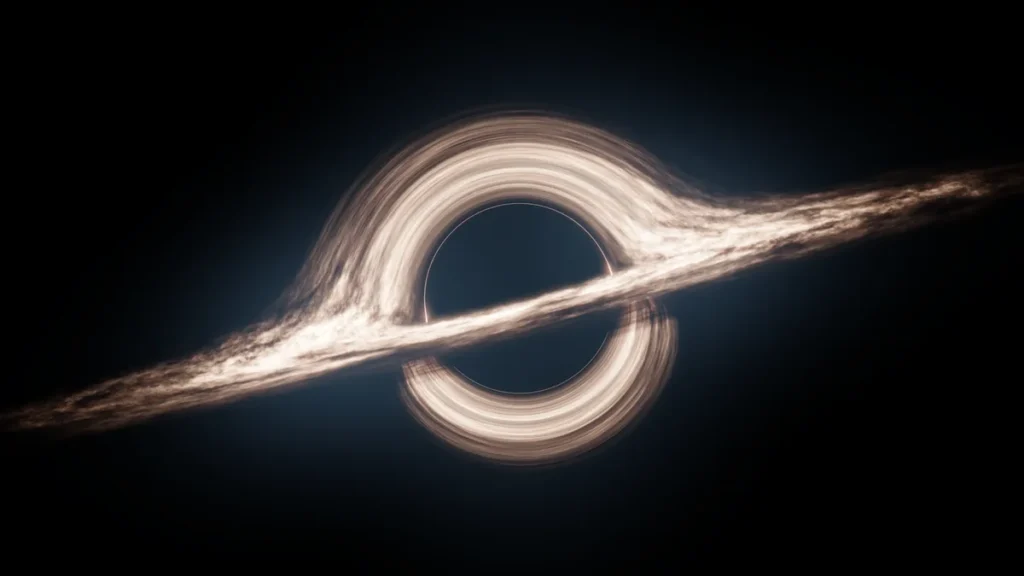
A research team led by Hirofumi Noda of Tohoku University and Kazuhiro Hada of Nagoya City University reported on Oct. 20, 2026, that the active galaxy 3C 120 in the constellation Taurus is rapidly feeding its supermassive black hole while launching a powerful relativistic jet.
That combination presents a puzzle because theory says rapid feeding should build a cold, flat accretion disk around the black hole, and such a disk was thought to prevent powerful jets from forming. Noda and Hada combined observations from the X-ray Imaging and Spectroscopy Mission with international networks of radio and millimeter telescopes to connect the region near the black hole with the jet that emerges from it.
XRISM detected an iron emission line from the accretion disk around the black hole in 3C 120. The line’s shape is distorted by Einstein’s general relativity, which let the researchers determine how close the disk extends toward the black hole.
The cold, relatively flat disk ends at about 20 times the black hole’s radius, marking the boundary called disk truncation. Beyond that point the disk transitions into a hot flow of plasma reaching hundreds of millions of degrees.
Radio and millimeter observations with the Global Millimeter VLBI Array, the Very Long Baseline Array and the East Asian VLBI Network traced the narrowing jet back to its origin within the hot flow close to the black hole.
The hot environment can allow magnetic fields to accumulate around the black hole. These fields are thought to extract some of the black hole’s rotational energy and channel it into a powerful jet.
The observations show that 3C 120 satisfies the conditions required for this jet-launching mechanism to operate, giving new insight into how rapidly feeding supermassive black holes produce relativistic jets. Noda said using state-of-the-art X-ray and radio telescopes on the same black hole let the team see both the hot plasma around it and the jet coming out of it.
The team plans further coordinated observations of a heavier black hole with XRISM and radio observatories around the world, checking the results against theoretical models and simulations to test whether the same conditions appear in a larger black hole system. Noda said the team wants to map how gas, magnetic fields and spin interact close to the hole, a step that could clarify how these black holes shape galaxy evolution and large-scale cosmic structures.
A separate study led by Adelle Goodwin of Curtin University’s International Centre of Radio Astronomy Research and Andrew Mummery of the Institute for Advanced Study in Princeton was reported on Oct. 11, 2026, and published in Nature Astronomy. Goodwin and Mummery found that supermassive black holes can launch jets once feeding falls to roughly 2 percent of the Eddington limit, where outward radiation pressure balances inward gravity.

Goodwin and colleagues studied 20 tidal disruption events using optical, ultraviolet, X-ray and radio observations from telescopes in Australia, the United States, India, South Africa and space, then narrowed the sample to 10 events for which they could reliably model both feeding rate and radio outflow timing.
The data showed two jet phases: one while feeding was high, and another hundreds to thousands of days after the star’s disruption, once accretion had slowed. Such delayed jets can show up long after the star’s destruction. Those delayed jets appeared once the feeding rate fell to roughly 2 percent of the Eddington limit.
The same roughly 2 percent threshold is already associated with jet formation in stellar-mass black holes in the Milky Way, suggesting the transition depends on accretion physics rather than black hole mass. Goodwin said enormous mass differences separate these black holes yet appear to switch on their jets at the same point in the feeding process.
Astronomers could use the marker to choose when to aim radio telescopes at a tidal disruption event again, Goodwin said, since timing matters as much as placement. Because jet timing varies, the feeding-rate threshold works as a probabilistic indicator rather than a fixed clock. Future sky surveys are expected to discover many more tidal disruption events than astronomers can follow continuously across every wavelength.
Separate work released on September 30, 2026, found that jets from supermassive black holes can disrupt star-forming gas well past a galaxy’s visible edge, creating a bright trail hundreds of thousands of light-years long. The jets keep this gas hot and stop it from flowing inward, which may decide if that galaxy keeps making stars or falls quiet.
Research led by Sanchayeeta Borthakur of Arizona State University and Namrata Roy, now at the Raman Research Institute, found that supermassive black holes power narrow plasma jets that are hot and can reach gas well past the galaxy’s visible edge. The Astrophysical Journal Letters published the findings.
The team searched for H-alpha, the faint glow of ionized hydrogen, by combining observations of hundreds of jet-producing galaxies from the Dark Energy Spectroscopic Instrument survey with radio jet measurements from the LOFAR Two-meter Sky Survey.
The H-alpha signal was weak when averaged in every direction around galaxies but became much stronger along the radio jets, showing the glow is directional rather than uniform. The team found two bright ionized-hydrogen regions: one near the galaxy where the jet first meets the circumgalactic medium, and another near the outer edge where the jet appears to deposit much of its energy.
Jets that heat, stir and disrupt gas around the galaxy can keep that material from cooling and falling inward, cutting the supply of star-forming fuel. Earlier studies missed the signal because they did not examine gas specifically along the jet direction.
Together, the three lines of research suggest jet-launching physics connects how supermassive black holes grow to how they regulate star formation across their host galaxies and the wider universe.





Join the discussion