Key facts
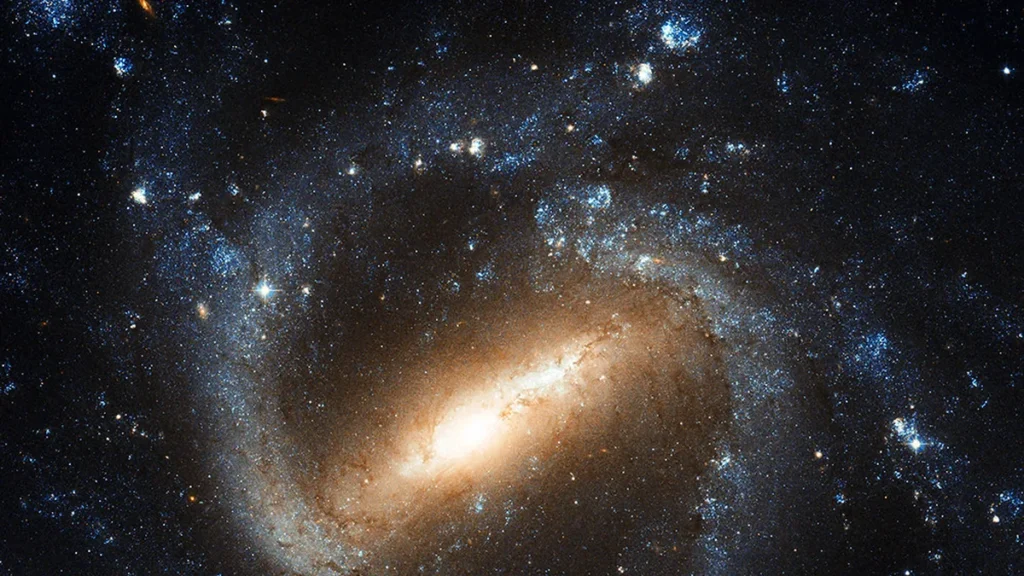
- NASA and ESA's Hubble Space Telescope produced a new image of barred spiral galaxy NGC 4394 that highlights its bright central bar and galactic structure, released on Nov. 24, 2026.
- NGC 4394 lies in the constellation Coma Berenices, also called Berenice's Hair.
- Galactic bars are extremely common, and astronomers estimate that 65 percent of spiral galaxies in the nearby universe have a bar.
- NGC 4394 resembles what astronomers picture for the Milky Way viewed face-on, with graceful spiral arms and a central bar of stars.
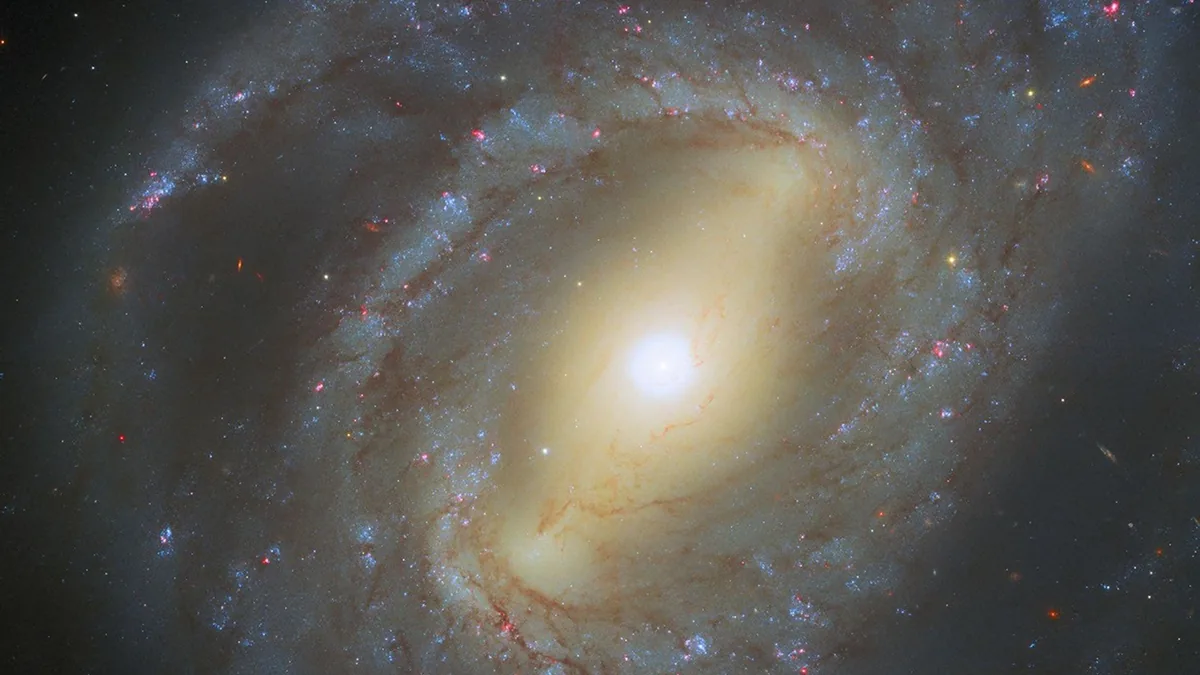
NASA and ESA’s Hubble Space Telescope captured a new view of barred spiral galaxy NGC 4394—a spiral galaxy with a straight bar of stars through its center—released on Nov. 24, 2026. The image spotlights the galaxy’s bright central bar and galactic structure. The release continues Hubble’s long-running imaging of nearby barred galaxies and gives a detailed look at NGC 4394’s prominent bar. ESA/Hubble is credited with the text of the release.
NGC 4394 is found in Coma Berenices, the constellation also called Berenice’s Hair. It sits about 55 million light-years away, a distance the release describes as relatively nearby for a galaxy. More than 1,000 galaxies belong to the Virgo Cluster, including NGC 4394. NASA describes the Virgo Cluster as the closest galaxy cluster to us.
Galactic bars are extremely common. Astronomers estimate that bars appear in 65 percent of nearby spiral galaxies. Straight stellar bars such as NGC 4394’s stand out next to arcing spiral galaxies and nebulae shaped by stars being born and dying.
NGC 4394 looks like the Milky Way as astronomers imagine it seen face-on, with graceful spiral arms surrounding a central bar of stars. That comparison frames barred galaxies as useful analogs for understanding the evolution of our own galaxy.
Hubble has also imaged barred spirals such as NGC 5728, NGC 685, and NGC 613, yet astronomers still do not understand how these striking bars form. The release asks how bars form, then explains that leading ideas focus on instability in a galaxy’s disk of stars.
Leading ideas hold that a galaxy’s disk of stars can grow unstable, perhaps because of gravitational nudges from passing galaxies, interactions among stars, or other forces. Once that disk becomes unstable, the stars’ circular orbits stretch out into the barred shape seen in NGC 4394.
Today’s universe has more galactic bars than it did several billion years in the past, according to observations. Research indicates this current popularity is temporary because increasingly massive bars can themselves grow unstable. That finding tempers the idea that bars are more common now than they were several billion years in the past.
NGC 4394 and the Milky Way might both contain a LINER, a central region near a galaxy’s center where spectra show certain ionized or neutral elements. Exactly how LINERs form is still unknown to researchers; one likely cause is a hungry supermassive black hole, and another is intense star formation.
Hubble released an earlier image of NGC 4394 about a decade before the Nov. 24, 2026 release. It came from Hubble observing program #10515, led by PI Peng, which focused on the unusual group of star clusters in Messier 85, NGC 4394’s neighbor. While one Hubble instrument studied Messier 85, the Advanced Camera for Surveys imaged a parallel patch of sky that included NGC 4394.
The new image also draws on Hubble program #18103, led by PI Thilker, which looks at how star formation ends in galaxies in dense clusters versus more isolated field galaxies. The cluster’s dense environment is relevant to the newer Hubble program that compares star formation in cluster galaxies with isolated field galaxies. Under program #18103, NGC 4394 is among the 40 galaxies whose star cluster ages researchers determined.
Researchers working on program #18103 used Hubble’s Wide Field Camera 3; its broad wavelength sensitivity helped them determine the ages of individual star clusters. The program compares star-formation shutdown in galaxies in dense clusters with those in more isolated field environments.
NASA’s media contact is Claire Andreoli at Goddard Space Flight Center in Greenbelt, MD; she can be reached at claire.andreoli@nasa.gov. She is listed as the media contact for the Hubble NGC 4394 image release.
Join the discussion