Key facts
- ESA astronaut Thomas Pesquet appeared on France 24 on November 24, 2026, to discuss his book "Space in 100 Questions" and how weightlessness helps advance medical research.
- Pesquet said that in space, gravity can be removed as a parameter and adjusted, revealing things hidden on Earth.
- Pesquet flew on the 2016 Proxima mission as the 10th French astronaut in space, stayed 197 days aboard the ISS, carried out two spacewalks, and took part in more than 50 scientific experiments.
- He holds the European mark for days in orbit and time spent spacewalking after four spacewalks and roughly 200 additional days on his second mission.
ESA astronaut Thomas Pesquet appeared on France 24 on Nov. 24, 2026, to discuss his book “Space in 100 Questions” and explain how weightlessness advances medical research. [F1, S1]
Pesquet said that in space, gravity can be removed as a parameter and adjusted, revealing things hidden on Earth. He made the comment while describing what weightlessness feels like after the engines stop and the crew begins floating in orbit. “Once you get to space, you remove that parameter, you can adjust that parameter, you discover things that are hidden on the ground.” [F2, S1]
He described launch acceleration as exceeding the fastest Formula One car, with speed climbing 100 kilometers an hour every 1.8 seconds for 8 minutes 48 until reaching 28,000 kilometers per hour, enough to free fall around Earth. Pesquet gives this launch description just before explaining that the sensation changes completely once the vehicle is in orbit. [F3, S1]
Pesquet has flown two missions aboard the International Space Station: Proxima in 2016 and Alpha in 2021. France 24 says he shares stories from those flights during the interview. On the 2016 Proxima mission, Pesquet became the 10th French astronaut in space, stayed 197 days aboard the ISS, carried out two spacewalks, and took part in more than 50 scientific experiments. [F4, F5, France 24, S2]
In 2021, he launched aboard SpaceX’s Dragon spacecraft on NASA’s Crew-2 mission for his second ISS flight, Alpha, and became the first French astronaut in charge of the orbiting laboratory. The Alpha flight included four spacewalks and roughly 200 additional days in orbit. [F6, S2]
He holds the European mark for days in orbit and time spent spacewalking. Yahoo! Finance presents this record alongside Pesquet’s status as the first French astronaut to command the station. [F7, S2]
Pesquet was selected by ESA in 2009 after a rigorous selection, having worked as a satellite dynamics engineer at Thales Alenia Space and GMV, joined CNES, and become an Air France airline pilot in 2006. Alongside his ESA astronaut duties, Pesquet flies in the Air and Space Force, serves as a test pilot at Airbus, and is CEO of Novespace. [F13, F14, S2]
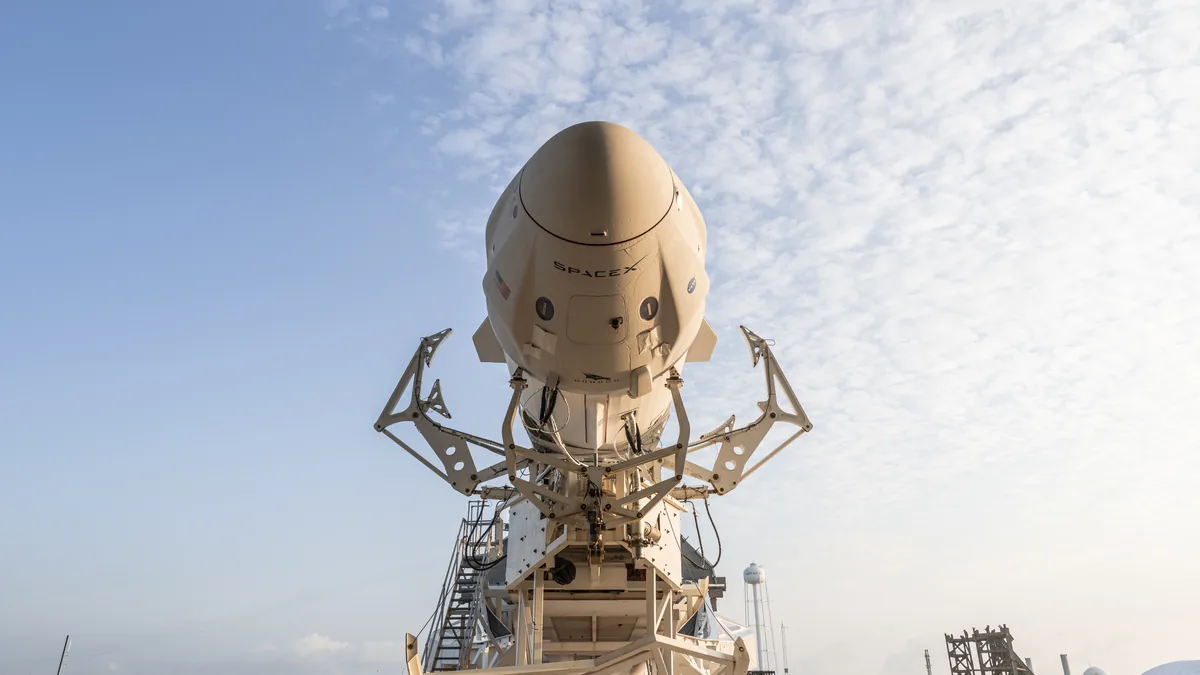
Vast and the Government of France agreed to two missions involving two French astronauts: a private astronaut mission to the ISS and the Haven-1 test flight, both planned for 2027 and expected to last approximately two weeks. The announcement came at the Choose France Summit created by President Emmanuel Macron and is framed as a way for France to continue low-Earth orbit missions based on prior crewed experience. Pending MCOP review and approval, Pesquet is set to command Vast’s private astronaut mission to the ISS alongside NASA. The approval depends on a panel whose members represent all five International Space Station partners. [F8, F9, S2]
Arnaud Prost, an ESA reserve astronaut, is slated to be flight test engineer for Haven-1’s first crewed flight acceptance test. The station is set to be the world’s first commercial space station and to launch in 2027. Haven-1 is described by Vast as the first crewed mission to its commercial space station, and the flight is part of the two-mission package with France. [F10, S2]
Vast pledged to open its European headquarters in Paris under an agreement with the Government of France made at the Choose France Summit. Vast made the Paris headquarters commitment alongside the human spaceflight agreement at the summit hosted by the French government. [F11, S2]
Further information on the French missions is to be presented at the International Space Summit in Paris on September 9 and 10, an event announced by President Emmanuel Macron. The summit will provide additional information on the agreements reached with France. [F12, S2]
The panel decides by consensus among members from the five station partners: NASA, ESA, Roscosmos, the Japan Aerospace Exploration Agency, and the Canadian Space Agency. This consensus rule governs the panel that must approve Pesquet’s command assignment on the Vast mission. [F15, S2]


Join the discussion