Key facts
- The Great Nebula in Orion is an immense, nearby starbirth region and one of the most famous astronomical nebulas.
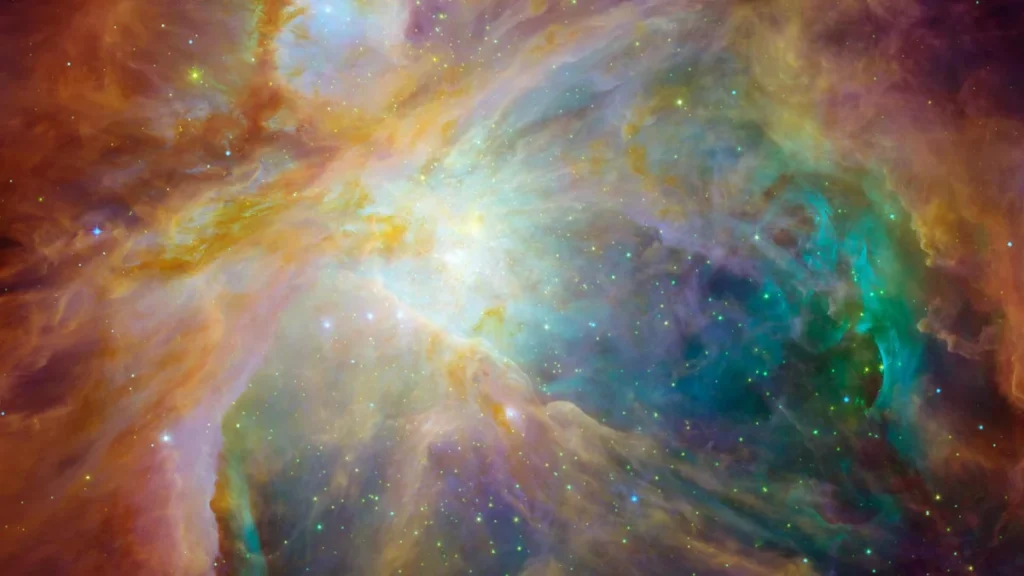
- NASA's Astronomy Picture of the Day for October 26, 2026 features M42, the Great Nebula in Orion, presenting a celestial image accompanied by an explanation written by a professional astronomer.
- The Great Nebula in Orion can be seen without a telescope near the three-star belt in the constellation Orion.
- The nebula contains a bright open cluster called the Trapezium and also holds many stellar nurseries.
NASA’s Astronomy Picture of the Day features M42, the Great Nebula in Orion, on Oct. 26, 2026, presenting a celestial image with an explanation written by a professional astronomer.
The Great Nebula in Orion is an immense, nearby star birth region and one of the most famous astronomical nebulas. Known also as M42, it spans about 40 light-years and lies in the same spiral arm of the galaxy as the Sun.
NASA’s Oct. 26, 2026 explanation puts hot young stars amid glowing gas along the edge of an interstellar molecular cloud 1,500 light-years away, while the Hubble lithograph dated May 24, 2018, lists 1,400 light-years in a Milky Way 100,000 light-years wide. NASA’s Hubble material calls the region a typical star-forming environment and an ideal laboratory for studying how stars form and evolve because of its closeness.
A bright open cluster called the Trapezium sits in the nebula along with many stellar nurseries. Four of the heaviest stars make up the Trapezium in the bright central area in a trapezoidal pattern. Ultraviolet light and strong stellar winds from these massive stars are carving a cavity in the central part of the nebula, and arcs and bubbles appeared when the winds struck nearby gas and dust.
The same ultraviolet light may be disrupting the growth of hundreds of smaller stars, and the massive stars are sculpting rugged valleys, ridges, and plateaus that resemble the Grand Canyon.
The stellar nurseries hold large amounts of hydrogen gas, hot young stars, proplyds, and stellar jets that eject material at high speeds. The stars in the nursery are all about two million years old. Many medium-sized stars are encircled by dark disks of dust and gas where planetary systems can form.
Hubble has found many brown dwarfs, gaseous bodies larger than planets but too small to sustain hydrogen fusion in their cores, and faint red objects in a close-up are among them. Because the nebula is close to Earth, astronomers use the telescope to count faint, cool brown dwarfs and learn how many form in stellar nurseries.
The bright glow at the upper left of the Hubble image comes from M43, a small region shaped and lit by ultraviolet light from a massive young star. Astronomers call M43 a miniature Orion Nebula because of its small size and the single massive star that shapes it.
The nebula is visible without a telescope near the three-star belt in the constellation Orion, a popular grouping with an identifiable belt. The featured deep image uses assigned colors highlighted by emission in hydrogen, which makes wisps and sheets of dust and gas stand out. The Hubble image shows more than 3,000 stars.
The Hubble image comes from the Hubble Space Telescope Orion Treasury Project Team, with credit to NASA, ESA, and M. Robberto of the Space Telescope Science Institute/ESA. The next Astronomy Picture of the Day will show open space.




Join the discussion