A research team led by F.-Y. F. Liu of the University of Edinburgh announced on Nov. 3, 2026 that it has reclassified the James Webb Space Telescope object nicknamed Capotauro, moving it from a possible early-universe galaxy to a cold brown dwarf in the Milky Way. The conclusion rests on images taken about three and a half years apart, from December 2022 and June 2026, that show the object had changed position between observations.
The finding resolves an ambiguity left open when Capotauro was first seen.
Capotauro first attracted attention because it appeared in Webb’s longer-wavelength infrared images but disappeared at shorter wavelengths. That color pattern matched the sharp light cutoff expected from a distant galaxy, making it an intriguing candidate for a glimpse of the universe’s first galaxies. The hues alone did not prove the object’s distance. The pattern marks sources whose light cuts off at short wavelengths and rises at long infrared wavelengths.
If interpreted as a distant-galaxy signature, the cutoff implied a redshift of about 32 (the stretch of light as the universe expands), placing the source roughly 100 million years after the Big Bang. That reading put Capotauro in an exceptionally early chapter of galaxy formation, though its true distance remained uncertain. The paper later revisited that interpretation with a motion test. The redshift estimate relied on assuming hydrogen absorption in a distant galaxy caused the cutoff.
Liu’s team compared Webb images from December 2022 with observations taken in June 2026, aligning the frames using 68 compact reference sources. The alignment allowed precise position measurements across the long baseline. The team also inserted artificial objects into the real backgrounds to gauge how noise could distort those measurements. The test separates a stationary distant galaxy from a nearby object whose position changes between observations.
Capotauro shifted by about 0.13 arcseconds, a detection with statistical significance exceeding six sigma. A distant galaxy would appear essentially fixed across the December 2022 to June 2026 interval. An object moving within the Milky Way could show a shift like the one measured for Capotauro. That contrast between expected behavior for a background galaxy and a nearby Milky Way object explained why the detected motion pointed to a brown dwarf.
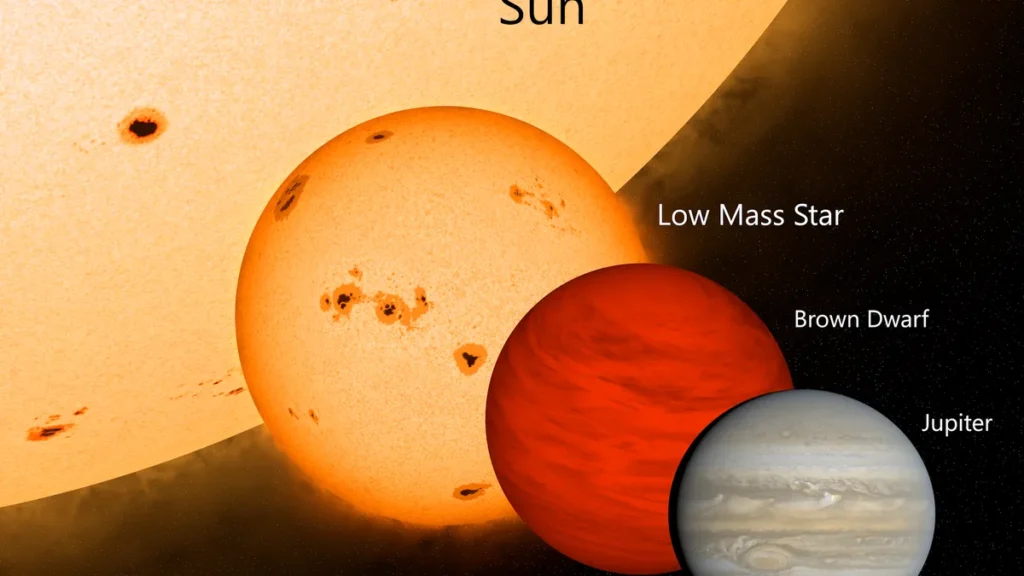
A brown dwarf holds too little mass to sustain hydrogen fusion, the reaction that powers stars. Y dwarfs sit at the coldest end, and their atmospheres hold water, methane and ammonia, gases that soak up wide stretches of infrared light. That absorption leaves a steep rise in brightness at longer wavelengths, a signature that can resemble the distant-galaxy cutoff. The similarity made Capotauro look like an early galaxy at first sight.
Because colors alone could be misleading, movement offered a different test for determining whether Capotauro was a distant galaxy or a nearby cold object. The proper-motion measurement provided an independent check beyond the ambiguous color data. The approach settled the question raised when Capotauro was first seen. Astrometric data thus complements photometric selection when hunting for distant galaxies.
The original study of Capotauro, published in February in Astronomy and Astrophysics, had already considered the explanation that it is a cold object within our own galaxy. That earlier work raised the possibility but could not settle it without a motion measurement. The new analysis now confirms that scenario. The earlier study left the object’s true nature open pending astrometric evidence.

Matching Capotauro’s infrared brightness pattern against known brown dwarfs produced a best match suggesting a temperature of about 350 Kelvin, or 77°C. The same comparison pointed to a distance of roughly 2,400 light-years. Capotauro is placed among the farthest Y dwarfs identified so far by the authors. The estimate remains uncertain because available comparison objects do not cover the coldest possibilities.
That gap means Capotauro could in fact be colder, intrinsically fainter and closer than the current best fit suggests. Making another carefully timed observation could help measure Capotauro’s distance through parallax, the apparent positional change caused by Webb’s changing viewpoint. That measurement would sharpen the picture of this faint member of the Milky Way. Parallax measurements from Webb’s changing viewpoint could reduce that uncertainty.
The physical mechanism behind the original galaxy interpretation involves hydrogen gas absorbing much of a distant galaxy’s light below a particular wavelength, creating a sharp cutoff. As the light travels through an expanding universe, its wavelengths stretch and the cutoff shifts into the infrared. By checking an object’s position, astronomers can tell how far back in time their view reaches. The stretching of wavelengths moves the cutoff into the infrared range where Webb is sensitive.
The reclassification offers a useful result for galaxy hunters because Webb can uncover cold objects that imitate some of the most extreme early-galaxy candidates. A repeat look at that patch can expose moving objects and separate them from sources in the distant universe. The proper-motion test gives observers a practical way to filter out nearby interlopers. This method applies to other faint red objects in Webb images.
The finding is reported as F.-Y. F. Liu et al., “A clear detection of proper motion confirms that the claimed z ≃ 32 galaxy candidate, Capotauro, is a Y-type brown dwarf,” in the Monthly Notices of the Royal Astronomical Society (2026), DOI 10.1093/mnras/stag2055. F.-Y. F. Liu of the University of Edinburgh, with colleagues, reported the finding in that journal.
Their analysis resolves an ambiguity that Capotauro’s unusual colors had left open at first sighting. Phys.org reported the finding, explaining how the team tracked the object’s motion across years.





Join the discussion