Key facts
- The research was led by Dr. Silvia Protopapa of NASA's Goddard Space Flight Center and the Southwest Research Institute and appeared in The Astrophysical Journal Letters.
- 3I/ATLAS was discovered in July 2025, with pre-discovery images traced to June 14, 2025, and it was first reported to the Minor Planet Center on July 1, 2025.
- The three visits occurred on August 6, 2025, December 22, 2025, and April 1, 2026.
- JWST detected a faint feature near 3.1 microns consistent with crystalline water ice after perihelion, meaning the molecules arrange in neat crystalline lattices rather than a disordered jumble.
Spectroscopy from the James Webb Space Telescope, gathered between August 2025 and April 2026, reveals that water ice on the interstellar comet 3I/ATLAS closely resembles ice found on distant trans-Neptunian objects in our own solar system, suggesting planet-building ice takes a similar form around different stars. The work was headed by Dr. Silvia Protopapa, who holds positions at NASA’s Goddard Space Flight Center and the Southwest Research Institute. Protopapa leads the paper analyzing the comet’s water ice, while Martin Cordiner directs the Webb observing program that collected the spectroscopic data.
3I/ATLAS is the third confirmed interstellar object found crossing the inner solar system, after 1I/Oumuamua in 2017 and 2I/Borisov in 2019. The object was discovered in July 2025, with earlier images traced back to June 14, 2025, and it was first reported to the Minor Planet Center on July 1, 2025, by the NASA-funded ATLAS survey telescope in Rio Hurtado, Chile. Its hyperbolic trajectory confirmed it originated outside the solar system and will carry it away.
The observing program made three passes with Webb’s Near-Infrared Spectrograph, or NIRSpec, on August 6, 2025, December 22, 2025, and April 1, 2026, bracketing the comet’s closest approach to the Sun. Cordiner said the program was designed to activate immediately when an active interstellar comet was found and to follow it over time, aiming to characterize the released ice, dust, and gas as clues to planetesimal chemistry around other stars.
JWST detected a prominent water-ice absorption band near 3 microns in 3I/ATLAS, but the corresponding bands at 1.5 and 2.0 microns were faint or absent. In most solar system comets, such as Hartley 2, water ice absorbs at all three wavelengths. The missing shorter-wavelength features initially caused some observers to doubt that the comet contained water ice. Protopapa stated, “The strong 3-micron band points to water ice in the coma,” and more detailed modeling confirmed that ice is indeed present.
Modeling suggests the ice resides in microscopic grains no larger than a micron, mixed with dust and dark rocky minerals including pyroxene and carbon. These tiny grains scatter shorter wavelengths more strongly, producing the blue near-infrared continuum slope across 1.15 to 2.50 microns that JWST observed, which explains why the shorter-wavelength bands weaken while the deeper 3-micron band stays prominent. Protopapa noted the grains are comparable in size to those in solar system comets, but the high dust fraction mixed into the ice sets them apart.
The water-ice absorption feature at 3 microns in 3I/ATLAS’s spectrum mirrors patterns seen among trans-Neptunian objects orbiting beyond Neptune, which are icy bodies thought to preserve early solar system material in nearly pristine form. The resemblance is specific to the water-ice band and does not extend to carbon dioxide features, and these objects also lack strong shorter-wavelength bands. Earlier work attributed this same pattern to complex hydrocarbons or organics, but the new paper proposes that dusty ice alone could account for it. If further observations confirm the shared grain properties, it would mean the physical form of water ice is established early in planet-forming disks around young stars.
The observation dates bracketed perihelion on Oct. 30, 2025, when 3I/ATLAS passed within about 130 million miles of the Sun inside Mars’s orbit, and its closest approach to Earth on Dec. 19, 2025, at roughly 170 million miles. During the first pass on August 6, 2025, the comet sat about 307 million miles from the Sun; by the final pass on April 1, 2026, it had receded to approximately 530 million miles and was moving outward. The observations ranged from about 3.31 astronomical units before perihelion to about 5.65 AU after it, with the spectrum changing at each epoch.
Following perihelion, the spectra indicated an additional population of larger, micron-scale aggregates rich in ice, though what triggered this shift is not yet known. Michael Kelley of the University of Maryland, the paper’s second author, said researchers cannot distinguish between solar heating and surface erosion as the cause. JWST also picked up a Fresnel reflection near 3.1 microns after perihelion, a signature of crystalline water ice in which molecules form orderly lattices rather than a disordered arrangement. The crystalline feature appeared either because solar warmth reconfigured surface ice or because blown-away dust exposed cleaner crystals beneath, and whether the ice was already crystalline before perihelion or crystallized afterward remains an open question.
Webb additionally detected water vapor, carbon dioxide, and carbon monoxide gas around 3I/ATLAS. On December 22 and 23, 2025, at a distance of about 2.4 AU from the Sun, the team used NIRSpec’s Integral Field Unit to examine the coma and found methanol, ethane, formaldehyde, water, and carbon monoxide.
Isotope analyses provide further evidence of the comet’s alien chemistry. The deuterium-to-hydrogen ratio in 3I/ATLAS’s water measured approximately 0.98%, more than 10 times higher than in known solar system comets, implying the ice condensed below about 30 kelvins. The European Space Agency characterized the enrichment as roughly 30 times typical cometary levels. Cordiner remarked, “The isotopic ratios we measured with JWST show that it is not only distinct, but also likely much older than our solar system.”
JWST also found a relatively high carbon-12 to carbon-13 ratio in the comet’s carbon dioxide and carbon monoxide, indicating formation in a region with less heavy-element enrichment than the young Sun’s environment.
The methane in 3I/ATLAS carries a deuterium-to-hydrogen ratio of about 3.33%, roughly 14 times the value measured in comet 67P/Churyumov-Gerasimenko and the highest deuterium enrichment in methane recorded anywhere in the Solar System. This ratio exceeds any other direct organic-molecule measurement by at least a factor of 1.4, with the closest solar system benchmark being D/H equals 1.5 percent in the Orgueil carbonaceous chondrite meteorite. Since direct methane D/H measurements do not exist for objects beyond the Solar System, the team relied on cyclopropenylidene deuteration as a chemical proxy. Estimates from that proxy place methane D/H at 4 to 7 percent or more in some star-forming regions and cold cores, consistent with 3I/ATLAS being interstellar material.
Roth noted, “Dynamical and compositional studies of these enigmatic objects may provide clues to their origins.” The methane study was published Oct. 23, 2026, in Nature Astronomy.
Galactic chemical evolution models put 3I/ATLAS’s age at 10 billion to 12 billion years, making it potentially billions of years older than the solar system’s 4.5 billion years. The estimate assumes the Milky Way was younger and chemically different when the comet formed. Its original planetary system may no longer exist, and no parent star has been identified, though a Milky Way origin is likely and an extragalactic one is not ruled out. A second Nature Astronomy study, led by Cyrielle Opitom of the University of Edinburgh and using the European Southern Observatory’s Very Large Telescope, found unusual nitrogen and carbon isotope ratios in 3I/ATLAS, lending independent support to the comet’s distinctive chemistry.
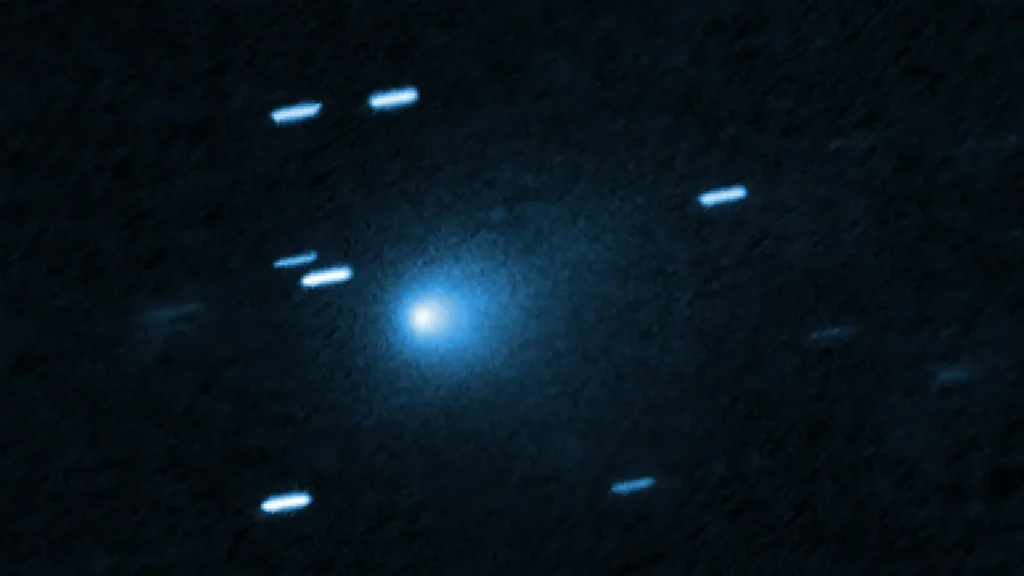
Darryl Seligman of Michigan State University, who was not involved in that study, said the comet’s age is uncertain but probably exceeds that of anything formed in the solar system. NASA’s Hubble Space Telescope observations suggest a nucleus diameter between roughly 440 meters and 5.6 kilometers, though the exact size is uncertain.
The paper is titled “JWST Reveals Refractory-rich Water Ice in Interstellar Comet 3I/ATLAS: Evidence for a Continuum of Grain Properties across Protoplanetary Disks.” The authors warn that their conclusions depend on models of light scattering by grains and that alternative explanations for the observed changes are still on the table. Additional Webb observations of solar system comets and of future interstellar visitors should determine whether 3I/ATLAS is representative of icy bodies around other stars or an unusual case.


Join the discussion