Key facts
- The ice signatures are broadly uniform throughout the disk, which the team attributes to frequent collisions among icy bodies rather than a single recent smashup.
- The team observed the system on 7 December 2023 using JWST's NIRSpec, analyzing reflected light from 0.6 to 5.2 micrometers from two disk regions about 100 astronomical units from the star.
- Sarah Betti is an astronomer at the Space Telescope Science Institute in Baltimore.
A team led by Sarah Betti used the James Webb Space Telescope’s near-infrared spectrograph to directly detect water ice and carbon dioxide ice in the debris disk around Beta Pictoris for the first time, reporting the finding in Science on Nov. 12, 2026. The detection came from analyzing reflected starlight from opposite sides of the nearly edge-on disk. The disk was among the first ever imaged, in 1984. The system appears almost exactly edge-on, making it a natural laboratory for studying how planetary systems grow and giving the historical and geometric context for why Beta Pictoris is heavily studied and well suited to disk investigations.
The observations took place on Dec. 7, 2023, when the team used the telescope’s NIRSpec instrument to analyze reflected starlight from 0.6 to 5.2 micrometers across two disk regions roughly 100 astronomical units – the distance from Earth to the Sun – from the star. The team spotted water ice absorption near 3 micrometers, with carbon dioxide at 4.27 micrometers and the carbon-13 form at 4.39 micrometers, using those bands to identify both ice types and the two carbon dioxide isotopologues. Spectra from the two regions showed both ice types, including the isotopic forms. The astronomers used JWST’s NIRSpec to map the disk and analyze reflected starlight from opposite sides of the star.
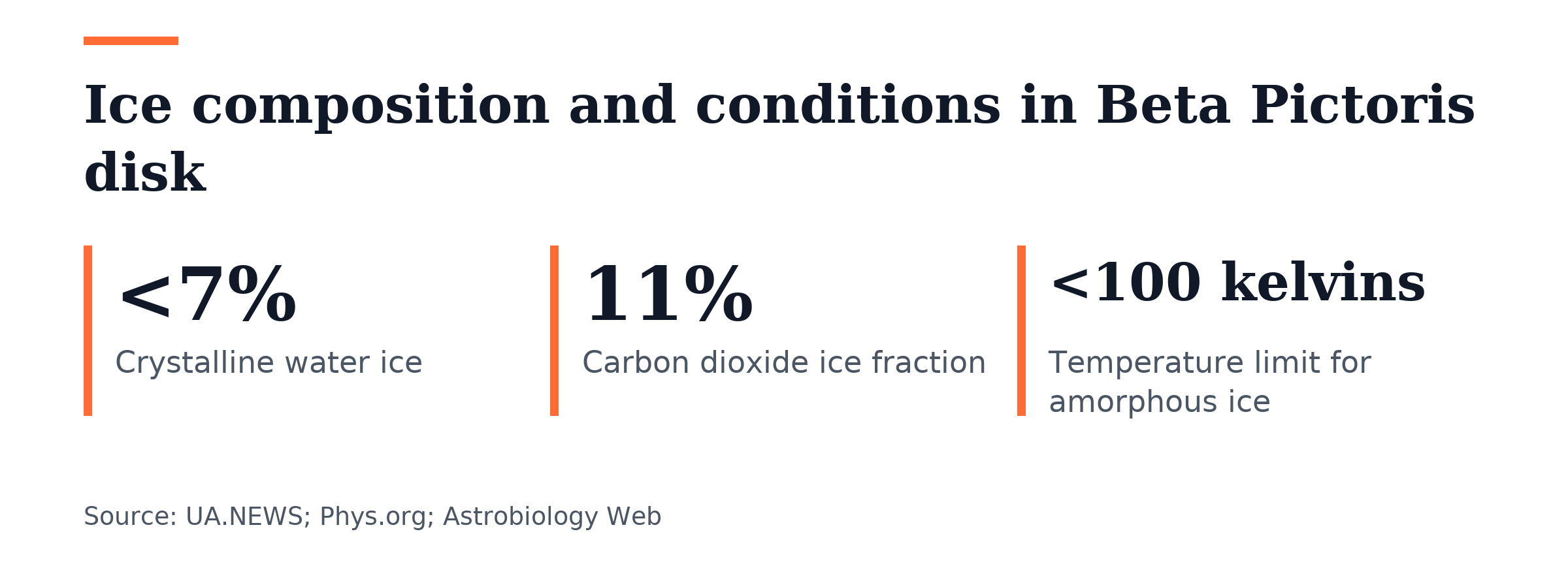
The water ice is overwhelmingly amorphous, with less than 7% of the ice volume potentially crystalline, meaning its molecules lack an orderly crystal structure. To keep that amorphous structure the water ice must remain colder than about 100 kelvins, or minus 173 degrees Celsius; otherwise high-energy ultraviolet radiation, cosmic rays, or stellar wind particles could alter it. The same temperature threshold and disruptive processes appear in the Science paper discussion, tying the amorphous state to the cold outer disk.
Carbon dioxide ice was detected in both the 12CO2 and 13CO2 isotopologues – forms of the molecule containing different carbon isotopes – and is mixed with water ice at roughly one carbon dioxide molecule for every 10 water molecules. The team’s estimate works out to about 11 percent of the ice as carbon dioxide, or slightly more than one carbon dioxide molecule for each ten water molecules, matching ranges seen in comets in our Solar System and in disks around other young stars. Although other mixtures are possible, the carbon dioxide-to-water ratio is consistent with other spectral observations within the Beta Pictoris system, and the authors acknowledge that the exact ice mixture is not unique but note that the measured ratio agrees with other spectral data already obtained for the system. The study authors write that “a CO2-H2O mixture is probably the dominant configuration of the CO2 ice,” with the carbon dioxide ice located in a water-rich environment in the disk.
The ice signatures are broadly uniform throughout the disk, which the team attributes to frequent collisions among icy bodies rather than a single recent smashup. The study authors say impact speeds in the early debris disk stage are too low to crystallize water ice, so ongoing collisions of icy bodies probably happen at gentle speeds that preserve the amorphous structure. Those impacts free up fresh icy dust, including ice sheltered inside the bodies, and may replace material lost to the star’s radiation. Scientists say the mixed carbon dioxide-water ice structure helps the ice withstand the star’s ultraviolet radiation; they attribute the protective effect against stellar UV to the intimate mixing of the two ices rather than their existing as separate particles.
The researchers infer the ices formed in cold conditions, likely in the interstellar medium – the gas and dust between stars – during an amorphous water-dominated formation phase, so the material may predate the star. The ice may date to cold material between the stars or to the first phases of star formation, with some of it probably trapped inside icy planetesimals that prevented crystallization. Modeling work indicates that pure ice grains would vanish quickly in disk conditions, while ice blended with other materials could last longer. This reasoning explains why earlier searches for pure ice found nothing and why the new detection of ice mixed with carbon dioxide is significant for the ice’s survival.
Beta Pictoris is a roughly 20-million-year-old star about 64 light-years – the distance light travels in a year – away, surrounded by a dusty debris disk in which astronomers have identified three larger planets, one discovered earlier this year. Beta Pictoris is roughly 20 million years old while our solar system is around 4.6 billion years old, so the Beta Pictoris system is still stabilizing and forming smaller bodies within its dusty disk. At 20 million years, the system is young and remains in an active planet-building stage even though that age sounds old by human standards. The disk extends far from the star such that molecules in the outer disk should freeze; this is the physical reason the team expected ice in the outer disk and why the team targeted the outer regions for observations.
The star hosts a debris disk. Dust in it gets continually replaced by collisions among comets and planetesimals, the small bodies that assemble into planets. This defines the debris disk mechanism that underlies the collision-based explanation for the uniform ice distribution in the system.
The properties of the planet Beta Pictoris b suggest it formed from ice-rich material, one of the reasons researchers expected the system to be full of ice. Previous searches around Beta Pictoris turned up no ice. Those efforts included hunts for water vapor and for a water-ice absorption feature in starlight at 3 micrometers.
The disk holds a large reservoir of carbon monoxide gas that stellar ultraviolet light should destroy within 50 to 300 years, and the team says frequent collisions likely replenish it by releasing gas from ice. This process may also explain the anomalous carbon monoxide found in an earlier study, with frequent collisions likely supplying new carbon monoxide as it gets constantly destroyed by the star’s light; this links the ice-and-collision model to carbon monoxide gas that stellar ultraviolet radiation should otherwise remove within decades or centuries. Earlier observations had found carbon monoxide gas around Beta Pictoris.
The ice found in Beta Pictoris looks much like ice in Solar System comets and in younger planet-forming disks. That points to shared ways of forming ice across different settings. The water ice is glassy rather than crystalline and is mixed with carbon dioxide in roughly the same proportions seen in comets of our own Solar System; the source uses glassy as a synonym for amorphous and ties the measured carbon dioxide-to-water mixture to known cometary composition in the Solar System. The team compares the disk ice to known cometary ice and ice around younger stars to infer shared formation pathways across different environments.
The definitive version of Carbon dioxide and amorphous water ices in the debris disk around Beta Pictoris by S. K. Betti et al. appeared in Science on Nov. 12, 2026, Vol 394, Issue 6825, pp 742-745, DOI 10.1126/science.adw7770; the authors submitted the arXiv preprint 2611.18918 on Nov. 13, 2026. Sarah Betti is an astronomer at the Space Telescope Science Institute in Baltimore.
Later work could compare debris disks around stars of different ages. That would show how ice evolves as planetary systems grow older. The study authors say the findings show ingredients necessary to form water-rich worlds might be common around young stars and offer context for understanding our own solar system’s icy ingredients. The results help explain where materials for planets with large water reserves come from.

Join the discussion