Key facts
- A team led by James Urquhart of the Center for Astrophysics and Planetary Science at the University of Kent discovered a giant hub-filament system called the λ-complex, designated G195.65−0.10.
- The research was published in the Monthly Notices of the Royal Astronomical Society on Nov. 17, 2026.
- The λ-complex lies about 43,000 light-years from the Milky Way's center and 16,800 light-years from the sun.
- The structure consists of a dense hub with three long filament arms meeting at the center, forming a lambda shape.
A team led by James Urquhart of the University of Kent’s Center for Astrophysics and Planetary Science discovered a giant hub-filament system in the Milky Way’s outer disk at the edge of the Galactic molecular disc, in research published Nov. 17, 2026. Phys.org reported the discovery.
The system, designated G195.65−0.10, has a dense hub where three long filament arms meet at the center — the filaments are the arms of the complex — forming the lambda shape that inspired its name. Such objects are hub-filament systems, dense regions called hubs where star-forming material gathers along filaments, the basic definition of the class of object that the λ-complex joins, with massive stars generally forming where the filaments come together and younger stars found in the filaments. The researchers named the formation the λ-complex.
The complex measures roughly 114 by 205 light-years overall, with three arms stretching 110 to 136 light-years each. Most hub-filament systems measure only 33 to 65 light-years across, so the λ-complex is substantially larger, and size is the main way the team distinguishes it from previously known systems. The team drew the size comparison from its own assessment of the dimensions.
The λ-complex sits about 43,000 light-years from the center of the Milky Way and 16,800 light-years from the sun, in the outer disk, a region less studied than the inner galaxy. Almost all known hub-filament systems lie in the galaxy’s inner regions, while rare outer-galaxy examples lie far away and are difficult to study closely, so the scarcity of these systems motivated the team’s work. Conditions in the outer galaxy make star formation harsher: the outer galaxy holds less gas and fewer heavy elements, and spiral-arm disturbances are weaker; whether the star-formation rules of the inner regions hold in the outer parts remains unknown, and these differences set the complex apart from inner-galaxy nurseries and frame the study’s broader question.
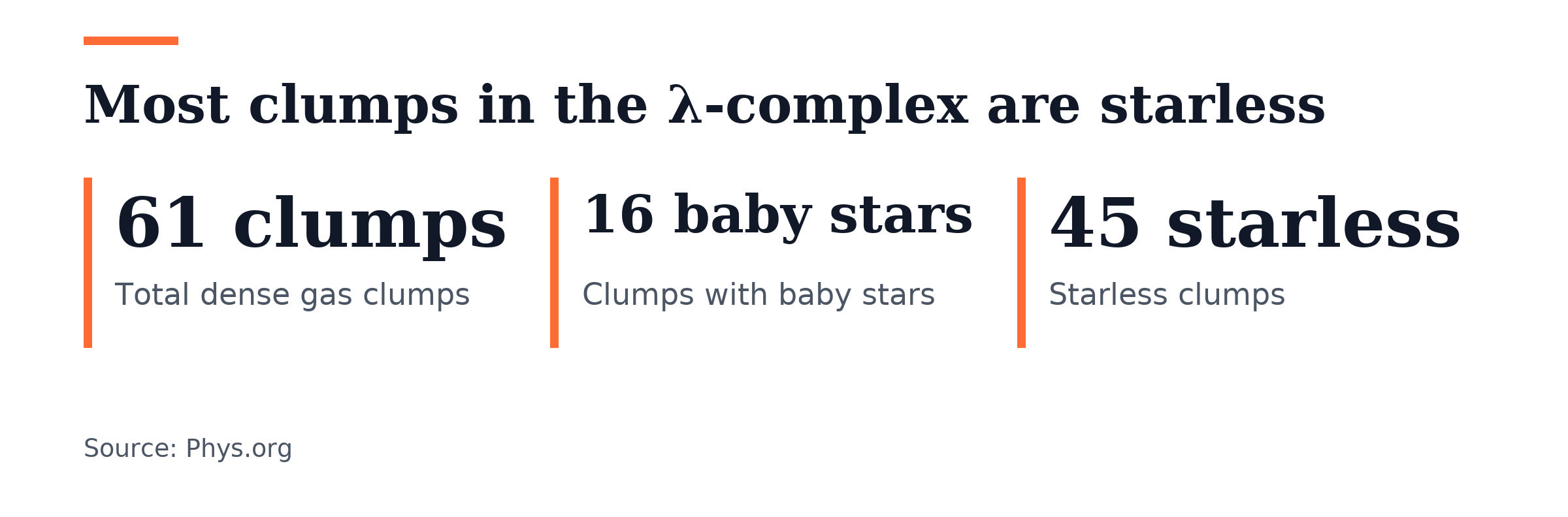
The researchers counted 61 dense gas clumps in the complex: 16 are linked to baby stars and 45 appear starless, and the clumps are not distributed uniformly throughout the structure. Of the 61 clumps, eighteen — nine protostar and nine starless — exceed 1,000 solar masses in mass, a reservoir of stellar fuel for future star formation across the complex. Some clumps classified as starless may conceal very young stars too faint for the team’s data to detect.
Star clumps near the hub are denser, heavier, and brighter than those farther out, with all three properties falling off as distance from the hub grows, gradients that show physical conditions changing across the network from center to outskirts. On average, protostellar clumps — clumps where baby stars are forming — sit 22 light-years from the hub and starless clumps 52 light-years away, quantifying the spatial separation between more evolved and less evolved clumps. The luminosity-to-mass ratio of protostellar clumps also decreases with distance, a gradient the team treats as a rough age indicator because a lower ratio points to less evolved clumps, meaning the hub area holds the most evolved star-forming regions.
Near the central hub, star formation is most active and advanced, while the outer filaments hold younger, earlier-stage clumps; the pattern suggests clumps mature near the hub as star formation moves inward from the filaments. Within the hub, a star cluster sits alongside two bright clumps and an ionized region powered by a star of roughly 15 solar masses, evidence that high-mass star formation is already established there. Researchers write that the complex’s star formation activity compares with that of inner galaxy complexes, and the team says the comparison shows the outer-disk complex acts much like better-studied systems closer to the galactic center.
The team says the complex demonstrates that hub-filament star formation like that seen in inner-galaxy nurseries occurs in the harsh outer Milky Way, and its young massive clumps could support future high-mass star formation beyond the solar neighborhood. The discovery adds one of the rare outer-galaxy examples to a class of structures astronomers know mostly from the inner galaxy.
Researchers say filling out the full picture will demand better knowledge of gas motions, a full survey of outer-galaxy complexes, and closer study of velocity-data oscillations. The goal is to clarify how gas moves through and shapes the complex.
The study appeared in the peer-reviewed journal Monthly Notices of the Royal Astronomical Society under the full title OGHReS: Discovery of a giant hub-filament system at the edge of the Galactic molecular disc. Being peer-reviewed sets the research apart from preprints or conference proceedings.

Join the discussion