Key facts
- New TESS transit-timing analysis strongly suggests a third planet, Kepler-396 d, exists in the Kepler-396 system.
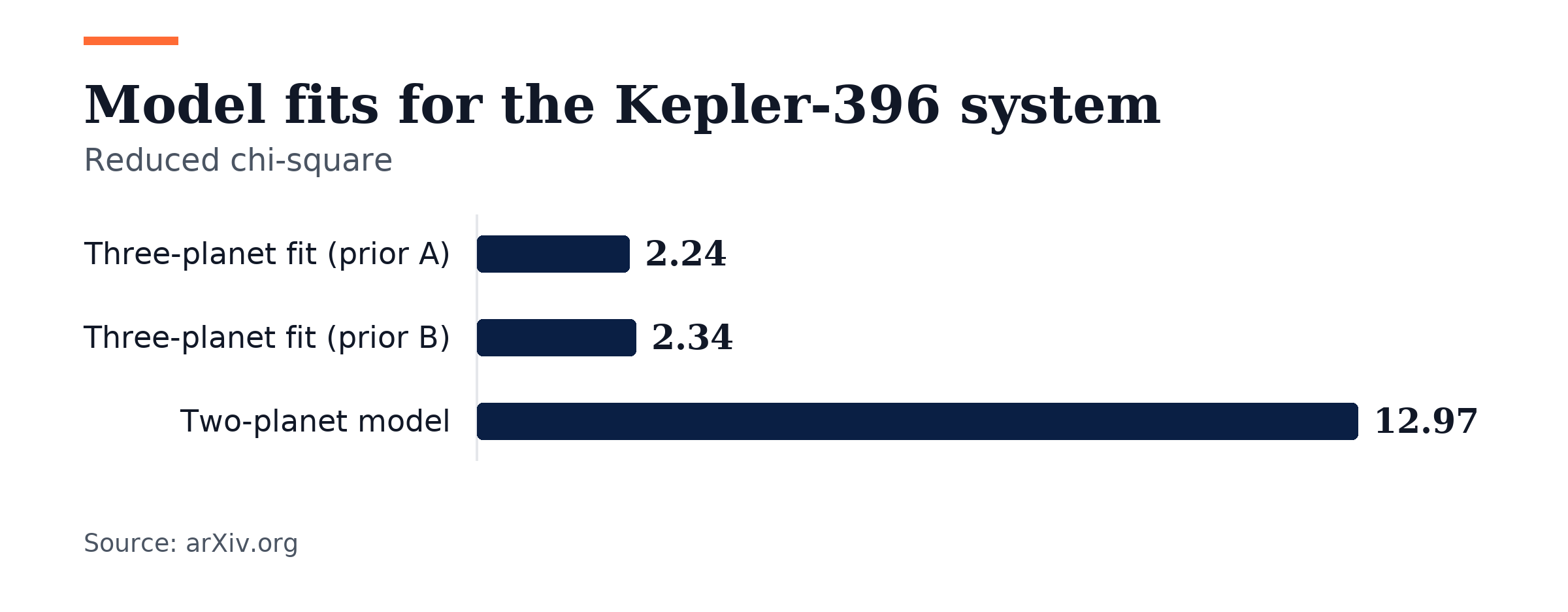
- Two best-fit solutions based on different orbital-inclination priors produced reduced chi-square values of 2.24 and 2.34, compared with 12.97 for the two-planet model.
- Dynamical simulations of the three-planet system show stability over a timescale of 10^6 years.
- The authors caution that Kepler-396 d's mass remains poorly constrained, its orbit could fit multiple configurations, and the proposed resonant architecture is unconfirmed pending further data.
A research team re-analyzed TESS data on the Kepler-396 system and submitted a paper to arXiv on Nov. 13, 2026, proposing that a third planet, Kepler-396 d, orbits the star alongside Kepler-396 b and Kepler-396 c.
The scientists determined mid-transit times using pixel-level decorrelation, a technique that strips instrument noise from image data. They then explored the third planet’s parameter space through long baseline transit-timing variation, which watches for changes in when a planet crosses in front of its star. The authors chose this approach to build a longer timing record and investigate the system’s configuration, returning to an old target with fresh measurements.
A third planet around Kepler-396 had been proposed before, but it remained obscure because the candidate’s mass was poorly constrained and its orbit could lie either inside or outside the path of Kepler-396 c. The ambiguity motivated the new TESS analysis, which revisits the idea with a longer baseline of transit-timing measurements. The team wanted to test whether the earlier hint could survive a fresh statistical look at the archival observations.
Two best-fit solutions, each based on different orbital-inclination priors, produced reduced chi-square values of 2.24 and 2.34. Reduced chi-square is a statistical measure of how well a model fits the data. The two-planet model scored 12.97, a much poorer fit. The researchers present the lower values as evidence that adding a planet better explains the transit-timing measurements than the older two-planet standard.
Based on those fits, the team updated the masses of Kepler-396 b, c and d to roughly nine, four and four Earth masses. The orbital periods are 43, 89 and 144 days respectively. The researchers use these revised masses to describe the composition and category of the known planets.
Kepler-396 b sits on the border between rocky and volatile-rich compositions, a description that follows from its revised mass of about nine Earth masses. The planet joins Kepler-396 c in the Neptune savanna, an orbital category based on the pair’s revised masses.
Kepler-396 c is confirmed to be a volatile-rich super-puff planet, a low-density world with a puffy atmosphere, and its revised mass is about four Earth masses. The source pairs this classification with the updated figure, treating the world as a puffy atmosphere-dominated planet rather than a dense rock. The classification rests on the revised mass estimate from the two best-fit solutions.
The authors ran dynamical simulations to test whether the proposed three-planet architecture could survive over long periods, and the model remained stable over 10^6 years. That stability test addresses whether the planets could remain in their proposed orbits without ejecting one another or collapsing into the star, a basic need for any long-lived multi-planet system.
Examining resonant angles led the authors to conclude that Kepler-396 b, c and d form a three-body apsidal resonance chain, an arrangement in which the planets’ elongated orbits line up in a repeating pattern. The proposed chain is the system architecture under discussion, though its confirmation depends on better mass constraints.
The authors caution that Kepler-396 d’s mass remains poorly constrained and that its orbit could fit several configurations. They also say the proposed resonant architecture is unconfirmed and awaits further data, meaning the system’s layout is still open to revision. The caution explains why the third-planet idea had stayed unclear even after earlier work suggested it might exist.
The authors put their case in their own words: “This result strongly suggests the existence of the third planet, i.e. Kepler-396 d.” They stop short of calling the detection certain.
The paper has been accepted by the Astronomical Journal and is posted as arXiv:2611.17667. Its authors are Li-Chin Yeh, Ing-Guey Jiang, Prangsutip Cherdwongsung, D. Bisht, Shraddha Biswas, Kaviya Parthasarathy and Hsin-Min Liu. The full author list appears alongside the arXiv posting, and the 20-page document represents the team’s complete submission to the journal.
The team frames the result as a suggestion rather than a confirmation. The lower chi-square values support adding a planet to explain the timing data, yet the authors stress that the resonant chain awaits further data before it can be treated as settled. Until new observations arrive, the system’s architecture remains unconfirmed, and the authors do not treat the third planet as settled fact.
Kepler-396 now hosts two known planets plus a third candidate whose properties remain loosely bounded. The TESS re-analysis offers a clearer view of the system’s timing without settling the newcomer’s mass or the resonant architecture. The authors say further data are needed before the three-body chain can be confirmed, and they leave the candidate’s exact path open to more than one arrangement pending new observations.



Join the discussion