Key facts
- One theory is that KY26 is a dark comet, meaning a rocky object that acts like a comet but shows no visible cloud or tail.
- Georgia Tech research has questioned whether KY26 can hold enough ice to create a dark-comet effect.
- Some research indicates that sunlight pressure and heat emitted from the object's surface might explain the acceleration.
- Loeb cited recent observations showing the object is highly reflective and completes one rotation roughly every five minutes.
Harvard astrophysicist Avi Loeb told Fox News Digital on Nov. 13, 2026 that near-Earth object 1998 KY26 is not an asteroid, challenging NASA Administrator Jared Isaacman’s statement that there is no evidence the object is anything other than an asteroid.
Isaacman made the remarks on Thursday during an appearance on Fox & Friends. “I’ve not seen any evidence to suggest this is…anything other than an asteroid,” Isaacman said.
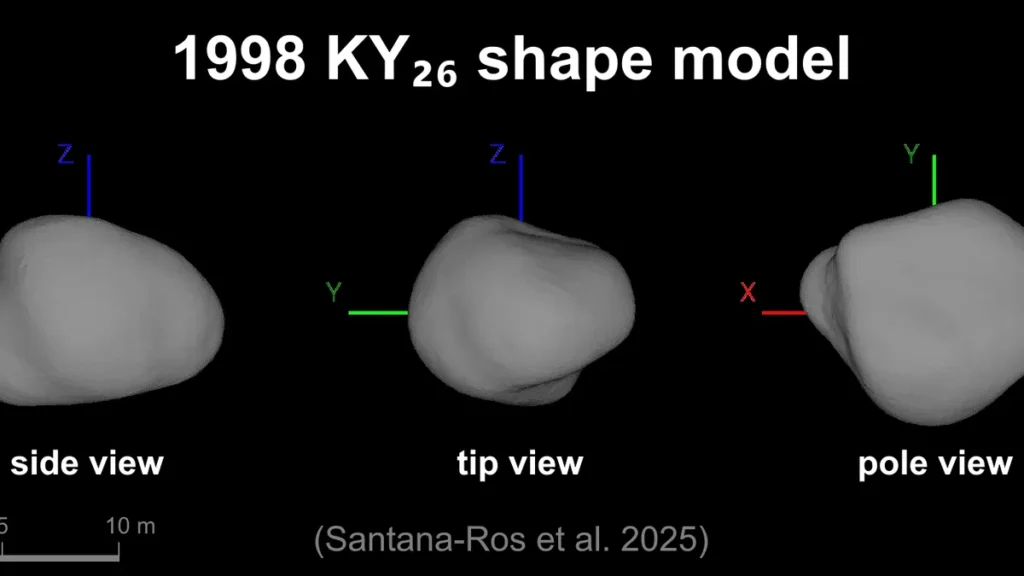
Near-Earth object 1998 KY26 is roughly 36 feet wide and is believed to be an asteroid, though it is accelerating in a way gravity alone cannot explain, Fox News reported. Researchers have proposed outgassing and radiation pressure as possible explanations for the extra push, the report said.
Loeb said the object shows non-gravitational acceleration, meaning something other than gravity is pushing it, and he described asteroids as just rocks. He cited observations that KY26 is highly reflective and completes one rotation about once every five minutes.
According to the Fox News report, one hypothesis is that KY26 is a dark comet, a rocky object that acts like a comet but shows no visible cloud or tail. Loeb rejects that idea because no tail or escaping material is visible around the object. Georgia Tech research has questioned whether KY26 contains enough ice to produce such an effect, and other research suggests sunlight pressure and heat from the object’s surface might explain the acceleration.
Loeb and his colleagues examined whether KY26 could instead be Phobos 1, a Soviet spacecraft that ceased communications while traveling to Mars in 1988. Loeb said the object’s path closely matches Phobos 1’s trajectory and that sunlight reflecting off the spacecraft could generate thrust matching the acceleration seen in KY26.
A conclusive answer could arrive in 2031, when the Japan Aerospace Exploration Agency’s Hayabusa2 spacecraft meets KY26, Loeb said. He said the rendezvous might reveal that researchers have been studying a Soviet artifact rather than a natural body, perhaps turning up a Soviet-made label instead of an iceberg. Finding rock or ice on the object would end the Phobos 1 hypothesis, he said.
Loeb acknowledged that his group has not proven its hypothesis and said a future mission could provide proof or disproof. Fox News Digital contacted NASA to ask whether Isaacman maintains his assessment; NASA had not publicly responded to Loeb’s claims at the time of the report.




Join the discussion