Key facts
- The authorization to proceed is valued at more than $100 million Canadian dollars, equivalent to $72 million.
- Airbus Defence and Space will build the 66 Ka-band Layer 1 platforms under Eutelsat's LEO contract, while Aerospacelab builds 264 dual Ku/Ka platforms for Layer Two launching in 2030.
- IRIS2, the EU Secure Connectivity Programme also known as Infrastructure for Resilience, Interconnectivity and Security by Satellite, is Europe's planned sovereign satellite communications network.
- A July 24, 2025 SpaceX software failure knocked Starlink offline for 2.5 hours across the Ukraine front, and a February 2025 suspension of US military aid raised questions about Starlink availability for allied forces.
MDA Space and Thales Alenia Space announced Oct. 30, 2026 that MDA will supply digital antenna subsystems for 66 satellites in the IRIS2 low-Earth-orbit layer, the same day Canada and the EU held exploratory talks on the network at a summit in Montreal.1
The authorization to proceed is valued at more than $100 million Canadian dollars, equal to $72 million. MDA will supply its Aurora broadband digital phased array antennas and digital antenna controller. The equipment has digital beamforming capabilities and serves as a key enabler for the Layer 1 satellites. Mike Greenley of MDA Space said, “is a landmark moment for MDA Space and our MDA AURORA technology.”1
Thales Alenia Space is a joint venture in which Thales holds 67 percent and Leonardo holds 33 percent. The company contracted MDA Space for the antenna work and will supply governmental payloads for the network’s low Earth orbit satellites. Under Eutelsat’s LEO contract, Airbus Defence and Space will build the 66 Ka-band Layer 1 platforms. Eutelsat contracted the LEO component in September 2026.1
IRIS2 is the EU Secure Connectivity Programme, also known as Infrastructure for Resilience, Interconnectivity and Security by Satellite, and serves as Europe’s planned sovereign satellite communications network. The European Commission awarded the 12-year concession to SpaceRISE, made up of SES, Eutelsat and Hispasat, on Oct. 31, 2024. The award followed review of an optimized best-and-final offer received Sept. 3, 2024, and the concession contract was signed Dec. 16, 2024.1
SpaceRISE dates the Rendezvous 1 implementation agreement signing to Aug. 6, 2026, while Tech Times gives Aug. 7, 2026. The agreement concluded negotiations begun in January 2026 and authorized manufacturing, ground construction and launch procurement. Andrius Kubilius, the European commissioner for defense industry and space, called the agreement a decisive step forward for Europe’s security and digital sovereignty. “Without secure connectivity there is no defence,” Kubilius said.1
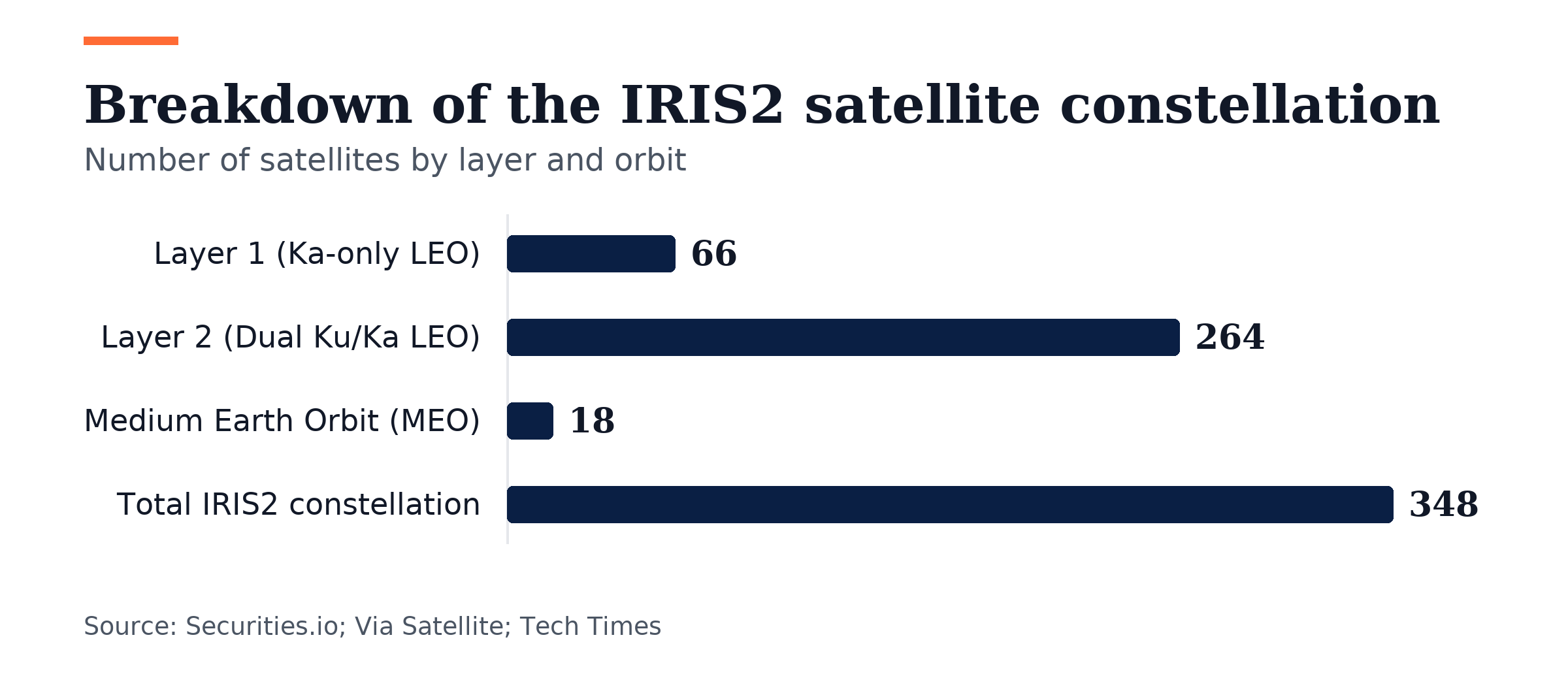
The expanded IRIS2 constellation totals 348 satellites. Of those, 330 operate in low Earth orbit at 1,200 kilometers, with 66 Ka-only spacecraft and 264 carrying dual Ku/Ka capability, while 18 sit in medium Earth orbit at 8,000 kilometers. Aerospacelab builds the 264 dual Ku/Ka platforms for Layer Two, with launches starting in 2030. The 330 low Earth orbit satellites yield round-trip latency of roughly 20 to 40 milliseconds, and the 18 medium Earth orbit satellites cover a wider footprint with longer ground-station contact times; the spacecraft communicate through optical inter-satellite links.1
IRIS2 aims to deliver military-grade quantum-secured communications for European governmental users. It will also host the first secure space-based 5G network. The system incorporates quantum key distribution via EuroQCI along with post-quantum cryptography. The spacecraft are fully reprogrammable, allowing updates from 5G to 6G across the 12-year operational life without replacement. Onboard computers use 7-nanometer chip integration not previously achieved in a European space program.1
IRIS2 carries a funding baseline of about €10.6 billion, or $12.22 billion. Public funds supply roughly €6.5 billion, or $7.49 billion, while SpaceRISE contributes €4 billion, or $4.61 billion, in private investment. The expanded 66-satellite defense layer needs added investment above baseline from EU budget resources for 2028 to 2034 and from member states, including €656 million from Poland, €500 million from Hungary, and between €1.6 billion and €2 billion from Spain. Norway and Iceland participate.1

HispaSat won designation as prime contractor for the full ground segment. Its budget exceeds €1.6 billion, or $1.84 billion, the largest for any European Commission program.1
SpaceRISE has not selected the prime manufacturer for the LEO-High segment’s 270-plus backbone satellites. The company runs competitive dialogues between Airbus Defence and Space and Aerospacelab. The choice remains pending even as work on other elements begins, and it stands as the most consequential manufacturing decision in the program’s history.1
Launching is targeted for 2029, with full operational capability set for 2030. Analysts see full capacity arriving as late as 2032, and no IRIS2 satellites are in orbit yet. GOVSATCOM went operational Jan. 14, 2026. The hub, led by GMV, pools geostationary capacity from France, Spain, Italy, Greece and Luxembourg. Its roughly 600-millisecond latency falls short of low-latency military command and control, and Norway and Iceland joined both GOVSATCOM and IRIS2 in March 2026.1
The IRIS2 antenna deal follows MDA Space’s Aug. 4, 2026 announcement of a $474 million follow-on order of MDA AURORA satellites for Telesat Lightspeed. Telesat Lightspeed is the customer for the follow-on order.1
Canada and the EU announced exploratory talks on cooperating with IRIS2 at an Oct. 30, 2026 summit in Montreal, using an arrangement for dialogue and information sharing. A July 24, 2025 SpaceX software failure took Starlink offline for 2.5 hours across the Ukraine front. A February 2025 suspension of U.S. military aid raised questions about Starlink availability for allied forces.1


Join the discussion