Key facts
- The spacecraft was renamed OSIRIS-APEX (OSIRIS-APophis EXplorer) and is using remaining propellant to head toward near-Earth asteroid Apophis, scheduled to arrive in 2029.
- Dante Lauretta, OSIRIS-REx Principal Investigator at the University of Arizona, said on LinkedIn he felt enormous pride and real sadness that the journey had ended.
- The $1 billion OSIRIS-REx project under NASA's New Frontiers Program won approval in 2011 after two prior rejections from the agency.
- Scientists expected Bennu's surface to be smooth and sandy, but OSIRIS-REx found it covered in jagged boulders and loosely bound material.
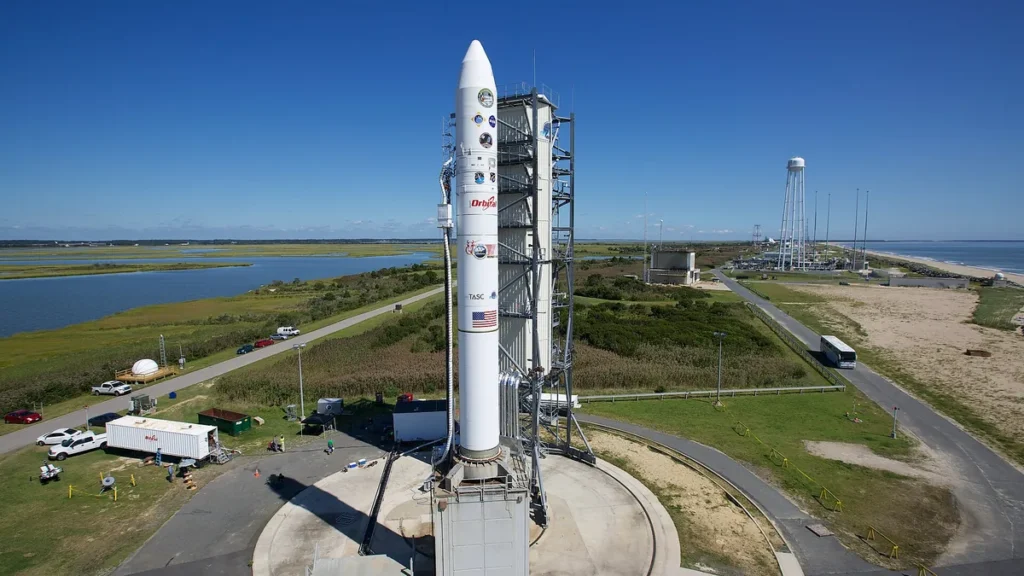
NASA formally concluded OSIRIS-REx on Sept. 30, 2026, ending active flight operations for the first U.S. mission to return a pristine asteroid sample to Earth._NASA’s formal conclusion capped a decade of high-stakes engineering. Dante Lauretta, the University of Arizona principal investigator, said on LinkedIn, “I feel enormous pride in what we accomplished together, and real sadness that this journey has come to an end.”_The spacecraft’s full name is Origins, Spectral Interpretation, Resource Identification, Security-Regolith Explorer. It launched on Sept. 8, 2016, on a two-year journey to Bennu and arrived at the asteroid in late 2018. OSIRIS-REx scooped up a pristine sample of rock and dust from Bennu in October 2020.
The $1 billion New Frontiers Program project won approval in 2011 after two prior rejections from NASA._On Sept. 24, 2023, OSIRIS-REx returned to Earth, and despite a parachute failing to deploy properly during reentry, the capsule landed safely in the Utah desert. The sample collector lid jammed partially open because the team had scooped up too much material, so the team stowed the head inside the return capsule to prevent further loss. The returned sample weighs 4.29 ounces (121.6 grams) on Earth, more than twice the mission’s requirement._In July 2023, OSIRIS-REx began steering to pass within around 155 miles (250 km) of Earth instead of the 1,370 miles (2,200 kilometers) of its original course. On Sept. 21, the spacecraft fired its thrusters for 30 seconds for a course correction, the first trajectory change since leaving Bennu on May 10, 2021.
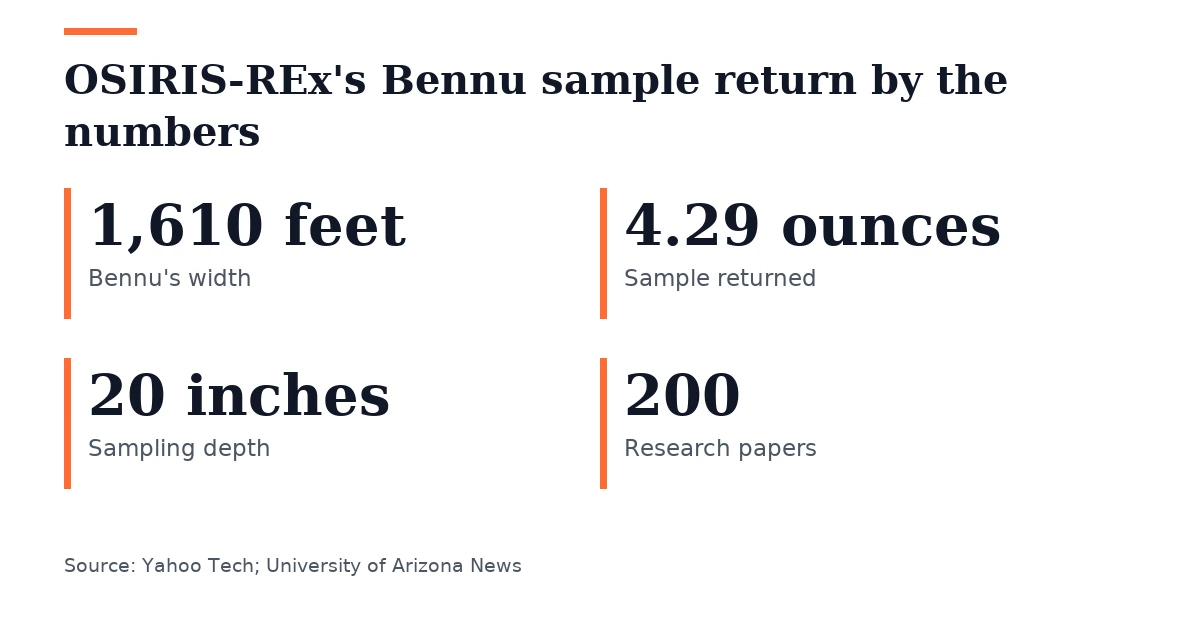
NASA targeted the capsule for a parachute-guided precision landing at the Air Force’s Utah Test and Training Range in the Great Salt Lake Desert._Scientists expected Bennu’s surface to be smooth and sandy, but OSIRIS-REx found it covered in jagged boulders and loosely bound material. Bennu is 1,610 feet wide (490 meters) and became the smallest object ever circled by a spacecraft, earning a Guinness World Record. On Oct. 7, Dante Lauretta said in a University of Arizona statement that expectations about Bennu’s surface were wrong and that no place to collect a sample existed anywhere on Bennu. Andrew Ryan, a scientist at the University of Arizona’s Lunar and Planetary Laboratory, said, “Instead, it looked like it was all boulders, and we were scratching our heads for a while.”_At Nightingale crater in October 2020, the sampling head sank 20 inches (51 centimeters) into Bennu because the surface acted like fluid with little structural resistance, and thrusters fired to pull the head away.
Had the spacecraft not backed away immediately, it would have sunk into the asteroid._Most of the returned Bennu sample is being preserved for future generations, while portions have been distributed to research institutions including the University of Arizona. Lauretta said most of the sample is being preserved for future generations who will study it with questions and instruments we cannot yet anticipate. The majority of the 4.3 ounces of Bennu material remains under careful curation at NASA’s specialized facilities._Researchers have published more than 200 research papers on the composition and history of the returned Bennu sample, identifying amino acids, sugars, signs of liquid water, and organic building blocks of the kind that may have seeded life on Earth. Scientists found evaporites in the sample, never before found in extraterrestrial samples, indicating the ancestor’s interior was warm enough for liquid water possibly for thousands of years.
The sample confirmed Bennu is saturated with water locked inside clay minerals, and scientists believe asteroid bombardments during Earth’s infancy delivered the water for the world’s oceans. Researchers found pieces of asteroid Vesta on Bennu, and the sample also contains stardust from stars that are long dead._Bennu contains pristine remnants from the dawn of the solar system more than 4.5 billion years ago and carbon-bearing compounds coat it. The asteroid was once part of a larger, water-rich parent that shattered in a catastrophic collision in the main asteroid belt between Mars and Jupiter. Tracking data shows Bennu’s impact probability through 2300 is about 1 in 1,750 (0.057 percent), making it one of the two highest known impact risks along with 1950 DA, though scientists say the risk is much lower than previously thought._NASA renamed the spacecraft OSIRIS-APEX (OSIRIS-APophis EXplorer) and is using remaining propellant to head toward near-Earth asteroid Apophis, scheduled to arrive in 2029.

Dani Mendoza DellaGiustina, assistant professor at the University of Arizona’s Lunar and Planetary Laboratory, leads OSIRIS-APEX to observe Apophis during its 2029 close approach to Earth._NASA scientists solved the mystery of why Bennu loses heat quickly despite boulder coverage: returned samples reveal the rocks contain extensive internal cracks. The research appeared in Nature Communications in 2026, volume 17, issue 1. Scott Eckley, an X-ray scientist and study co-author at NASA Johnson, said X-ray computed tomography lets scientists look at an object’s interior in three dimensions without causing damage._Measurements from NASA’s Spitzer Space Telescope in 2007 had indicated Bennu’s surface warmed and cooled rapidly as it rotated through sunlight and darkness. Low thermal inertia describes materials such as beach sand that quickly gain heat in sunlight and lose it once the Sun disappears.
The thermal inertia measured in lab samples turned out much higher than what the spacecraft’s instruments had recorded. Researchers at Nagoya University in Japan examined Bennu samples using lock-in thermography, a laser-heating technique that measures how heat spreads through material._Nicole Lunning, lead OSIRIS-REx sample curator at NASA’s Johnson Space Center, oversaw sample preparation in a nitrogen glove box for X-ray computed tomography scanning. X-ray CT scans produced permanent three-dimensional digital records of sample particles added to a publicly accessible database for study without handling original material. JAXA’s Hayabusa-2 is OSIRIS-REx’s partner mission.
Ron Ballouz, a Johns Hopkins University Applied Physics Laboratory scientist and study second author, said the findings connect remote telescope observations with actual asteroid material structure.


Join the discussion