Key facts
- NASA and its partners mutually agreed to key contract actions to speed up SR-1 Freedom development, actions that program director Steve Sinacore said reduce technical risk and maintain momentum toward the 2028 launch.
- The Department of Energy's Idaho National Laboratory is designing and developing the fission reactor that will be integrated with the power conversion system to complete SR-1 Freedom's nuclear power module.
- Mars launch windows open roughly every 26 months under the Hohmann transfer orbit, making the December 2028 target non-negotiable; missing it means waiting until approximately 2030 for the next chance.
- In March 2026, NASA Administrator Jared Isaacman announced suspension of work on the Lunar Gateway orbital station, freeing the Power and Propulsion Element hardware for reuse on SR-1 Freedom.
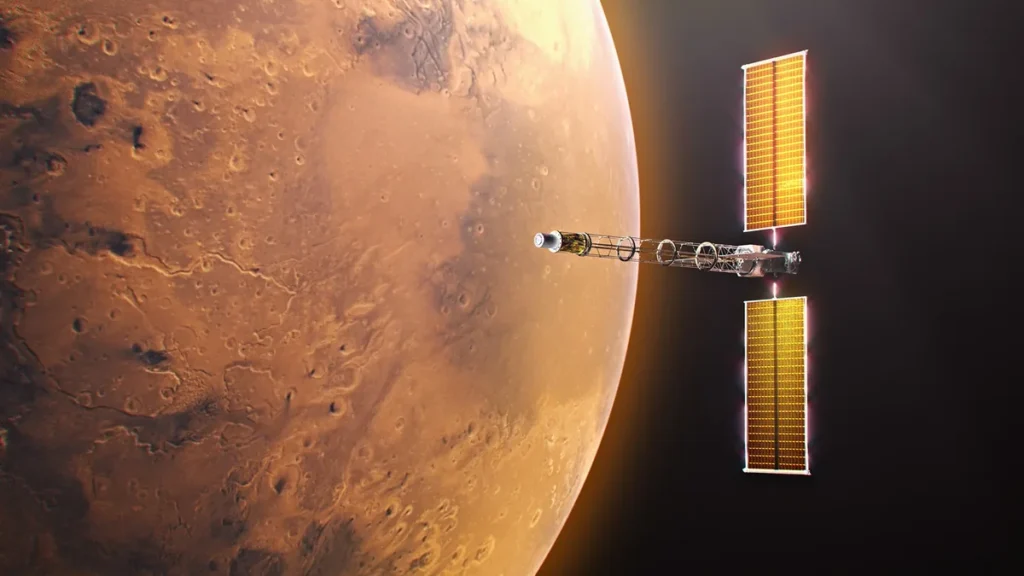
NASA is developing the Space Reactor-1 Freedom, a fission-powered spacecraft intended to demonstrate nuclear electric propulsion in deep space.
NASA advances SR-1 Freedom nuclear power module for Mars mission
Scheduled for launch in late 2028, the spacecraft will carry three Mars helicopters, called SkyFall, to gather scientific data and scout exploration zones.
On Oct. 20, 2026, NASA announced that the Space Reactor-1 Freedom nuclear power module has advanced, with a launch targeted for late 2028. The fission-powered spacecraft is designed to be the first U.S. reactor to operate beyond Earth orbit, demonstrating nuclear electric propulsion. NASA and its partners have agreed to key contract actions to speed up development, which program director Steve Sinacore said reduce technical risk and maintain momentum toward the 2028 launch.
"These contract actions not only reduce technical risk and help us maintain momentum toward our 2028 launch, but they also strengthen collaboration across our partners,"
Steve Sinacore, SR-1 Freedom program director, NASA
NASA introduced the SR-1 Freedom at its Ignition event, which also outlined plans for a Moon base and a successor to the International Space Station. The announcement in March 2026 that NASA would suspend work on the Lunar Gateway orbital station freed the Power and Propulsion Element hardware for reuse on the Mars mission.
NASA plans to begin hardware development roughly 18 months after design finalization, with assembly starting in January 2028 and the spacecraft arriving at the launch site in October 2028.
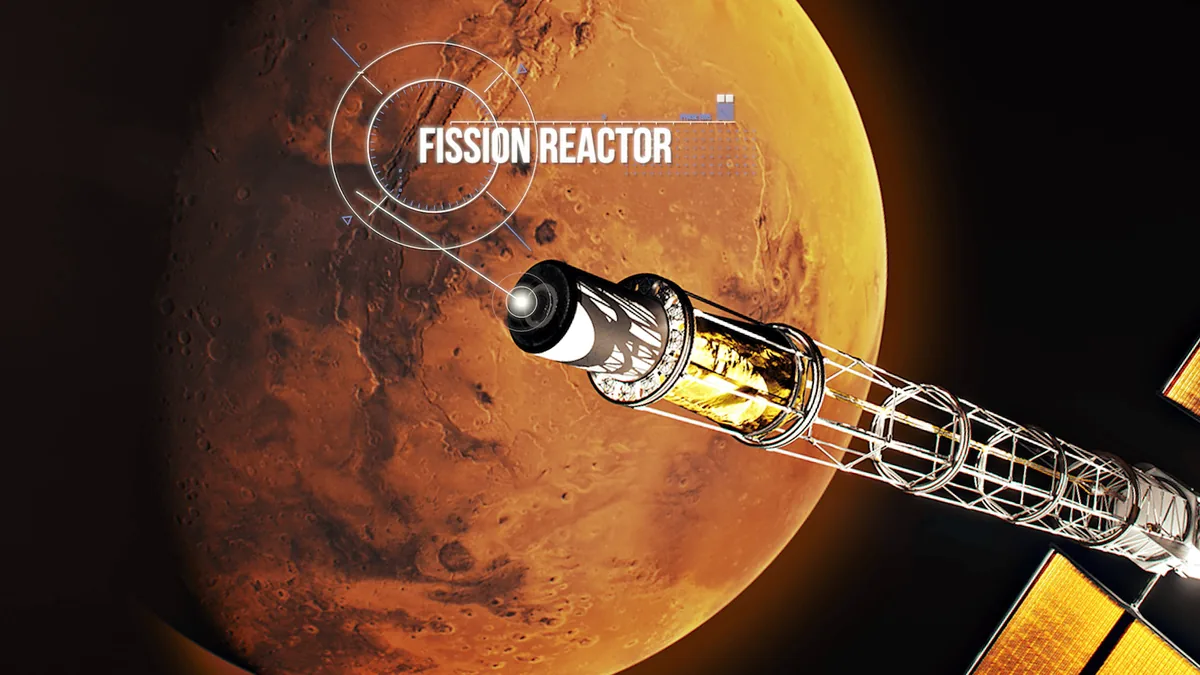
The Department of Energy’s Idaho National Laboratory is designing the fission reactor that will be integrated with the power conversion system. Sierra Lobo Inc. will supply the closed Brayton cycle power conversion system under a contract awarded in 2024, with work taking place at NASA’s Glenn Research Center. The closed Brayton cycle power conversion system turns thermal energy from the fission reactor into the electrical power required for the SR-1 Freedom nuclear electric propulsion demonstration.
The reactor uses high-assay low-enriched uranium dioxide fuel enriched to between 5 and 20 percent U-235 and targets more than 20 kilowatts of electrical power. Heat is transferred via heat pipes and shielded by boron carbide, while a composite material and titanium heat sink manages excess heat.
The spacecraft will carry SkyFall, a team of three Mars helicopters evolved from the Ingenuity design, managed by NASA’s Jet Propulsion Laboratory and co-designed with AeroVironment. Ingenuity, the precursor, completed 72 flights on Mars in 2021 and 2024. Firefly Aerospace won a $13 million subcontract for the entry aeroshell. The helicopters are intended to gather scientific data, demonstrate exploration zones, and identify possible water sources.
The helicopters will scour Mars for subsurface ice, according to CNET. SkyFall’s costs are expected to draw from the approximately $110 million Mars Future Missions budget line within NASA’s Mars Exploration Program.
Primary propulsion comes from seven Hall-effect thrusters: four 6-kilowatt Busek-built BHT-6000 units and three 12-kilowatt Advanced Electric Propulsion System thrusters by L3Harris. Hall-effect thrusters, a type of ion propulsion that uses an electric field to accelerate ions, produce thrust with far less propellant than chemical rockets. These thrusters accelerate xenon ions to exhaust velocities between 10 and 80 kilometers per second, compared to 4 kilometers per second for the best chemical rockets. The specific impulse ranges from 1,200 to 1,800 seconds versus 450 seconds for hydrogen-oxygen engines.
The result is extraordinary fuel efficiency, though at 20 kilowatts the spacecraft will not dramatically shorten Mars transit time compared to previous craft. The mission’s value lies instead in fuel efficiency, endurance, and establishing regulatory and supply-chain precedent.
NASA’s push for nuclear power is driven by the limitations of solar and chemical propulsion for deep space missions. Solar panel efficiency drops to 4 percent of Earth levels at Jupiter and becomes negligible beyond, while the lunar night lasts 14 days, or 354 hours. Liquid propellant mass fraction makes chemical rockets too heavy for efficient crewed flight to Mars. For a long-term Mars base, Sinacore noted that solar power would require “football fields of solar panels.”
These limitations explain why NASA is pursuing nuclear power for deep space and lunar surface operations. Steve Sinacore, the SR-1 Freedom program director, calls these physics constraints rather than engineering problems.
Mars launch windows open roughly every 26 months under the Hohmann transfer orbit, making the December 2028 target non-negotiable. The Hohmann transfer orbit minimizes fuel requirements, making the window a product of orbital mechanics rather than scheduling. Sinacore stated that the schedule must align with the December 2028 window because orbital mechanics will not negotiate.
The propulsion system is based on the Power and Propulsion Element, originally built by Lanteris Space Systems for the suspended Lunar Gateway under a $375 million contract. The PPE was originally designed for asteroid repositioning before being repurposed for the Gateway and now for Mars. The hardware, with a launch mass of approximately 5,000 kilograms, was designed as Gateway’s power and propulsion hub with Hall-effect ion thrusters capable of up to 60 kilowatts of solar electric power. Sinacore said the PPE gives the program a major advantage and is the only thing that makes the mission achievable.
NASA Administrator Jared Isaacman said in March 2026 that the SR-1 nuclear program is not about lobbying for billions for an entirely new mission, citing roughly $20 billion in failed programs over time, and that the Gateway suspension made the PPE available for the Mars probe.
NASA and the Department of Energy are applying thorough safety standards, including interagency safety reviews, continuous oversight by a NASA chief safety officer, and a safety design process focusing on hazards, failure tolerance, and nuclear safety. The reactor will remain inactive until the spacecraft leaves Earth orbit, ensuring no nuclear operation occurs while the spacecraft is still within Earth’s vicinity. Within 48 hours of escaping Earth’s gravity, NASA will activate the fission reactor, while supplementary solar arrays provide power during the early mission phase.
NASA has placed a $2.1 billion price tag on the mission, the first specific dollar figure publicly assigned, in a document sent to Congress. The agency requires $890 million from congressional appropriations in fiscal year 2027, but the House Appropriations Committee has recommended only $10 million, leaving an $880 million shortfall. The gap is described as not a rounding error and represents the program’s most immediate non-technical risk. The spending plan allocates $640 million in FY2026, $890 million in fiscal year 2027, $415 million in FY2028, and $180 million in FY2029, shaped by hardware needing integration readiness by late 2027.
NASA plans to draw money from its exploration account and from the 2025 Working Families Tax Cut Act, which included $2.6 billion originally earmarked for the suspended Lunar Gateway. Associate Administrator Lori Glaze confirmed the funding approach at a June 2026 National Academies meeting. Sen. Jerry Moran, chair of the Senate appropriations subcommittee that funds NASA, supports nuclear propulsion funding and would seek FY2026 funding levels, though appropriated dollars remain below NASA’s stated needs.
The U.S. HALEU supply chain barely exists at commercial scale after the 2024 ban on Russian uranium imports. Centrus Energy’s Piketon, Ohio facility produced about 920 kilograms by mid-2025, with full-scale output not expected until roughly mid-2029. Centrus’s $900 million DOE task order calls for a full-scale cascade within roughly 42 months. The Department of Energy has committed more than $2.7 billion to domestic HALEU production, but the program will likely depend on national laboratory fuel rather than commercial output for the 2028 launch.
America’s only previous fission reactor in space, SNAP-10A, operated for 43 days in 1965 before a voltage regulator failure ended the mission. Unlike the Radioisotope Thermoelectric Generators on Curiosity and Perseverance, which rely on plutonium decay and generate only 110 watts, the SR-1 Freedom reactor is designed to produce 20,000 watts. NASA’s space nuclear work traces to the 1950s SNAP program, which found nuclear power suited for planetary missions like Mars. The SNAP program, launched in the 1950s, established the foundational finding that space nuclear made sense primarily for propulsion to another planet.
If SR-1 Freedom succeeds, Lunar Reactor-1 would be the next project, planned for a 2030 lunar surface landing to provide continuous power for a future Moon base during extended lunar nights. The White House’s National Science and Technology Memorandum 3, issued in April 2026, directed NASA to develop a mid-power space reactor of at least 100 kilowatts-electric for the 2030s, using SR-1 Freedom as the foundation.
- March 2026: NASA Administrator Jared Isaacman announced suspension of Lunar Gateway work, freeing the Power and Propulsion Element for SR-1 Freedom.
- April 2026: The White House issued National Science and Technology Memorandum 3, directing NASA to develop a mid-power space reactor of at least 100 kilowatts-electric for the 2030s.
- June 2026: The Mars Exploration Program Analysis Group warned that absorbing SkyFall's costs could lead to termination of operating Mars missions.
- July 2026: NASA sent a $2.1 billion price tag for SR-1 Freedom to Congress.
- Oct. 20, 2026: NASA announced progress on the SR-1 Freedom nuclear power module.
- January 2028: Assembly of SR-1 Freedom is scheduled to begin.
- October 2028: The spacecraft is expected to arrive at the launch site.
- December 2028: The launch window opens for a Mars mission.
- 2030: Lunar Reactor-1 is planned for a lunar surface landing.
- 1. CNET – CNET, "Mars Just Got Closer: How NASA's SR-1 Freedom Could Rewrite Space Travel", Mar. 25, 2026
- 2. NASA – NASA, "NASA's SR-1 Freedom Advances with Progress on Nuclear Power Module", Oct. 20, 2026
- 3. Mirage News – Mirage News, "NASA's SR-1 Freedom Advances Nuclear Power Module Development", Oct. 20, 2026
- 4. GeekWire – GeekWire, "NASA\u2019s chief talks up nuclear power during \u2018Inspiration Tour\u2019 of Northwest space ventures", Sep. 4, 2026
- 5. ExtremeTech – ExtremeTech, "SR-1 Freedom Mission Could Fulfill NASA's 70-Year Dream of Putting Nuclear Reactors in Space", Mar. 31, 2026
- 6. Tech Times – Tech Times, "NASA Unveils $2.1B Cost for Nuclear Mars Mission as Congressional Funding Falls Short", Jul. 24, 2026


Join the discussion