Key facts
- Post‑flight engineering analysis confirmed that Orion's heat shield performed as expected during reentry.
- After Artemis I heat shield findings, NASA shortened the maximum downrange distance for Artemis II reentry to limit time in the problematic temperature range.
- The Orion heat shield consists of 186 unique blocks of the ablative material Avcoat.
- Post‑flight assessment found Orion’s aerodynamic and aerothermal performance, including heat shield and backshell, matched pre‑flight predictions and ground‑test results.
After the Artemis II mission splashdown off San Diego on April 10, NASA’s post‑flight engineering analysis confirmed that Orion’s heat shield performed as expected during reentry.
Recovery teams, with Navy divers, retrieved the crew from Orion aboard USS John P. Murtha after the splashdown and returned the spacecraft to Naval Base San Diego. Orion landed just 2.9 miles from its target during the Artemis II mission, showing high‑accuracy touchdown.
During reentry, onboard sensors recorded that Orion reached a maximum velocity of 39 times the speed of sound and experienced external temperatures exceeding 4,000 °F (2,200 °C), while cabin temperature stayed in the mid‑70s °F. Telemetry showed that the spacecraft traveled at nearly 35 times the speed of sound and that its entry speed was within one mile per hour of predicted values.
The SLS rocket delivered Orion to its planned trajectory, exceeding 18,000 mph at main engine cutoff and achieving high‑precision orbital insertion. Launch‑pad and mobile‑launcher upgrades made after Artemis I proved effective during the Artemis II launch, experiencing minimal damage despite launch forces.
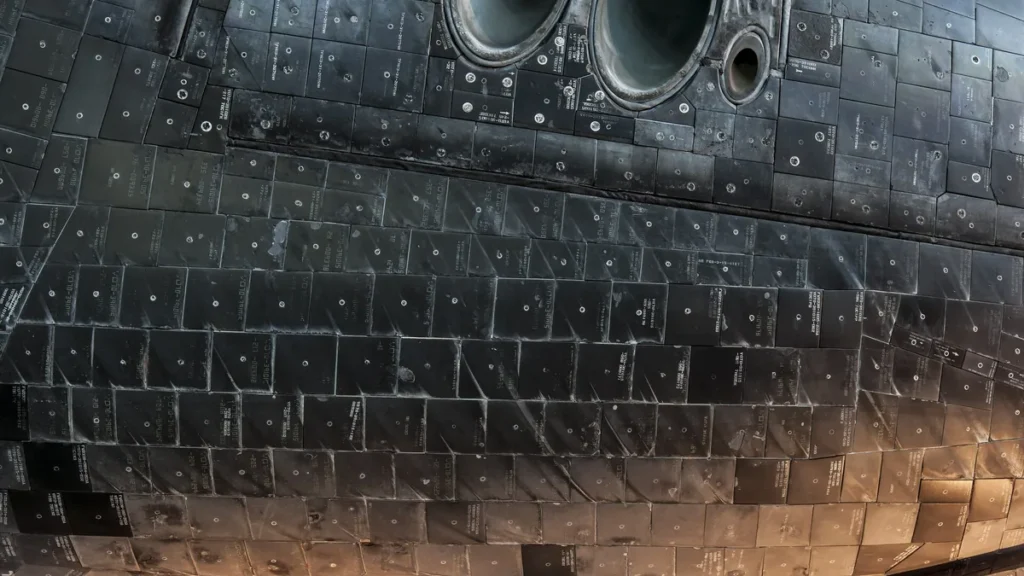
The Orion heat shield consists of 186 unique blocks of the ablative material Avcoat. Design remained consistent from Artemis I to Artemis II, as shown by seam performance between Avcoat blocks and Avcoat around compression‑pad bolts, observed during post‑flight inspection. After return to Kennedy, the heat shield was transported to Marshall where sample extraction and internal X‑ray scans began in August.
Ongoing heat shield sample extraction, material testing and thermal analysis at Marshall support long‑term development, manufacturing and data capture. Post‑flight assessment found Orion’s aerodynamic and aerothermal performance, including heat shield and backshell, matched pre‑flight predictions and ground‑test results.
Initial inspections showed the heat shield performed as expected with a significant reduction in cracks and char loss compared to Artemis I. Laser scans of the heat shield surface were performed post‑flight and are being compared to pre‑flight measurements to determine material recession. Initial inspections indicated the heat shield performed as expected, with charring seen during Artemis I significantly reduced in size and amount.
Post‑flight inspection of Orion’s backshell (1,300 ceramic tiles) indicated expected performance across the crew module, with seal‑and‑protect features meeting expectations and no overheating observed. NASA measured whether the thermal protection system safeguarded the crew and Orion systems during Earth atmospheric entry.
After Artemis I heat shield findings, NASA shortened the maximum downrange distance for Artemis II reentry to limit time in the problematic temperature range. The shortened downrange distance reduced cracking and char loss on the Artemis II heat shield relative to Artemis I by a factor of ten. Engineers counted only nine char‑loss spots on the Artemis II heat shield dish, versus 103 such spots on the Artemis I heat shield.
Following the Artemis I investigation, upgrades were made to the Artemis III heat shield design to achieve uniformity and consistent permeability of the Avcoat blocks. Technicians attached the Artemis III Orion heat shield at Kennedy in early July and joined the crew and service modules by end of July. The spacecraft was powered for the first time to verify connection lines between the crew and service modules.
NASA continues toward Artemis III, preparing Orion for a low‑Earth‑orbit mission. NASA plans to launch SLS and Orion with astronauts Randy Bresnik, Frank Rubio, Andre Douglas and ESA’s Luca Parmitano. The launch will test lander articles for future lunar landings, beginning with Artemis IV in 2028. NASA is targeting an Artemis III launch in 2027, followed by crewed Moon‑surface missions starting in 2028, using Artemis II data for preparation.
Crew commander Wiseman reported a safe splashdown after the lunar flyby, and officials said the heat shield looked good. Aerospace Safety Advisory Panel member Paul Hill described the heat shield condition as “highly satisfying”. The confirmed performance of the Artemis II heat shield gives NASA confidence in the deep‑space vehicle for future lunar missions. He noted approximately nine char‑loss sites on the Artemis II heat shield, compared with more than 100 on the Artemis I heat shield.
Artemis II commander Wiseman stated that investigators found the root cause of the heat‑shield problem and solved it. He affirmed that the heat shield would be safe to fly if they follow the new reentry path.
Before Artemis II, former astronaut Olivas expressed concern about a “deviant” heat shield, questioning its suitability for crew flight. NASA acknowledged uncertainty in qualifying changes to the Avcoat manufacturing process but maintained that the improved heat shield would be crucial for crew safety. Engineers determined that during Artemis I gases inside the heat shield could not vent and dissipate as expected through the Avcoat outer layer, causing outer‑layer loss.
During Artemis II, they flew the ablative heat shield that had suffered large‑chunk loss in a 2022 test flight unchanged. Artemis II used a modified reentry trajectory while flying the same heat shield design.


Join the discussion