Key facts
- NASA announced that applications for its next astronaut class are open, setting a deadline of Dec. 3, 2026, at 11:59 p.m. EST, as reported by Yahoo Tech and CBS News.
- NASA anticipates finalizing its astronaut selections in late 2027, after which the chosen candidates will commence their training program, as reported by Yahoo Tech and Mashable.
- CBS News and Mashable attribute the statement to NASA Administrator Jared Isaacman that picked applicants may set foot on the moon, stay and labor at a lunar base, and help pioneer systems that carry crews to Mars.
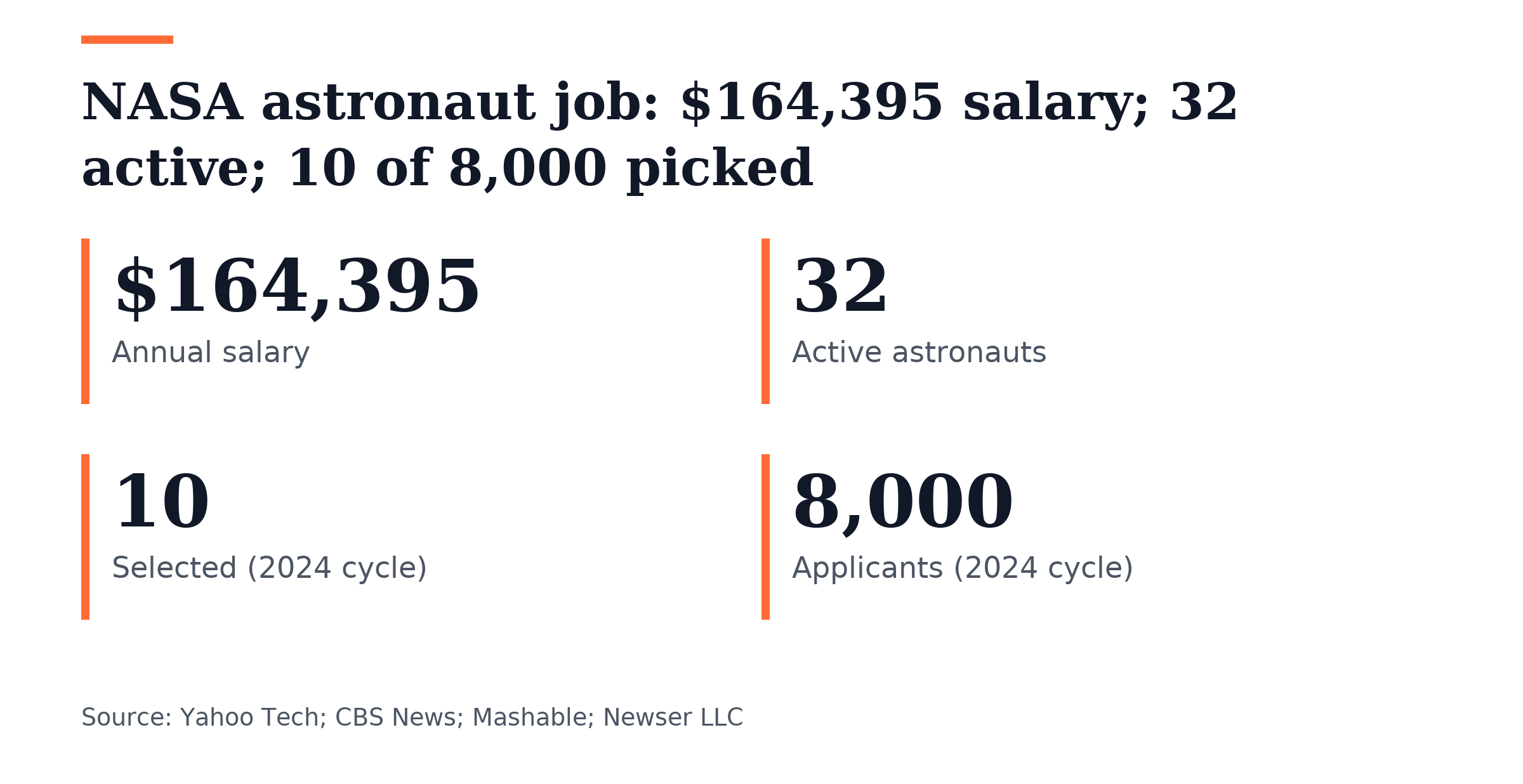
- NASA's application portal describes the astronaut opening as having "few vacancies," pays $164,395 annually, and requires relocation to Houston to work at Johnson Space Center, CBS News reported.
NASA opened applications for its next class of astronauts on Saturday, Nov. 7, 2026, and will accept them through Dec. 3, 2026, at 11:59 p.m. EST via the U.S. government job portal. The announcement was accompanied by a recruitment video featuring Jessica Meir, Andre Douglas, Deniz Burnham, Randy Bresnik, Kayla Barron, Jack Hathaway, and Chris Williams, Mashable reported.
According to NASA, those chosen will train for lunar-surface living and work, help build the lunar base, and make preparations for crewed journeys to Mars. Training takes place at the Johnson Space Center in Houston. NASA Administrator Jared Isaacman said applicants who are picked may set foot on the moon, stay and work at a lunar base, and help pioneer systems for carrying crews to Mars.
Applicants must be U.S. citizens with a master’s degree in a science, technology, engineering and mathematics (STEM) discipline. Alternatives include two years of doctoral coursework, a qualifying medical degree, or an approved Test Pilot School program completed by July 2027, and Test Pilot School applicants must also hold a STEM bachelor’s degree. Qualifying medical degrees include Doctor of Medicine, Doctor of Osteopathic Medicine, Physician Assistant, Doctor of Nursing Practice, Family Nurse Practitioner, or related degrees. Accepted fields are biological science, physical science, computer science, engineering, and mathematics.
Yahoo Tech and CBS News reported that candidates must have at least three years of professional experience after their degree, or flight training. Pilot applicants meet the flight requirement with 750 hours as commander of a high-performance jet, 1,500 total hours with 750 of those commanding fixed-wing aircraft, or 1,000 total hours with 300 commanding rotary-wing aircraft. Initial flight training and drone hours do not count, and medical residencies finished by July 2027 qualify as professional experience.
CBS News reported that applicants must pass medical and psychiatric exams, a long-duration flight physical, drug screening, background checks, and a swimming test, with vision correctable to 20/20 in each eye. They must consent to space deployments of 12 months or longer involving severe isolation, basic living conditions, and time away from family. The work also requires heavy lifting, crouching, crawling, and hazardous conditions.
The position pays $164,395 a year under the 2026 pay rate with no overtime pay, and the rate could change for 2027-2028, CBS News and Yahoo Tech stated. Astronauts must relocate to Houston to work at the Johnson Space Center, remote work is not offered, and NASA may cover moving costs. The agency’s portal lists few vacancies for the role.
Mashable reported that applicants must submit five references rather than recommendation letters, turn in all STEM transcripts, file a pilot qualifications form if required, and track their applications online. All materials go through the U.S. government jobs website.
NASA expects to finalize selections in late 2027, and chosen candidates will begin training after that, Yahoo Tech and Mashable reported. Successful applicants will join the active astronaut corps once training ends. They may later fly progressively harder missions near the lunar South Pole as work on the base continues.
Since the 1960s, the agency has picked 370 astronaut candidates and keeps 32 astronauts on active duty, Yahoo Tech and Newser reported. The 2024 cycle selected 10 people from more than 8,000 applicants; that class, nicknamed The Platypi and designated the class of 2026, is completing its training at the Johnson Space Center.
Mashable reported that after training, new astronauts will work on spacecraft development and maintenance, spacewalks, research, and Mission Control support. Those duties precede any potential Artemis lunar-surface assignment.
Scott Tingle, who chairs the Astronaut Selection Board and serves as chief astronaut at the Johnson Space Center, said, “For those who apply, becoming a NASA astronaut is more than a career opportunity.” The board runs recruitment out of Houston. Matt Anderson, NASA’s deputy administrator, said applications are open and that the applicant is the only missing piece of humanity’s greatest adventure, Yahoo Tech reported.
On Sept. 9, 2026, NASA put Artemis II astronauts Reid Wiseman and Victor Glover into the emeritus program at the Johnson Space Center so they can mentor current employees before Artemis III in 2027, UPI reported. Under the program, people with extensive technical knowledge can donate time to training and mentoring NASA employees while serving in a consultant role that leaves flexibility for other opportunities. Glover will share Orion knowledge with future Artemis crews, and Wiseman plans to share his flight experience with colleagues on the low-Earth-orbit mission ahead of Artemis III.
CBS News reported that four NASA astronauts flew around the moon in April 2026 on a flight that set the record for the farthest distance from Earth. UPI reported that the Artemis II crew of Reid Wiseman, Victor Glover, Christina Koch, and Jeremy Hansen splashed down on April 10, 2026, after a 10-day mission; Wiseman led the mission after 165 days on the space station, while Glover, a former naval aviator, test pilot, and Crew-1 astronaut, piloted it. Artemis III is planned for 2027 to see how Orion connects with commercial crewed landers during operations in low Earth orbit, UPI reported.
Helen Pilcher, a British science writer, wrote in The Guardian that U.S. citizenship rules her out, though she argues that women in midlife bring problem-solving and teamwork skills to lunar missions. She pointed to an ESA model finding that women astronauts use less food and water than men, along with less oxygen, and generate less carbon dioxide and heat. She also cited studies of crews overwintering at Concordia, Antarctica, where mood and coping declined during the long polar winter and people entered psychological hibernation. In a 10-month study, loneliness and conflict rose as shared time increased clashes.

Join the discussion