Key facts
- SUPARCO shortlisted two pilots, Muhammad Zeeshan Ali and Khurram Daud; one will fly as primary payload specialist and the other as backup.
- Planning Minister Ahsan Iqbal went to Beijing for the departure ceremony and was to visit Jiuquan on Monday, Nov. 23, 2026, to meet the two trained candidates.
- The final choice between Muhammad Zeeshan Ali and Khurram Daud follows training; Chinese crew names are expected a day before launch; the final selection and launch date remain unannounced.
- Unlike Chinese crew members who run spacecraft and station operations, Pakistan's representative will mainly conduct microgravity research, including material science and biotechnology experiments.
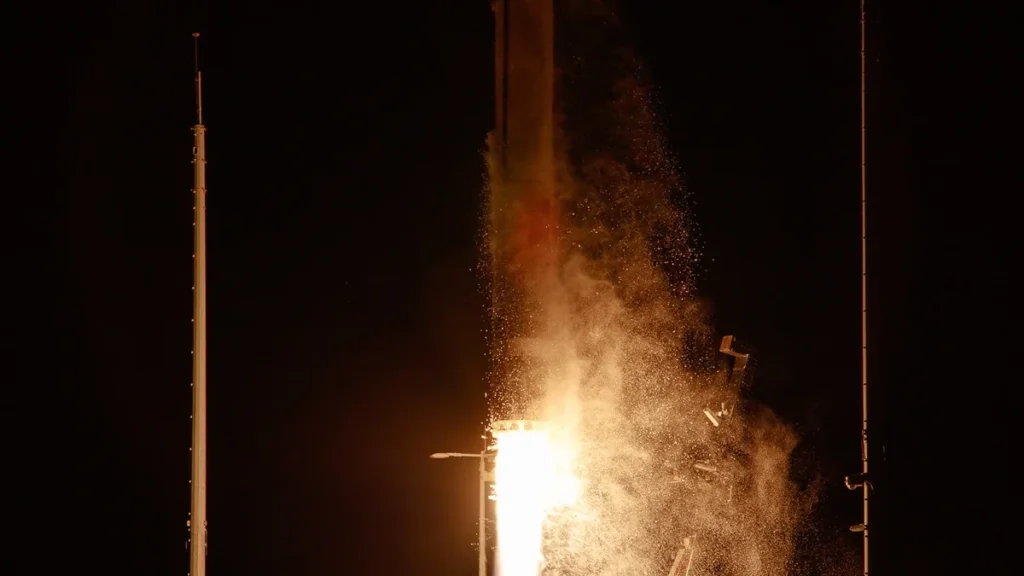
China will launch Pakistan’s first astronaut aboard Shenzhou-24 to the Tiangong space station from the Jiuquan Satellite Launch Center in northwestern China, with liftoff targeted for Tuesday, Nov. 24 at 7:18 p.m. EST according to Astronomy Magazine’s listing citing Next Spaceflight. Around Prague sets the date at Nov. 25, while Daily Times says the China Manned Space Agency has not announced a launch date.
The three-person crew will fly on a Long March 2F rocket and rendezvous with the Tianhe core module of Tiangong. Pakistan’s representative will travel as a payload specialist alongside two Chinese crew members, a pilot and a commander. Around Prague says crew names are generally expected only a day before launch, with the Pakistani astronaut’s identity as the exception, and Daily Times confirms the final selection and launch date remain unannounced.
SUPARCO selected Muhammad Zeeshan Ali and Khurram Daud in April 2026 from a pool of 20 pilots and scientists after medical examinations, psychological evaluations and technical aptitude tests. One will fly as the primary payload specialist and the other will serve as backup. Both completed training at China’s astronaut research and training facilities, covering spacecraft systems, microgravity operations, physical endurance, high-G centrifuge exercises, emergency response and Mandarin.
The visiting astronaut is expected to spend about one week aboard Tiangong and return aboard Shenzhou-23, which Daily Pakistan says is already docked with the station. Unlike Chinese crew members who run spacecraft and station operations, Pakistan’s representative will mainly conduct microgravity research, including material science and biotechnology experiments. Daily Pakistan expects the roughly one-week flight to let Pakistani researchers deepen scientific understanding and gain hands-on experience with experiments in space.
Planning Minister Ahsan Iqbal traveled to Beijing for the departure ceremony and was received by Yang Yunli, Vice President of China Great Wall Industry Corporation, and officials from Pakistan’s embassy. He was to visit Jiuquan on Monday, Nov. 23, 2026, to meet the two trained candidates. “Speaking about the mission, Iqbal described it as a significant step for Pakistan,” Ahsan Iqbal said.
The mission grew out of a February 2025 Islamabad agreement between the China Manned Space Agency and SUPARCO to select and train Pakistani astronauts for short-duration Tiangong missions and allow future Pakistani flights. Daily Times says CMSA announced Pakistan’s Shenzhou-24 participation earlier in November 2026, while The Friday Times dates the announcement to November 7, 2026; Daily Times adds that the agency has not named the chosen candidate. Around Prague describes Shenzhou-24 as China’s 18th crewed spaceflight.
That makes the flight the first joint Chinese-foreign crewed flight of Beijing’s human spaceflight program, the first time a foreign country will send an astronaut to Tiangong and Pakistan’s first human spaceflight mission. Pakistan’s flyer will be the first foreign national to visit China’s space station, which had previously hosted only Chinese crews.
China assembled its own three-module station between 2021 and 2022 after being shut out of the International Space Station and barred from NASA cooperation by the 2011 Wolf Amendment. Daily Times reports China plans to send astronauts to the Moon by 2030, with Tiangong central to its exploration plans. The Friday Times points to the first soft landing on the far side of the Moon, the 2024 Chang’e-6 sample return from that hemisphere, and the Tianwen-1 Mars mission that achieved orbit, landing and roving in a single attempt.
Pakistan and China have already cooperated on terrestrial infrastructure, and Around Prague characterizes the shift to deep-space exploration as a change in their strategic partnership. Daily Times says Pakistan’s ties with China already span trade, investment and defense, and that the astronaut mission adds an area to their longstanding bilateral relationship. Pakistan launched seven satellites on Chinese rockets since May 2024, including ICUBE-Q on Chang’e-6 and PakSat-MM1, plus five more from January 2025 to April 2026 such as PRSC-EO3. Earlier, PRSS-1 and PakTES-1A launched from China in 2018, and the newer PRSC series supply imagery used for defense planning and to watch floods, crops and melting glaciers.
Under the February 2025 agreement, a Pakistani rover will travel to the lunar south pole on China’s Chang’e-8 mission in 2028. The Friday Times, citing the Stimson Center, says Pakistan is the only country with access to BeiDou’s restricted, encrypted service, and its military moved to BeiDou in 2014 after 1999 Kargil-war GPS fears.
Around Prague says the flight would put Pakistan ahead of India by close to a year, since Gaganyaan is expected no sooner than the second quarter of 2027. India’s 2026-27 space budget is Rs13,705 crore, and Shubhanshu Shukla reached the International Space Station in 2025 on a commercial American flight. Meanwhile, SUPARCO’s development allocation was cut by over 90 percent in 2025-26, per Quwa as cited by The Friday Times.
The Friday Times says China has opened Tiangong to experiments from UN member states through a program with the UN Office for Outer Space Affairs and has invited countries into the International Lunar Research Station. The outlet contrasts this with an older Western model under which smaller nations bought commercial seats or accepted political conditions, saying Beijing treats space as a frontier shared by the Global South.
The Friday Times recommends that Pakistan adopt space-related confidence-building measures with India based on the 2005 pact on advance notice of ballistic missile tests. The outlet also says Pakistan should remain open to the European Union, the United States and other partners while building indigenous space capacity alongside SUPARCO.
Around Prague frames the flight as part of China’s growth as a major space power now taking on partners and as Tiangong opening to astronauts from partner countries. The Friday Times presents it as proof that space should not remain the preserve of a privileged few, with nations across the Global South watching how wide the door opens.


Join the discussion