This is a new development in a story we reported earlier: Japan plans to launch the world's first mission to return samples from Phobos, Mars's larger moon.
Key facts
- The Martian Moons eXploration (MMX) mission aims to collect at least 10 grams of soil and rock from Phobos and return the samples to Earth by 2031.
- The MMX mission has a total budget of $578 million.
- The MMX spacecraft has a mass of about 5 tons.
- The MMX return capsule is scheduled to reach Australia in July 2031 with the Phobos samples.
MMX spacecraft separates from H3 rocket, heads to Mars
JAXA confirmed the spacecraft is on its interplanetary trajectory after the predawn Oct. 19 launch from Tanegashima.
On Oct. 19, JAXA announced that the MMX spacecraft had separated from the H3 F10 rocket’s upper stage about an hour after a 4:41 a.m. launch from Tanegashima, putting the probe on a path to Mars. JAXA officials hailed the launch as a success an hour after liftoff, confirming that the spacecraft had separated from the upper stage as planned. Thousands of people watched the launch via livestream as the H3 rocket, co-developed by JAXA and Mitsubishi Heavy Industries, lifted off. The booster is 207 feet tall and powered by a pair of LE-9 engines (liquid oxygen/liquid hydrogen staged combustion engines) that burn liquid hydrogen and liquid oxygen, generating roughly 331,000 pounds of thrust. It also carries four solid rocket boosters.
It also carries four solid rocket boosters.
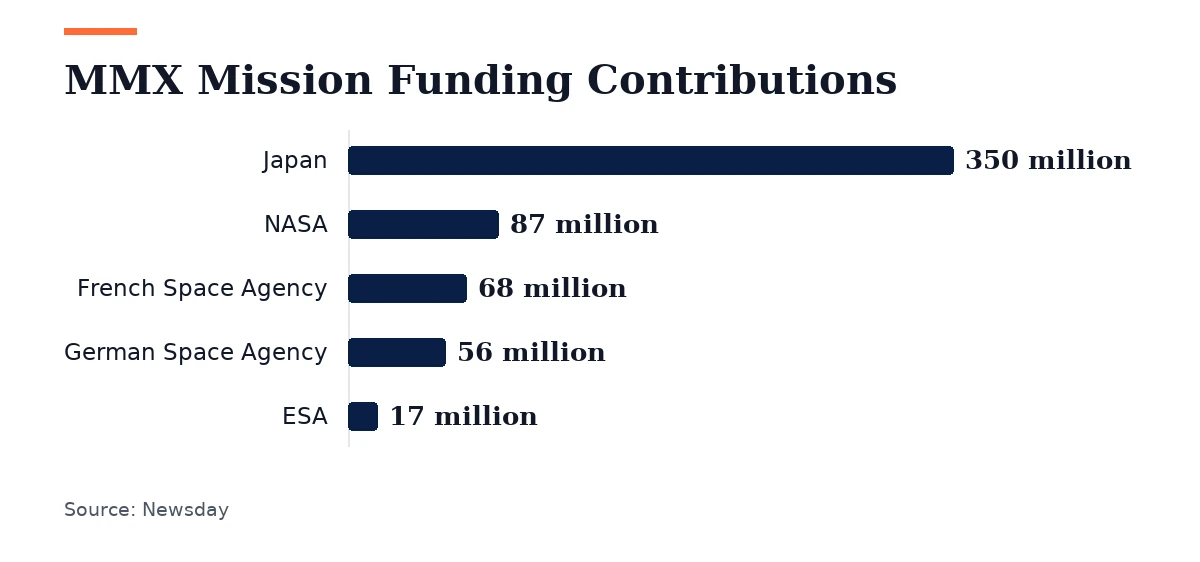
MMX is built to retrieve a minimum of 10 grams of soil and rock from Phobos and deliver the samples to Earth by 2031. The spacecraft weighs about 5 tons, and the mission’s total budget is $578 million. The project involves five space agencies: JAXA (lead), NASA, France’s CNES, Germany’s DLR, and the European Space Agency. Japan is providing $350 million of the budget, with NASA contributing $87 million, CNES about $68 million, DLR roughly $56 million, and ESA approximately $17 million.
The spacecraft is on track to reach Mars in August 2027, following a cruise of roughly one year. It will then match the close orbit of Phobos and spend roughly three years investigating both moons. The plan calls for two landing events on Phobos in late 2028 or 2029, followed by flybys of Deimos. The spacecraft will depart the Martian region in 2030.
The sample capsule is set to touch down in the Australian outback in July 2031, using a recovery approach that JAXA has employed in its two earlier asteroid missions.
Idefix, a rover built by France and Germany, will explore Phobos for approximately 100 days to locate suitable sampling locations. The rover, roughly the size of a microwave oven, travels at a mere 1 millimeter per second and can regain its footing if it lands upside down, but only before its solar panels unfold. The moon’s gravity, roughly 1/1000th of Earth’s, makes the rover bounce for a few minutes when it lands. In late 2028 or 2029, the primary spacecraft will touch down on Phobos twice, employing a drill that bores 2 centimeters into rock and a pneumatic device (a device that uses pressurized gas to collect samples) that blasts pressurized gas to gather loose surface material.
A four-legged lander will remain on the surface for roughly two hours, drilling and sucking up at least 10 grams of material before launching back into space.
Phobos is roughly 14 miles (22 km) in diameter and circles Mars three times daily at an altitude near 6,000 km. Deimos, the smaller moon, is about 8 miles across. Researchers want to know if the moons resulted from a giant impact with Mars or if Mars captured them as asteroids, a mystery that could shed light on how terrestrial planets became habitable. Material from Phobos may hold clues to Mars itself, with some grains likely originating from an ancient impact that created the moons and others from more recent cosmic collisions.
Dating the samples will help researchers build a collision timeline for the Martian region, a record that today depends on the Earth-Moon system. One of the hardest tasks will be confirming which small grains actually came from Mars, since those particles are micron-sized, have no geologic context, and space radiation has exposed them.
Neither Phobos nor Deimos has ever been visited by a lander, and no material from Mars or its moons has ever been brought back to Earth. Russia’s three earlier attempts to return Phobos samples all ended in failure, and Japan’s sole prior Mars venture never made it into orbit. NASA’s Perseverance rover has operated on Mars since 2021 and has stashed sample tubes, but Congress ended funding for the return mission, citing rising costs and doubts about the feasibility of launching from Mars. Because NASA’s return plans are uncertain, researchers see MMX as a critical chance to get Martian system material.
China intends to send its own Mars sample-return mission in 2028, with samples potentially arriving in 2031. That could set up a race between Japan and China to be the first to deliver Martian system material to Earth.
MMX will show technologies that may underpin future crewed Mars missions, including robotic surface sampling and long-duration deep-space communications. NASA is providing the Megane gamma-ray and neutron spectrograph, a pneumatic sampler technology demo (a device that uses pressurized gas to collect samples), and Deep Space Network communications and navigation support. Once JAXA processes and catalogs the returned material, it will distribute portions to international partners. NASA’s Johnson Space Center will receive 15 percent of the sample.
JAXA has already completed two asteroid sample-return missions, giving the agency experience in retrieving material from small bodies. Phobos and Deimos take their names from the Greek god of war’s twin sons, meaning “fear” and “dread.” Tom Statler, a NASA astrophysicist, said, “There’s a lot of adrenaline and a lot of excitement and a lot of wow,” and Briony Horgan, a Purdue University planetary scientist, called it “a chance to get a totally different sample and view of Martian materials.” Markus Grebenstein, the Germany Space Agency’s rover chief, said, “It is a once-in-a-lifetime chance.
We are part of the first sample return mission from the Martian system.”



Join the discussion