
Key facts
- Space experts believe the debris could be part of a Zhuque-2E rocket launched by LandSpace from the Gobi Desert on September 15, 2026.
- On September 15, 2026, LandSpace launched a Zhuque-2E medium-lift rocket from the Dongfeng launch zone at the Jiuquan Satellite Launch Center in northwestern China.
- The Zhuque-2E rocket's flight on September 15, 2026 lasted between 75 and 80 minutes and did not complete a full orbit, putting it on a path to shed debris over the American Midwest.
The farmer said he discovered an 11-foot-diameter circular metal object in his field while harvesting corn in Scott Township, Minnesota, on October 14, 2026, while cutting his corn for the fall harvest. The Stevens County Sheriff’s Office said the prompt from a local resident triggered an immediate response by deputies, who then coordinated with state and federal agencies to investigate the find. The Stevens County Sheriff’s Office said deputies confirmed the debris, describing it as likely originating from space based on its appearance after inspecting and recording its diameter. The Stevens County Sheriff’s Office said officials evaluated the object’s location in a rural cornfield and concluded that, even if it were space debris, it presented no immediate threat to nearby residents or passersby, and the office arranged for the debris to be taken away from the field to allow farming operations to resume.
Ars Technica reported that on September 15, 2026, LandSpace launched a Zhuque-2E medium-lift rocket from the Dongfeng launch zone at the Jiuquan Satellite Launch Center in northwestern China, lifting off carrying a payload of communications satellites. After reaching orbit, the rocket released its satellite payload before conducting the maneuver that set its upper stage on a course toward Earth. The Zhuque-2E rocket’s flight on September 15, 2026 lasted between 75 and 80 minutes and did not complete a full orbit, putting it on a path to shed debris over the American Midwest; a suborbital trajectory (a flight path that does not complete a full orbit) meant the upper stage began its descent shortly after engine cutoff, scattering fragments along a northeastern trajectory across the central United States.
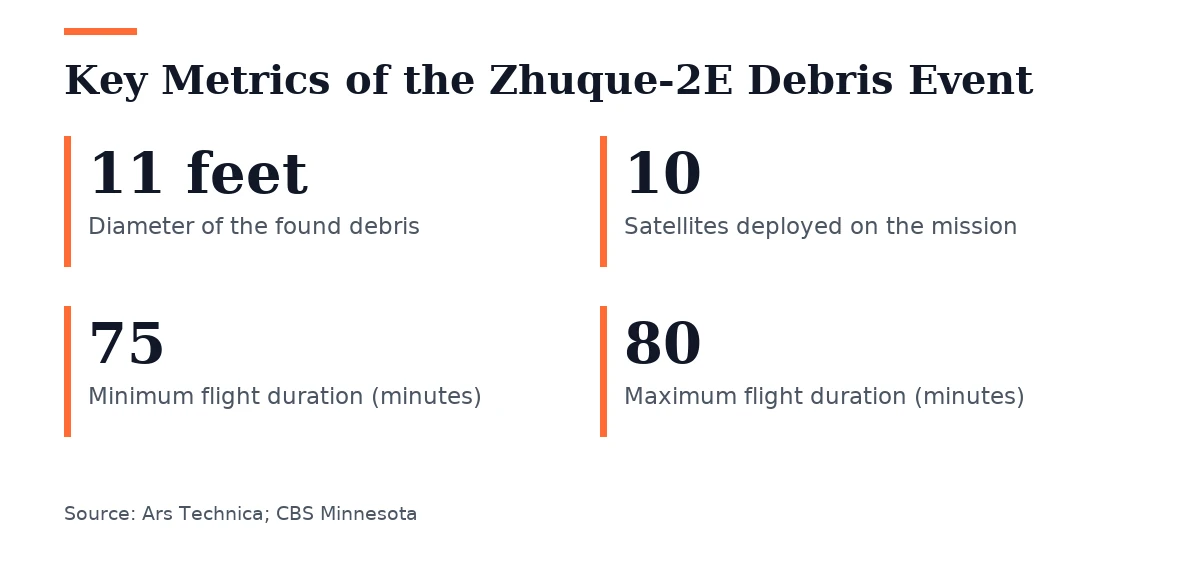
According to Ars Technica, the Zhuque-2E rocket’s upper stage measures approximately 11 feet in diameter, matching the object found in Minnesota. Space experts hypothesize the debris originated from this rocket, given the alignment between the fragment’s dimensions and the launch vehicle’s specifications. Based on the launch date, the trajectory tracked by observers, and the size match, experts have voiced the hypothesis that the fragment originates from the rocket’s upper stage that reentered over the American Midwest. While investigators continue to examine the object, no formal statement has been issued linking the fragment to any specific launch, leaving the connection provisional.
According to Ars Technica, experts used the exact time, location, and direction of the debris to connect it to the September 15 Zhuque-2E launch. According to Geo News, if investigators confirm the debris originated from the Zhuque-2E and caused harm, China could face compensation claims under the convention.


Join the discussion