Key facts
- The probe never reaches the black hole's center because time stretches away to infinity, so reaching it would take an infinite amount of time.
- According to the researchers, the classical singularity lies beyond what quantum probes can physically reach.
- Researchers employed a simplified model to study what a quantum probe would encounter while entering a black hole's interior, in work published in Physics Letters B.
- Real black holes spin and particles have many quantum properties governing interactions, so it is uncertain whether singularities stay unreachable once real-world factors are included.
Physicists used mathematics to send a quantum probe into a black hole’s interior to learn what happens inside massive celestial objects, according to research described by ScienceAlert.
The article clarifies that the experiment is mathematical rather than an actual physical mission. Researchers employed a simplified model to study what a quantum probe would encounter while entering a black hole’s interior, in work published in Physics Letters B.
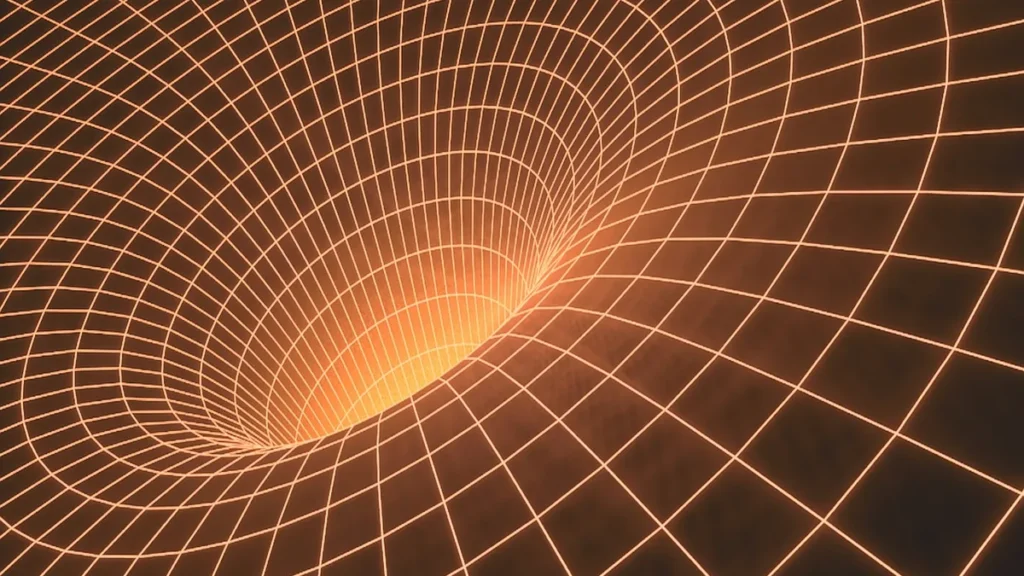
The research was published in Physics Letters B, and ScienceAlert includes this publication detail at the end of its report. ScienceAlert opens by comparing how black holes warp spacetime—the four-dimensional fabric of space and time—to wringing out a wet towel, describing the resulting curvature as extreme enough to trap light.
Theoretical singularities at black hole centers are considered infinitely dense, compressing swallowed stars, planets, and other black holes into an infinitely small space after violent spaghettification—the stretching of objects into long thin shapes by extreme gravity. Singularities are described as the heart of black holes where swallowed matter is compressed after being violently spaghettified. Using infinity as a cosmological explanation may signal a breakdown in understanding rather than proof that physical infinities exist.
The probe never reaches the black hole’s center because time stretches away to infinity, so reaching it would take an infinite amount of time. The article states the outcome is effectively nothing because the probe does not arrive. According to the researchers, the classical singularity lies beyond what quantum probes can physically reach.
Researchers converted the tricky quantum-probe question into a clean geometric experiment to sidestep quantum weirdness and chaotic interior physics. The researchers sought accessible ways to explore concepts they describe as somewhat tricky. The framework gives a purely geometric account of how the altered dynamics affect the quantum probe. These specifications were tailor-made for the model described in the work.
At large scales in the Einsteinian universe—the cosmos as described by Einstein’s relativity—probes are modeled as particles or tiny solid marbles rolling across spacetime curves. This classical picture treats spacetime curves as voluptuous and contrasts with the quantum treatment used at smaller scales. At the smallest scales, the researchers treated the probe as a quantum particle or wave rather than a discrete marble. The shift reflects how quantum-scale entities do not behave like distinct classical objects.
In classical spacetime, entities take the shortest route across a fabric shaped by the gravitational pull of massive objects. This describes object motion under gravity in the classical picture of spacetime. The wave-like probe’s motion is described by two values, amplitude akin to strength and phase akin to direction. These components offer an accessible way to explore what happens as the probe goes deeper toward the singularity—points of infinite density at a black hole’s center.
The team applied a specialized mathematical method to map the probe’s path through the black hole interior because quantum waves spread outward like ripples on a lake. Quantum-mechanical waves do not take clear paths, according to the article. The research team simplified an altered quantum-modified motion that particle-wave entities follow in tiny realms, turning it into a model whose path through a black hole is quantifiable. Future research could increase complexity because this work examined a non-spinning black hole and the simplest quantum probe.
This limitation is presented as a reason future work could ratchet up the complexity. Real black holes spin and particles have many quantum properties governing interactions, so it is uncertain whether singularities stay unreachable once real-world factors are included. This uncertainty follows from the simplifications built into the model. The model suggests an application to exploring the Universe’s birth because the Big Bang is thought to have started from an unimaginably dense point potentially resembling black-hole singularities.
These existential questions are raised alongside the model’s application to the birth of the Universe. The work asks whether cosmic history might stretch without end from a quantum-cosmic probe’s viewpoint. These questions consider whether the greatest mysteries will inherently outpace humanity forever. Some surmise the beginning point is not a singularity but a current, hopefully temporary, hiccup in physics.
This alternative view is offered alongside the idea that the beginning point was a singularity. The work asks whether universal laws prohibit exploring things like singularities, described as phenomena that apparently shape existence. The article frames this as a fundamental cosmic question about phenomena that shape existence.
Join the discussion