Key facts
- Light from the structure, named the Big Ring, traveled 6.9 billion years to reach Earth.
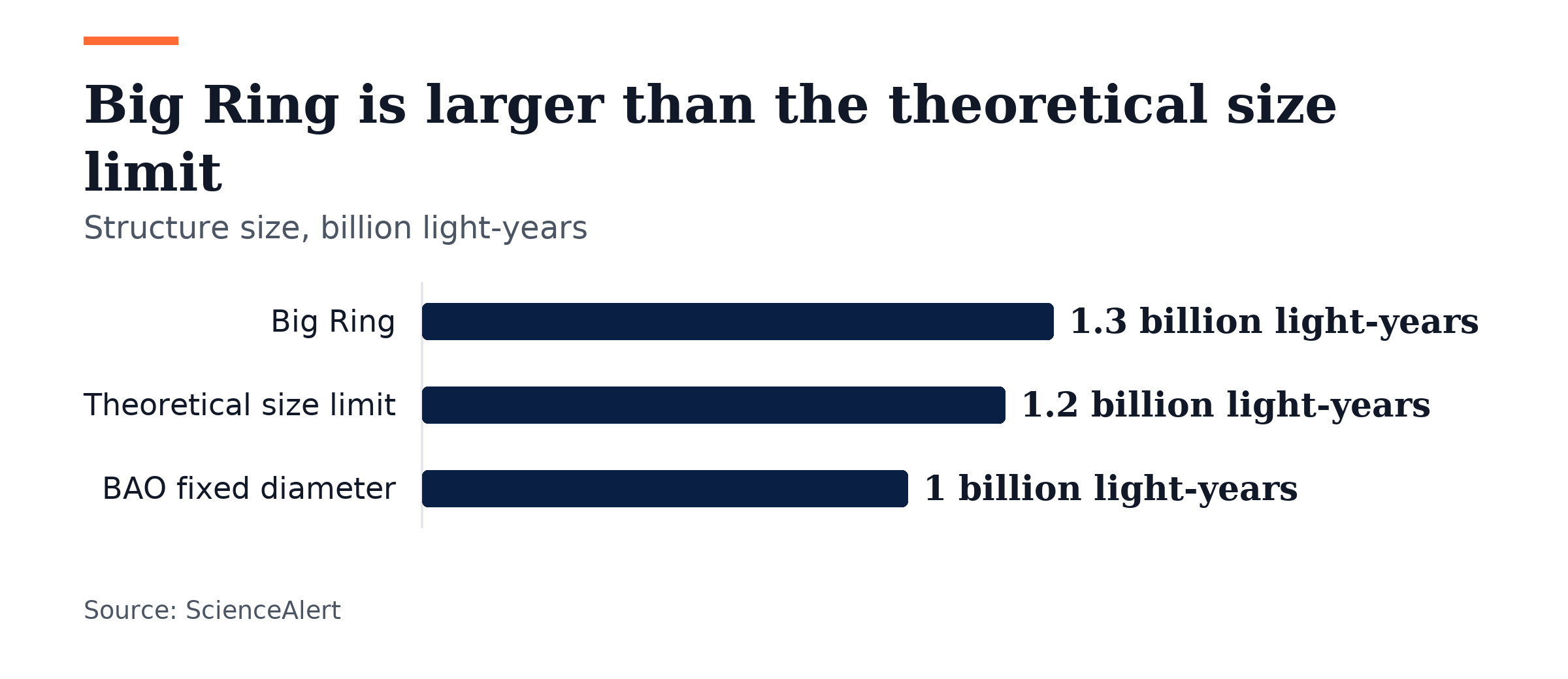
- Cosmologists place the present theoretical size limit for structures at 1.2 billion light-years, so that the Big Ring's existence could mean amendments to the Standard Model of cosmology are needed.
- The Big Ring is unlikely to be a Baryon Acoustic Oscillation because BAOs have a fixed diameter of about 1 billion light-years, while inspections show the Big Ring is corkscrew-shaped and aligned to look like a ring.
- The discovery challenges the cosmological principle, which holds that space should look much the same in all directions on a large scale, because two ultra-large structures share the same distance and part of sky.
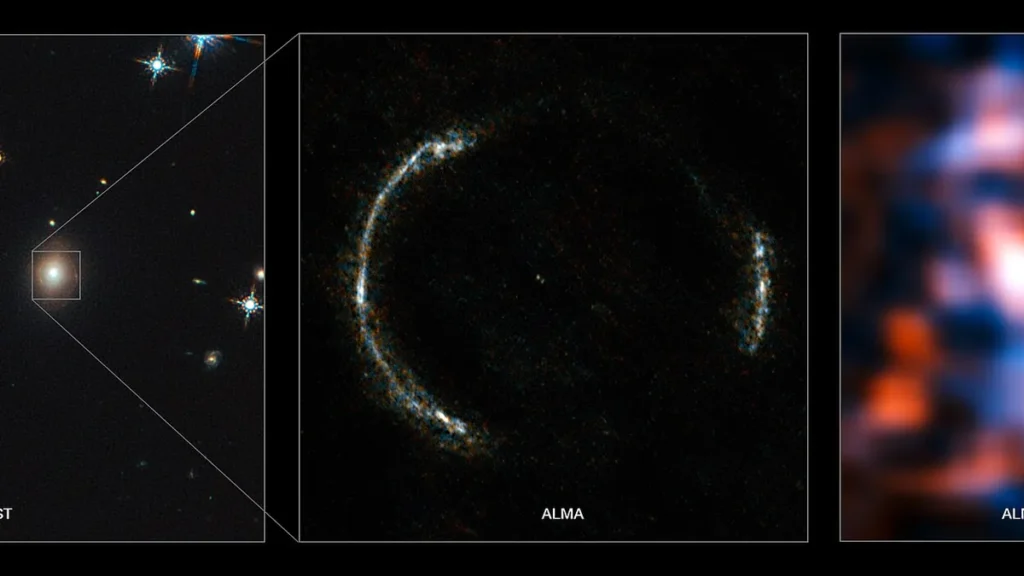
Astronomer Alexia Lopez of the University of Central Lancashire led the discovery of a giant near-perfect ring of galaxies about 1.3 billion light-years across in the distant Universe, ScienceAlert reported. The finding was presented at the 243rd meeting of the American Astronomical Society in 2024 and reported in the Journal of Cosmology and Astroparticle Physics.
The structure is named the Big Ring, and light from it traveled 6.9 billion years to reach Earth. It does not correspond to any known structure or formation process. The source says the structure does not match any known structure or formation mechanism and is defying current understanding of how the Universe evolved.
It is the second giant structure found by Lopez and her colleagues. Alexia Lopez led the team behind both discoveries. The Giant Arc’s discovery was announced in 2021 and puzzled astronomers, and the source says the arc’s announcement created confusion among astronomers before the Big Ring was found.
The source identifies the pair as cosmological neighbors, and the Big Ring deepens the mystery raised by the first structure. Alexia Lopez and her colleagues first discovered the Giant Arc, which resides in the same region of sky at the same distance from Earth as the Big Ring.
Cosmologists place the present theoretical size limit for structures at 1.2 billion light-years, so the Big Ring already exceeds the cap. The Giant Arc is almost three times larger than that limit, and the Big Ring’s circumference is on the same scale as the Giant Arc’s length. This size discrepancy is one of the problems the discovery poses for cosmology alongside the challenge to the cosmological principle.
The current cosmological model fits observations best, but some features are difficult to account for within its framework. The Big Ring’s existence could mean amendments to the Standard Model of cosmology are needed. The source presents this as the backdrop for why the Big Ring and Giant Arc are prompting researchers to reassess assumptions about matter distribution and early-universe development.
The discovery challenges the cosmological principle, which holds that space should look much the same in all directions on a large scale. Lopez said researchers expect matter to be spread evenly across space when viewing the Universe on a large scale, so there should be no obvious irregularities beyond a certain size. Both structures exceed the theoretical size limit, and they appear in the same region of sky at the same distance from Earth.
Lopez said researchers did not believe structures of this scale could exist. Current cosmological theories suggest maybe one exceedingly large structure could exist in the entire observable Universe, according to Lopez. She called the two huge structures and cosmological neighbors extraordinarily fascinating. “We didn’t think structures on this scale were possible,” Lopez said.
The finding is therefore forcing a reassessment of cosmological assumptions about matter distribution and early-universe development. The source attributes Lopez’s remark to her in connection with the Big Ring and Giant Arc, emphasizing that current theories did not predict such enormous formations.
The most immediate proposed link for the Big Ring is a Baryon Acoustic Oscillation, but inspections show the ring is corkscrew-shaped and aligned to look like a ring. BAOs are spheres formed from acoustic waves from the early Universe that froze when space grew too diffuse for the waves to continue. They have a fixed diameter of about 1 billion light-years. The source describes BAOs as giant circular arrangements of galaxies found throughout space.
The source says BAOs are galaxy arrangements found across space, created when early-Universe acoustic waves froze once space grew too diffuse for the waves to travel. It says this origin makes the Big Ring an unlikely match because BAOs have a fixed diameter and the Big Ring looks like a corkscrew aligned as a ring.
Roger Penrose’s conformal cyclic cosmology proposes endless Big Bang expansion cycles that would produce ring structures, though that model has serious problems of its own. The source offers this as one alternative model proposed to address features that are hard to explain in the standard framework. It notes that conformal cyclic cosmology is not without its own difficulties.
Cosmic strings are thought to be proton-wide wrinkles in spacetime that emerged as the early Universe stretched and froze into place. The source describes cosmic strings as a kind of topological flaw woven into the fabric of spacetime and offers them as another possible explanation for the ultra-large structures. Little physical evidence of cosmic strings has been found, but the theoretical evidence looks promising.
Nobody knows for sure what the Big Ring and Giant Arc signify. They could be chance arrangements of galaxies, though the likelihood seems small. The source acknowledges uncertainty about the meaning of both structures and says they could represent rare or chance configurations.
The best hope for understanding the structures is to find additional similar galaxy groupings spread across the Universe that remain hidden in plain sight. The source presents this as the next step for researchers, given that both structures remain unexplained.



Join the discussion