Key facts
- Researchers investigate how photochemistry alters atmospheres released from varied Earth-sized planets through the magma ocean phase, and evaluate whether sulfur can indicate the oxidation state inside.
- A grid of planetary evolution models was run by the team, spanning different mantle redox conditions, stellar irradiation levels, and host-star light spectra.
- For each simulation case, the authors compare atmospheric compositions using three post-processing calculations: thermochemical equilibrium, disequilibrium vertical transport, and vertical transport plus photochemistry.
- Bulk atmospheric composition stays controlled by mantle redox state and the outgassing history.
Astrobiology Web reported that researchers Ioannis Panagiotou, Tim Lichtenberg, Shang-Min Tsai and Harrison Nicholls argue in a new preprint posted Nov. 20, 2026 that sulfur-driven photochemistry in the atmospheres of rocky worlds can reveal the oxidation state of the mantle underneath, connecting gases released from the interior to atmospheres that can be observed.
Mantle redox state means the oxidation state of the mantle, and it helps set the makeup of a secondary atmosphere — one built from gases released from the interior rather than captured from the disk around a young star. The paper frames volatile outgassing from planetary interiors as controlling secondary atmosphere composition on rocky exoplanets. Mantles that are reduced produce atmospheres rich in hydrogen and methane while mantles that are oxidized yield atmospheres dominated by carbon dioxide and water, with the overall makeup set by the mantle and how gases were released over time.
The team investigated whether sulfur can reveal a planet’s interior oxidation state by tracking atmospheres released from varied Earth-sized rocky planets as they pass through the magma ocean phase (a molten early stage of a rocky planet), assessing whether sulfur serves as a marker of internal oxidation state. Photochemistry — chemical changes driven by starlight — alters outgassed atmospheres and can change the chemical makeup of gases released from a planet’s interior. They linked PROTEUS, a planetary interior-atmosphere evolution modelling framework, with the chemical models FastChem and VULCAN. The work examines photochemical modification of outgassed atmospheres during the magma ocean phase.
The team ran a grid of planetary evolution models covering various mantle redox states, levels of stellar irradiation, and spectra from different host stars. In every model run, the authors compared atmospheric makeup through three calculations: thermochemical equilibrium, the chemical balance driven by heat; disequilibrium vertical transport, where gases move in ways that push chemistry away from balance; and vertical transport plus photochemistry, which combines mixing with light-driven chemistry.
Light-driven chemistry changes the thin upper atmosphere by stripping away neutral gases and boosting reactive fragments. Even so, the overall bulk makeup stays tied to the mantle and how gases were released over time, meaning the interior still sets the base chemistry.
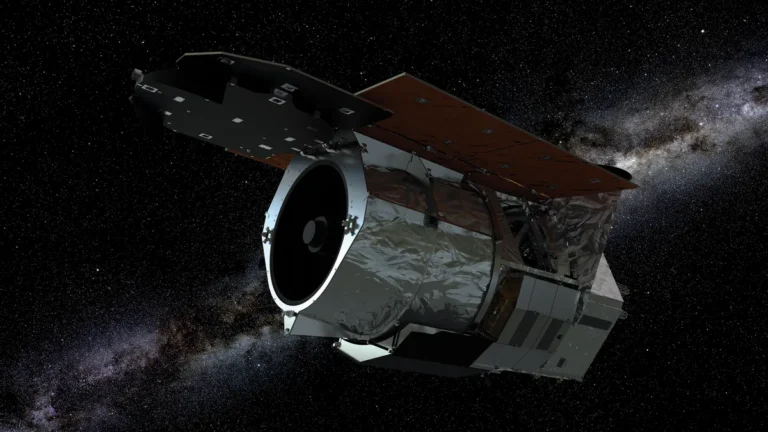
In models of an oxidised mantle, computer-generated spectra show sulfur dioxide absorption features at roughly 60 parts per million near 4 micrometers and at roughly 100 parts per million near 7.3 or 8.7 micrometers, then falling back to about 30 parts per million and about 50 parts per million. Parts per million is a measure of concentration, and sulfur dioxide is a gas made of sulfur and oxygen. The researchers say these signals might be detectable using the James Webb Space Telescope, which supports focused observation campaigns.
The paper appears on the preprint server arXiv — a site where scientists share papers before formal publication — and has been accepted for publication in the journal A&A, or Astronomy & Astrophysics. Astrobiology Web reports the work as a single preprint.
The initial submission arrived on Thu, 16 Jul 2026 at 17:01:27 UTC, or Coordinated Universal Time, and measured 1,504 KB. Version 2 was submitted on Fri, 20 Nov 2026 at 12:49:26 UTC and measured 2,085 KB. On arXiv, the paper is listed under Earth and Planetary Astrophysics and Geophysics. Earth and Planetary Astrophysics studies planets and planetary systems, while Geophysics covers the physics of planets.
The preprint notes that chemical processes far from equilibrium can strongly reshape hot Jupiter atmospheres, citing observations. It also says scientists still do not fully understand how gases released from the interior and light-driven chemistry jointly determine atmospheric makeup, calling this an open question.

Join the discussion