Key facts
- NASA's Hubble Space Telescope imaged a dense stellar field toward the Milky Way's galactic bulge as part of a survey supporting the Nancy Grace Roman Space Telescope.
- The data will assist researchers in reading Roman's future observations of stars and exoplanets in the crowded Milky Way bulge region.
- The new Hubble observations come from observing program number 17776, led by S. Terry, and are designed to assist Roman in finding exoplanets, black holes, neutron stars, and additional targets.
- Hubble used wavelengths overlapping Roman's sensitivity, including the red visible range and near-infrared, so researchers can compare the two telescopes' observations of the region.
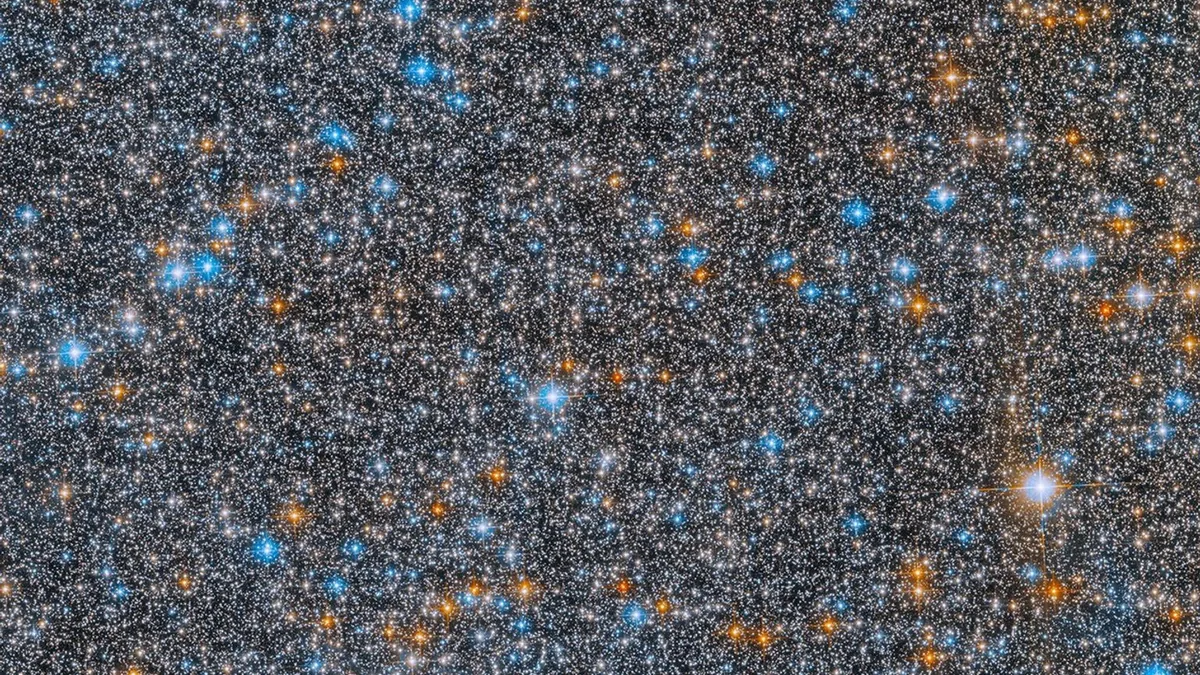
NASA’s Hubble Space Telescope imaged a dense stellar field toward the Milky Way’s galactic bulge on Nov. 25, 2026, as part of a survey supporting the Nancy Grace Roman Space Telescope. The images show an expanse of stars in a rainbow of colors toward that densely packed spherical region around the center of the galaxy’s disk.
These observations belong to a survey meant to support Roman’s future observations of stars and exoplanets in that crowded part of the galaxy. NASA said the data will assist researchers in reading Roman’s future observations of stars and exoplanets in the crowded Milky Way bulge region.
NASA said the observations come from Hubble observing program number 17776, led by S. Terry. The program is designed to assist Roman in searching for exoplanets, black holes, neutron stars, and additional targets.
Hubble used wavelengths overlapping Roman’s sensitivity, including the red visible range and near-infrared, so researchers can compare the two telescopes’ observations of the region. Hubble primarily observes ultraviolet, visible, and near-infrared light. Near-infrared is light just beyond the red edge of the visible spectrum.
Roman will search for exoplanets using microlensing events, a gravitational lensing effect where a closer object’s mass magnifies and distorts light from a farther star to reveal the foreground star and planets. Microlensing is a form of gravitational lensing where the mass of a closer object magnifies and distorts light from a more distant object along the line of sight. Roman’s exoplanet strategy depends on capturing these events.
These microlensing events involve stars and planets, a much smaller scale than the galaxy- and cluster-scale gravitational lenses described by the source. Galaxies and galaxy clusters produce larger gravitational lenses.
Hubble will describe stars in the area prior to any lensing event. Months or years later, researchers can compare Hubble data with Roman data of the event to simplify interpretation.
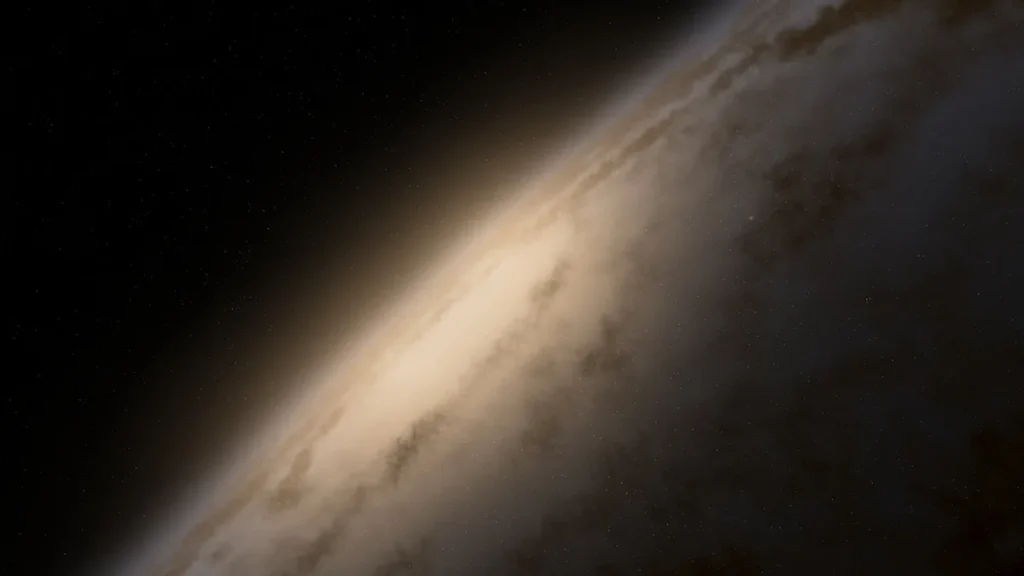
According to the source, the Milky Way’s bulge contains about a quarter of the galaxy’s stellar mass. Because the bulge is nearby, researchers can examine it more closely than crowded, distant bulges in other galaxies. Crowded galactic bulges in other galaxies are too jam-packed and far away for researchers to resolve individual stars.
Researchers hope studying the Milky Way’s galactic bulge will yield new planets and improve understanding of how galaxies form, evolve, and interact across billions of years. Astronomers study the Milky Way’s bulge because other galaxies’ bulges are too crowded and distant to resolve individual stars.
The Milky Way’s galactic bulge is a densely packed, spherical region of stars that surrounds the center of a galaxy’s disk. The bulge’s mass share and closeness make it a valuable laboratory.
One earlier Hubble legacy survey, the WFC3 Galactic Bulge Treasury Program, used Wide Field Camera 3 to measure stellar brightness, exact positions, and motions in the galaxy’s crowded central bulge. The WFC3 Galactic Bulge Treasury Program is one of several legacy surveys Hubble has conducted of the galaxy’s central bulge over its lifetime.
Another legacy survey, the Sagittarius Window Eclipsing Extrasolar Planet Search, employed the Advanced Camera for Surveys to examine 180,000 stars in our galaxy’s bulge. It is cited alongside the WFC3 program as part of Hubble’s continuing high-precision legacy of bulge observations.
Hubble’s high-resolution instruments can record stellar brightness, ages, composition, and motion across time. Astronomers can use that information to hunt exoplanets, locate black holes or dark matter, and understand galactic evolution.
Roman focuses on near-infrared light and some visible light. Because Roman gathers near-infrared and some visible light, Hubble observed the bulge at comparable wavelengths to allow direct comparison between current and future observations.
Join the discussion