Key facts
- NASA plans to fly three Ingenuity-class Mars helicopters to the Red Planet aboard the Space Reactor-1 Freedom (SR-1), the agency's first fission nuclear-powered interplanetary spacecraft, with launch set for late 2028.
- After an initial Mars flyby in 2029, SR-1 will make a second approach in the Fall of 2030 to deploy a SkyFall entry capsule carrying the helicopter fleet.
- SkyFall's prime mission is planned for six months with a one-year goal, and NASA intends to arrive during northern spring on Mars to avoid dust storms.
- Each of the three identical SkyFall helicopters carries a nominal payload of five scientific instruments plus engineering navigation cameras.
NASA intends to launch three SkyFall helicopters to Mars aboard the first fission nuclear-powered interplanetary spacecraft, the Space Reactor-1 Freedom, in late 2028.
Following a Mars flyby in 2029, the craft is due back in the Fall of 2030 to release a SkyFall entry capsule bearing the helicopter fleet. After release at roughly one kilometer above the surface, each craft will start its rotors and touch down on its own, then begin flights every other Martian sol. A sol lasts roughly 24 hours, 39 minutes and 35 seconds.
After landing, the craft may cover distances ranging from tens to hundreds of kilometers in different directions. NASA plans a six-month prime mission with a one-year goal, targeting arrival in northern spring to avoid dust storms. Golombek, JPL’s SkyFall project scientist, discussed the timing at a Nov. 10, 2026 virtual meeting. The Mars Exploration Program Analysis Group held the meeting.
The three identical helicopters each carry five scientific instruments and engineering navigation cameras as a nominal payload. Their instruments study subsurface structure, surface shape and geology, atmospheric weather, and radiation. One important tool is ground-penetrating radar that uses a flexible antenna to find buried rocks, soil layers, and ice below the surface.
Golombek called SkyFall the shortest Mars mission ever devised and described the helicopters as the smallest landers ever dispatched to the planet. He said the mission will show how helicopters explore and close what he calls a resolution gap between orbital data and surface data. Looking from above would help planners pick rover routes and choose detailed surface studies for later missions.
Scott Hubbard, who formerly led NASA’s Ames Research Center and served as the first Mars Program Director, says programmatic or political motives drove approval of SkyFall. “It is clear that SkyFall was approved for programmatic or political reasons,” Hubbard said. He calls the coupling of SkyFall with the nuclear rocket a shotgun marriage that creates unusual management issues.
He says the setup reverses the usual science-mission sequence, so researchers must shape requirements around what the helicopters can already do. He says nuclear electric propulsion does not shorten Mars trips, so it has little value there, though it helps with risk reduction and could serve Moon, outer planet, and interstellar missions. He says the current process cannot support the design of strategic missions meant to serve as human-exploration precursors.
He says the mission grew out of Ingenuity as a step past a technology demonstration toward a science platform. Work began in March 2026, and the team has expanded from about six people to over 200 individuals. Golombek says SkyFall could fly on a conventional rocket such as a Falcon 9 if the nuclear craft misses the 2028 launch window.
JPL ran 137 tests of Mars helicopter rotor blades in March at a Southern California simulator filled with carbon dioxide to imitate the thin Martian air. Tips hit Mach 1.08, going past the speed of sound, and lift rose by 30 percent with the blades intact. “We thought we’d be lucky to hit Mach 1.05, and we reached Mach 1.08 on our last runs,” said Shannah Withrow-Maser, an Ames Research Center aerodynamicist.
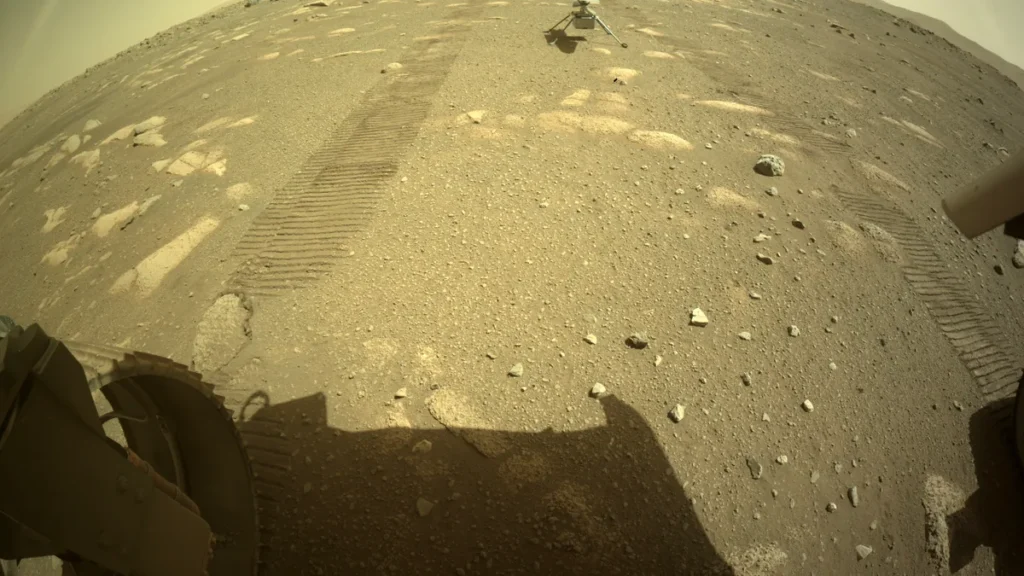
Another rotor under consideration for SkyFall has two slightly longer blades and reaches near-supersonic speed at 3,570 revolutions per minute before simulated headwinds begin. Test results from the rotors now appear in SkyFall’s performance specifications. Ingenuity achieved the first powered, controlled flight at another planet on April 19, 2021, flew 72 times, and held blade tips at Mach 0.7 while turning 2,700 revolutions per minute.
NASA researchers working with Imperial College London and Nagoya University created the roamx-0201 airfoil, which wind tunnel tests suggest could stretch a single flight from Ingenuity’s 0.7 kilometers to 18.7 kilometers while carrying instruments. The AIAA Journal published work on the roamx-0201 blade design on Sept. 22. The blade design disturbs the boundary layer at the front edge to make an upward-pulling disturbance that boosts lift compared with older shapes.
Drag divergence creates sudden performance loss as rotors near the speed of sound, and that speed is lower on Mars than on Earth. Mars sound speed is about 540 mph, while Earth’s sea level speed is roughly 760 mph.
Arcadia Planitia, in Mars’s northern lowlands, is a candidate landing site because studies show large amounts of ice just below the surface there. One early idea would fly back to discarded SkyFall hardware, such as fuel tanks and cruise stages, to create icy craters where subsurface ice sits within centimeters of the surface. He says ice can be used for life support and return fuel, so human landing-site talks focus on icy spots.
The science community will give input on SkyFall science and landing sites in two workshops next year, and NASA Headquarters will make final landing-site decisions. JPL says the helicopters could reach areas that traditional rovers cannot access. That would expand how scientists investigate the Martian surface. JPL notes that Ingenuity is still the only rotorcraft to have flown on another planet.




Join the discussion