Key facts
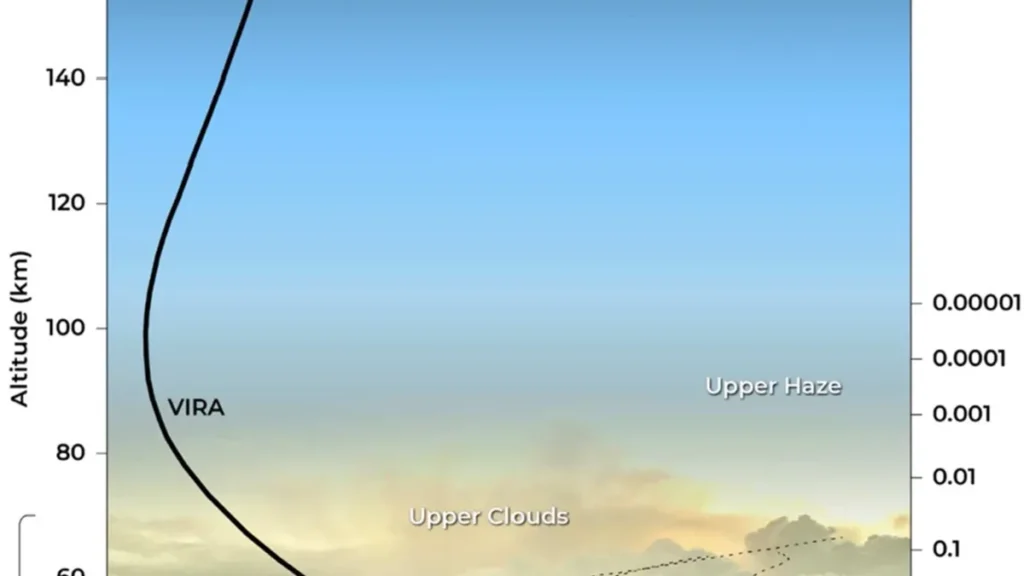
- Researchers using the James Clerk Maxwell Telescope conducted three multi-week campaigns monitoring HDO and SO2 absorption in Venus's upper mesosphere at approximately 80–110 km altitude.
- The campaigns occurred in February 2022, July 2023, and August–September 2023.
- SO2 in the upper mesosphere was largely absent in February 2022 but present in both 2023 campaigns, and researchers suggest it may track the same long-term pattern seen at cloud tops.
- Long-term variability in H2O has been identified for the first time and is read as an inverse response to SO2 changes over time, likely through H2SO4 formation.
Researchers using the James Clerk Maxwell Telescope ran three multi-week campaigns in February 2022, July 2023 and August–September 2023, measuring HDO, a deuterated form of water, and SO2, or sulfur dioxide, absorption in Venus’s upper mesosphere at roughly 80–110 km altitude, according to Astrobiology Web.
The campaigns used disc-integrated data, light combined across the planet’s disc, to characterize the composition and variability of Venus’s atmosphere. That approach let researchers distinguish changes across different timescales and viewing conditions, a separation earlier work found difficult. Dense sampling across these dates helps separate short-term changes from longer-term and local solar time effects.
According to Astrobiology Web, researchers report that SO2 was largely absent in the upper mesosphere in February 2022 but present in both 2023 campaigns, the first of four main findings in the study. That change points to a long-term atmospheric shift similar to trends seen at cloud tops, and SO2 may track that same long-term pattern.
The study also identified long-term variability in H2O, or water, for the first time, reading it as an inverse response to SO2 changes over time, likely through H2SO4, or sulfuric acid, formation, the second main finding that ties the two gases together in the upper mesosphere. Within each campaign, H2O levels remained broadly stable, though occasional short-term variability appeared as a depletion event, the third finding, and that broad stability contrasts with the long-term variability found across the observation period.
To handle the spectra, the team built a dedicated reduction and retrieval pipeline that mitigates strong standing-wave baseline structure and quantifies systematic uncertainties, offering it as a framework for similar future work. The 22-page paper is accepted for publication in MNRAS. Its arXiv submission, version 1 at 6,417 KB, was made on Fri, 13 Nov 2026 at 15:02:53 UTC.
The paper lists Sixteen authors, with Wei Tang identified as the arXiv submitter. The other authors are David L. Clements, Jane Greaves, Malcolm J. Currie, Supachai Awiphan, Helen Jane Fraser, Masataka Imai, Ing-Guey Jiang, Xiaohu Li, Kim Miskovetz, David A Naylor, Bannawit Pimpanuwat, Anita M. S. Richards, Gerald Schieven, Stephen Serjeant and Sirinrat Sithajan.


Join the discussion