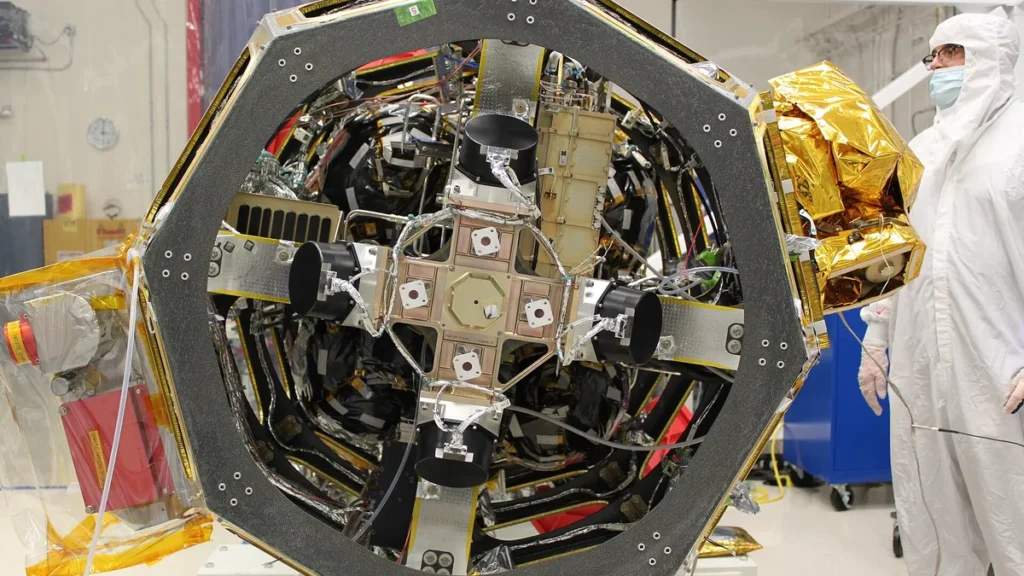
NTT and ispace signed a collaboration agreement on November 16, 2026, to research and develop communication and power infrastructure for lunar and cislunar operations using NTT’s Innovative Optical and Wireless Network.
The two companies will develop high-speed optical communication links between Earth and the Moon and test laser-based power transmission, which sends energy through laser beams instead of wires, for future missions and commercial infrastructure in space. Optical communications transmit data using light instead of electrical signals. NTT announced the ispace partnership ahead of its annual R&D Forum in Tokyo, framing it as support for expanding lunar exploration and development through advanced communications around the Moon.
Minako Tsumenaga holds the post of senior vice president at NTT and leads its Alliance Department. She said the agreement pairs ispace’s lunar transportation work with NTT’s optical communications expertise, calling it “the collaboration would combine ispace’s experience in lunar transportation, exploration and mission operations with NTT’s expertise in optical communications and laser power transmission.”
She also said the companies aim to develop Earth-Moon infrastructure through optical technologies and support sustainable lunar activities and cislunar economy growth. The tie-up merges ispace’s lunar operational experience with NTT’s optical and laser power capabilities.
NTT said the initiative supports Japan’s economic security interests in lunar and cislunar space. NTT framed the Moon infrastructure work as part of broader national and commercial interest in lunar exploration and development as countries increase their focus on the Moon.
The ispace agreement sits inside NTT’s Constellation 89 Project, which the company launched in 2024 to bring together and expand its space-related businesses and research initiatives. C89 serves as NTT’s umbrella initiative for expanding its space-related businesses and research, under which the ispace agreement falls.
NTT disclosed the partnership ahead of the NTT R&D Forum 2026, scheduled for November 18 to 20 and November 24 to 25 at the NTT Musashino R&D Centre in Tokyo. The company also used the forum to unveil its quantum machine learning SDK and AI cybersecurity tools.
The forum carries the theme “Mehr Licht!”, or “More Light!”, and focuses on photonics in communications, computing and other technologies. Photonics is the science and technology of generating and detecting light. The theme highlights photonics as demand for processing power rises with AI adoption.
On November 9, NTT, NTT DOCOMO, Mitsubishi Electric, MUFG Bank and the Development Bank of Japan signed a memorandum of understanding to develop and operate MegaConstellation infrastructure, a large network of satellites working together.

On November 4, NTT signed an agreement with Safran Data Systems to introduce IOWN, NTT’s optical-communications framework, into its optical ground stations, which communicate with satellites across different orbits. Optical ground stations are facilities that communicate with satellites using light-based signals.
Earlier in 2026, NTT signed a memorandum with Ireland-based MBRYONICS to research and develop optical communication technologies for space, one of the recent pacts alongside agreements with Safran Data Systems and Cailabs. NTT linked up with France-based Cailabs in September 2026 to tie its optical ground stations into NTT data centers using the All-Photonics Network, which is a core part of IOWN.
IOWN uses optical communications to sharply cut power consumption in data centers and permit faster, higher-volume data transmission. NTT describes IOWN as valuable for AI data centers because of their high electricity consumption and need for faster data transmission. AI data centers are facilities that house computing systems for artificial intelligence workloads.
NTT, SK Group and Chunghwa Telecom established the IOWN AI Fund on June 10, 2026. The fund is worth approximately $500 million, or 80 billion Japanese yen. The fund supports global adoption and commercialization of IOWN technology.
Catalight Capital, a new fund management firm with operations in Silicon Valley and Tokyo, will manage the fund. The firm will target startups working on photonics, AI semiconductors, optical communications and related fields across North America, Asia and Europe.
Young Sohn, founding managing partner of Walden Catalyst Ventures, joined NTT, SK Group, Chunghwa Telecom and the Development Bank of Japan as an operating partner of the fund. Sohn operates from Silicon Valley and brings venture investment experience in deep tech fields including optical communications and semiconductors. NTT President and CEO Akira Shimada said, “Through the IOWN AI Fund, we will promote business collaboration with promising startups.”




Join the discussion