Key facts
- IBUKI GW carries TANSO-3, which observes carbon dioxide and methane, and AMSR3, which monitors the water cycle.
- Collaborators on the JOGMEC verification project include Satellite Data Services, JGC Corporation, Mitsubishi Electric Software Corporation and GHGSat, with MUFG Bank contributing expertise.
- GHGSat was founded in 2011 and pioneered high-resolution greenhouse gas remote sensing from space.
- Climate Investment has backed GHGSat since 2018.
In October 2026, Mitsubishi Electric, MUFG Bank and Climate Investment purchased convertible notes from GHGSat Incorporated, and the Québec-based company announced the deal on Nov. 5, 2026 without revealing the amount or conversion terms.
Mitsubishi Electric’s stake went through the ME Innovation Fund, a corporate venture fund run jointly with Global Brain Corp. MUFG Bank joined in through Green Convertible Notes tied to GHGSat’s Green Finance Framework, which the bank helped develop. DNV Business Assurance Japan supplied a third-party opinion that the framework aligns with the pollution prevention and control category of the Green Loan Principles. Convertible notes are loans that become shares later, most often at the next round of fundraising.
Climate Investment also bought notes; the firm has backed GHGSat since 2018 and has been operational since 2017. Climate Initiative member companies founded it, and it manages $1.8 billion in committed capital for venture and growth strategies spanning energy, industry and transport plus the built environment. Its portfolio includes more than 45 climate tech companies that delivered 208 MT CO2e, or million metric tons of carbon dioxide equivalent, of cumulative greenhouse-gas reductions and over $600 million in operational worth to limited partners from 2019 to 2025.
GHGSat, founded in 2011 and based in Québec, pioneered the use of high-resolution sensors for greenhouse-gas monitoring from space. Its network identifies methane and carbon dioxide plumes at individual factories, revisits sites daily and issues alerts within hours. It offers emissions data to companies, governments, regulators and investors to improve operations and meet environmental rules. Methane, the main component of liquefied natural gas, traps more heat than carbon dioxide, so energy firms and other industries increasingly need to locate emission sources, find leaks fast and measure them precisely.
The October 2026 notes follow a November 2024 accord among Mitsubishi Electric, MUFG Bank, Satellite Data Services and GHGSat to build a tip-and-cue service that matches broad satellite views with GHGSat’s close-up monitoring of individual sites. President and CEO Kazutaka Kumeno leads Satellite Data Services, headquartered in Chiyoda-ku, Tokyo. Their collaboration on the service dates back to late 2024. The investors say the investment will deepen cooperation and accelerate work on the monitoring service.
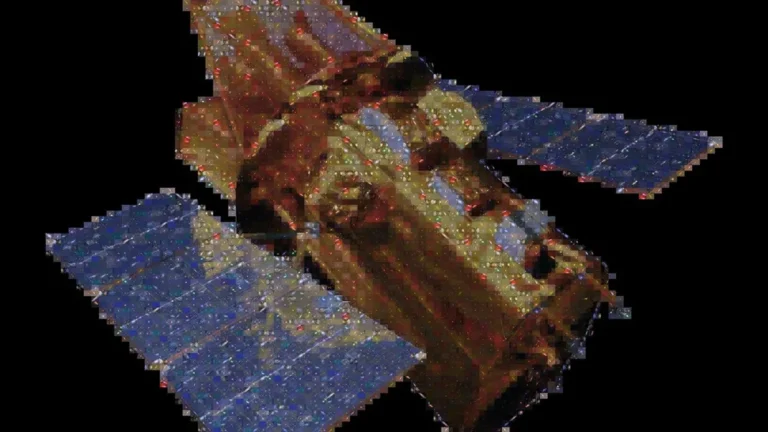
IBUKI GW, also called GOSAT-GW, launched on June 29, 2025, and surveys wide areas to point to suspected greenhouse-gas emissions. According to JAXA’s mission record, Mitsubishi Electric bore primary responsibility for developing IBUKI GW and the sensors it carries. TANSO-3 observes carbon dioxide and methane; AMSR3 monitors the water cycle. It suits wide-area observing.
If IBUKI GW spots a suspected source, GHGSat’s spacecraft then take a closer look and can pin the methane plume on a single plant. Beginning with the wide-area satellite narrows the search area ahead of detailed measurements. The partners describe the immediate goal as visualizing emissions and pinpointing their sources rather than launching a finished commercial service.
Mitsubishi Electric leads the contractor team for a JOGMEC technology-verification project chosen under the fiscal 2026 public solicitation to identify and measure greenhouse-gas emission sources using satellite data. JOGMEC brought Mitsubishi Electric on board in June to run real-site tests through March 2027, and Mitsubishi Electric announced the contract on June 25, 2026. The goal is to confirm accurate detection and measurement of methane under field conditions, and to set the technical requirements and operating procedures needed for real-world use. GHGSat supplies satellite data and analysis, working with Satellite Data Services, JGC Corporation and Mitsubishi Electric Software Corporation; MUFG Bank contributes expertise.
The parties plan to deepen their cooperation, speed up work on the tip-and-cue service, and support climate-change mitigation by visualizing real emissions and improving transparency, according to Mitsubishi Electric’s announcement of the financing. MUFG Bank takes the view that satellite data can make decarbonization initiatives more transparent and help create fair markets, and it pledges to keep backing the space industry and broader use of satellite data.
It will also check whether satellite-based methane measurement fits the Oil & Gas Methane Partnership 2.0, a United Nations Environment Programme framework using measurement-based reporting. Mitsubishi Electric plans to demonstrate the system at Japan’s pavilion during the COP31 climate talks in Antalya, Turkey, opening Nov. 9. It hopes to sell the service eventually to companies and local governments wanting visibility into where their emissions come from.
Its September 2025 round comprised $47 million of loans and convertible notes, and GHGSat has not disclosed how large the October 2026 investment was. Mitsubishi Electric and MUFG Bank bought more Satellite Data Services shares in a third-party allotment on Feb. 27, 2026, after which SDS became a fully operating company. Mitsubishi Electric links both moves to a business base that runs from satellite-data acquisition through analysis to service delivery.
Securities.io says the deal’s undisclosed size is less important than the alignment of money, satellites and verification around one service. GHGSat’s business model hinges on showing that broad-area tips plus detailed cues yield accurate methane measurements in actual operations, and on converting those into repeatable steps and reports for customers.



Join the discussion