
Key facts
- A study published on April 14, 2026 in The Astrophysical Journal Letters proposes neutrinos from the Blaze Star could reach Earth about 9 to 10 hours before light and gamma rays.
- A second model has magnetic field lines in superheated plasma near the white dwarf breaking and reconnecting, releasing energy that speeds up particles.
- The research team compared the Blaze Star to RS Ophiuchi, a recurring nova that erupted in 2021, to help predict the outburst.
- Neutrinos carry no electric charge, cannot be seen directly, and are detected only through charged particles or light flashes from rare collisions with atoms.
Astronomers remain confident that the recurrent nova T Coronae Borealis, also called the Blaze Star or T CrB, will erupt into a naked-eye outburst in the constellation Corona Borealis. Around Prague reported on Nov. 3, 2026, after scientists had expected the explosion as early as 2024, and it has not yet occurred.
In this system, a swollen red giant transfers material to a white dwarf, and the dwarf gathers it in a disk buried in a thick gas cloud the red giant expelled. Around Prague described this as the system setup. The outlet added that the arrangement differs from a supernova because the star system survives and can brighten again and again.
Around Prague said the star should soon brighten into an outburst visible to the naked eye. The report called it a rare opportunity to watch a stellar explosion with no optical aid. Experts cited in the report keep that confidence.
A study in The Astrophysical Journal Letters, published on April 14, 2026, says Blaze Star neutrinos could beat the light and gamma rays to Earth by about 9 to 10 hours. Around Prague said EarthSky described the paper as the first work to suggest neutrinos as an early warning for the star’s next explosion. The report also said neutrinos hardly ever interact with matter, so they can slip out of dense regions that stop other signals.
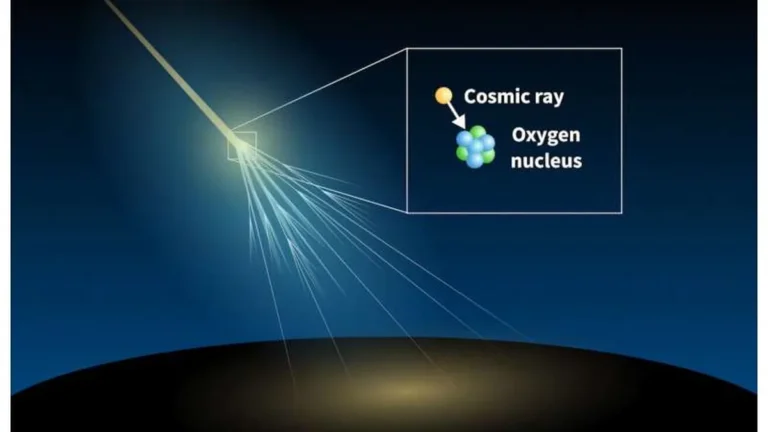
Around Prague said neutrinos carry no electric charge and cannot be seen directly. Researchers spot them only when the particles collide with atoms and produce charged particles or light flashes. Since the particles hardly interact with matter, researchers must look for the rare atomic collisions they cause.
Waiting continues for the Blaze Star, Around Prague emphasized. It said the paper describes models of what could happen rather than an observed warning or a detected precursor.
One model imagines white-dwarf debris slamming into surrounding gas, Around Prague said, and shock waves from that impact could produce high-energy gamma rays and neutrinos. The team treated this as one of two ways particles could gain energy in the period before or during the eruption.
A second model imagines magnetic field lines breaking and reconnecting in superheated plasma near the white dwarf, and that reconnection releases energy that speeds up particles. Dense gas around the system could block the gamma rays there, even as neutrinos head to Earth. Around Prague said the reconnection model carries the 9-to-10-hour early warning.
With a few hours of neutrino notice, astronomers could aim instruments at the system before the light arrives rather than scrambling afterward. That signal could reveal which process drives the eruption. Around Prague said such advance notice could matter for observers and could reveal the mechanism inside the eruption.
To help predict the outburst, the research team compared the Blaze Star with RS Ophiuchi, a recurring nova whose eruption came in 2021. Around Prague said the team drew on those RS Ophiuchi observations when forecasting what T CrB might do.
The constellation Corona Borealis forms a C shape. It hangs low in the northern sky during northern fall, and it lies between Arcturus and Vega near the Keystone pattern in Hercules. Around Prague said the constellation is simple to find and stays in view much of the year from mid-northern latitudes, though skywatchers there cannot see it all year long. EarthSky said binoculars are not needed, though they remain useful for finding it.
South of the equator, Corona Borealis hangs low in the northern sky, so viewers there need darkness and an unimpeded view toward the north. Around Prague noted this viewing condition.
EarthSky said the star could briefly rival Gemma, which is also known as Alphecca, if the eruption occurs. Gemma is the brightest star in Corona Borealis.


Join the discussion